
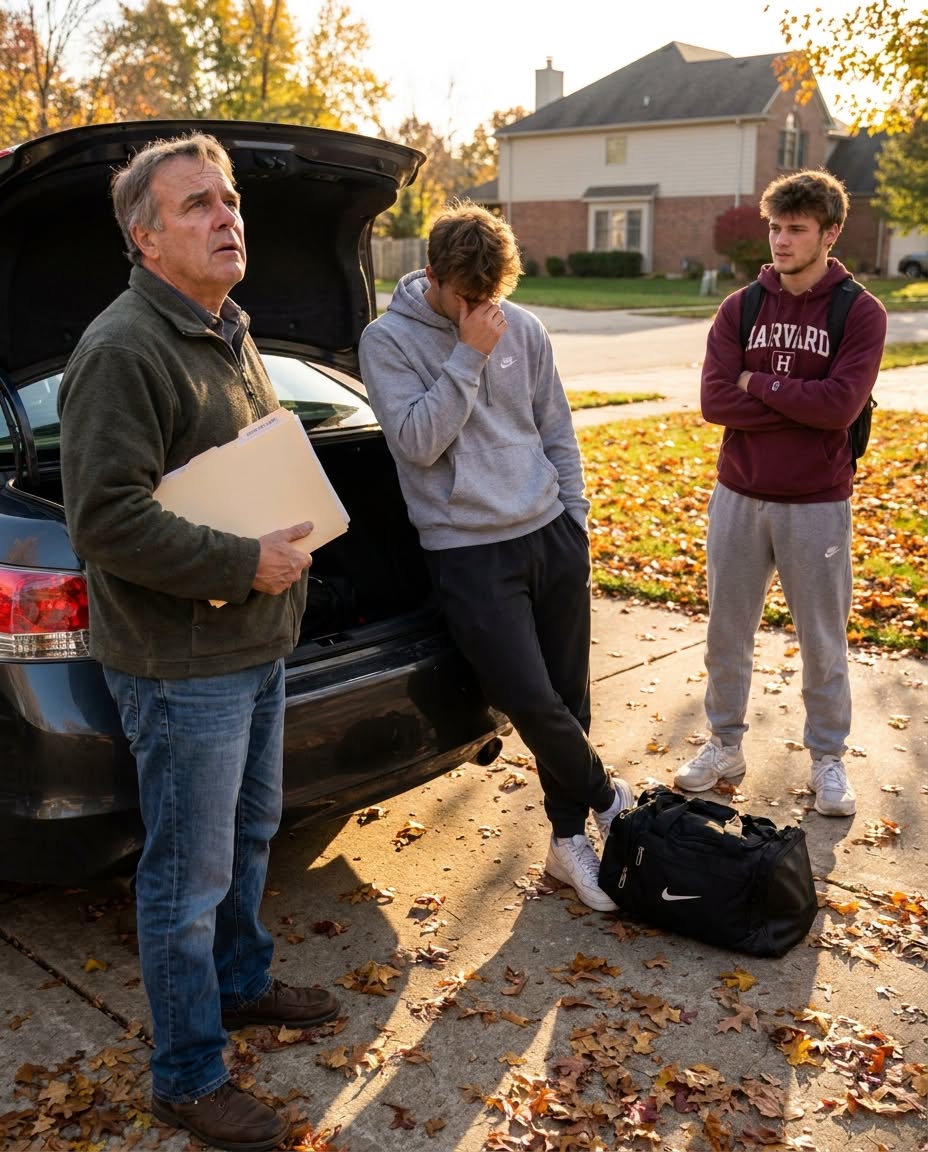
The lawyer found me behind a strip-mall restaurant with both hands inside a dumpster, searching for anything I could eat. I was eighteen years old, nine days homeless, and so hungry that the afternoon seemed to flicker at the edges. When the man in the pressed suit said, “Nathan Brooks?” I nearly ran. Instead, I stood there with garbage on my sleeves while he introduced himself as Richard Hartwell and told me he represented the estate of my grandfather, James Brooks. I told him that was impossible because my father had always said Grandpa James died before I was born. Richard looked at me with the careful expression adults use when they know the next sentence will rearrange your life. “Your father lied,” he said. James had died twenty-three days earlier after spending years trying to find me, and six months before his death he had finally succeeded. Then Richard told me my grandfather had left me an estate worth approximately $4.7 million—but not without conditions.
Nine days earlier, on my eighteenth birthday, my father had sat across from me at the kitchen table with my stepmother Patricia and my stepbrother Tyler and announced that his legal responsibility for me was over. I still had three months of high school left. It did not matter. My belongings had already been stuffed into garbage bags by the front door. Worse, the nearly $3,000 I had saved from grocery shifts, lawn work, and washing dishes was gone; Patricia said they had used it for Tyler’s college applications and called it “back rent.” My father defended her. I left with three bags, an old sedan, and nowhere to go. For the next week and a half, I slept in parking lots, showered before school in the gym, saved half my free lunch for dinner, and watched every ordinary routine become harder because I had no address, no reliable phone, and eventually no gasoline. By the ninth day, my car was stranded, shelters were full, and I had not eaten properly in forty-eight hours. That was where Richard found me—less than two weeks after the people who raised me had decided I was no longer their problem.
At his office, Richard fed me before explaining anything else. Then he showed me a photograph of James Brooks, a retired construction-company owner whose eyes looked disturbingly like mine. My father had cut James off decades earlier after James stopped paying gambling debts and insisted his son seek treatment. James tried repeatedly to reconnect, but my father refused every attempt and concealed my existence from him. When cancer made time short, James hired an investigator and discovered not only that I existed, but how I had been living. He wanted to intervene immediately, but I was still a minor and legally under my father’s roof. Instead, he revised his estate plan. The house, investment accounts, and proceeds from the company were placed into a trust for me with a one-year protective period. I would live in James’s home with Eleanor Vance, his seventy-three-year-old friend and a retired teacher, receive a controlled allowance, finish high school, enroll in college or vocational training, complete a financial-literacy course, and have no contact with my father’s household for one year. If I refused, the estate would pass to charity. At that moment, the conditions did not feel restrictive. They felt like the first boundaries anyone had ever created for my protection.
That year changed me more than the money ever did. Eleanor—Ellie—gave me a room, regular meals, expectations, and something I had no idea how to receive at first: ordinary kindness. I apologized for eating food, sitting on furniture, using hot water. She kept reminding me, “Nathan, you live here now.” I graduated with honors, enrolled in community college, completed the financial course my grandfather had required, and slowly learned James’s history from people who had known him. At the end of the year, the trust provisions were satisfied and the estate transferred under the terms James had written. I invested most of it conservatively and continued school. Later, I met my father at a coffee shop because I wanted closure more than revenge. He had already heard about the inheritance. When he suggested that James had only wanted to make him look bad, I told him quietly that the estate was not a contest. Then I told him I would not give him money. His reaction confirmed what I already suspected. I left without screaming, without trying to force an apology, and without offering another chance to use me.
Three years later, I had graduated, stepped into my grandfather’s construction business, and begun learning it from the foremen and crews who had worked beside him. Ellie still lived with me and had become more family than anyone who shared my childhood address. I also found my late mother’s sister, Catherine, who had spent years wondering what had happened to me after my mother died. She gave me photographs, stories, and the missing half of a history my father had kept sealed away. I still keep James’s photograph near my bed—the first one Richard ever showed me. Sometimes I look at it and think about how close our lives came to missing each other completely. I had been eighteen, starving, and searching through garbage when proof finally arrived that somebody had cared whether I survived. The inheritance gave me security, but that was not the part that saved me. What saved me was learning that I had not been invisible. Someone had looked for me. Someone had planned for me. Someone had believed I might become worth protecting before I had learned to believe it myself.

