
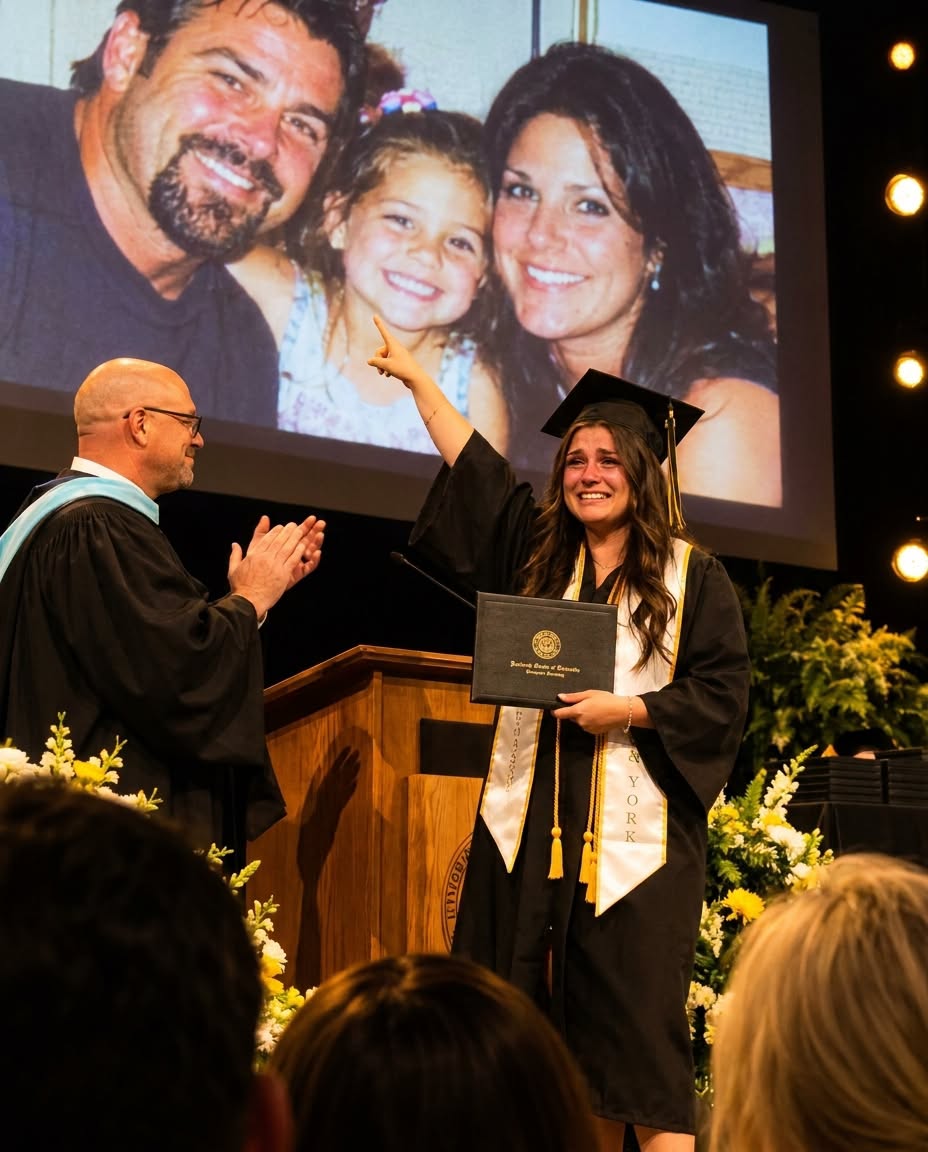
“Callie Brooks.” My name came over the gym speakers and disappeared into the same polite applause people give when they do not know who they are clapping for. Every graduate before me seemed to have a section of the bleachers erupting—parents shouting, grandparents waving signs, little brothers blowing air horns—but I had nobody in the crowd. My parents had been killed seven months earlier in a rain-slicked crash on Route 40, and my eighty-one-year-old grandmother Bea, who had taken me in, was too weak from heart trouble to sit through a two-hour ceremony in June heat. I crossed the stage wearing my father’s oversized watch and made myself smile for the photographer. Then two warm, rough hands covered my eyes from behind. A deep voice beside my ear said, “Guess who finally made it?” I knew the voice before I could breathe. My brother Danny—the brother I had refused to speak to for seven months—was standing behind me in his Army dress uniform, crying.
Danny had once been my whole world. He taught me to ride a bike, drove me to school in a broken-down Honda, and used to sneak up behind me with the same “Guess who?” game until I laughed myself breathless. But he enlisted at nineteen, spent years moving between bases and deployments, and came home from overseas the summer before my senior year changed—quiet, sleepless, jumping at sudden noises, unable to tolerate the normal family life I had been desperate to share with him. When he volunteered to return early, I accused him of always leaving and stopped answering his calls. Then our parents died. Danny was deployed somewhere without regular communications, and by the time the Army reached him and he crossed multiple airports to get home, the funeral had already ended. I watched him run across the church parking lot in uniform, too late by less than an hour, and turned away before he could explain. He spent four days sleeping on Grandma Bea’s couch, knocking on my door, apologizing, then had to return to his unit. Afterward he called every Sunday at four. Forty-one times by graduation. I never answered once.
Grandma Bea never ordered me to forgive him. She simply kept the kitchen door partly open when she spoke to him every Sunday and waited for me to decide something on my own. As graduation approached, though, her health deteriorated enough that even walking to the mailbox left her breathless. The morning of the ceremony I told her I was not going because there would be nobody there to watch. She sat beside me with shaking hands and asked for one thing: get the diploma for Mom, Dad, and her, and when my name was called, look up instead of at the floor. What I did not know was that three weeks earlier she had spent three days writing Danny a letter by hand. She told him I was not really angry at him; I was angry at death, at the accident, at everyone who had disappeared from my life, and he was simply the one person still alive whom I could punish. She told him she was too sick to sit in the bleachers. Then she wrote the sentence that brought him across an ocean: Don’t miss this. Just once, show her that somebody comes back. Danny took emergency family leave, crossed the Atlantic, arranged wheelchair seating for Bea with the school, picked her up after I left home—and then ignored her instruction to wait quietly in the audience by sneaking onto the stage behind me.
I dropped my diploma and threw my arms around him. For a few seconds, the entire gym went silent; then one person began clapping, followed by another, until nearly everyone in the bleachers was standing. When Danny finally set me down, he pointed toward the front row. Grandma Bea was sitting in a wheelchair wearing her best blue dress and a white-rose corsage, waving both hands above her head. Later, after photographs and dinner at my father’s favorite Chinese restaurant, Danny and I sat on Bea’s porch swing beneath the fireflies and finally said everything we had spent a year avoiding. He told me how hard he had tried to reach the funeral—six hours by military vehicle, fourteen hours stranded by weather in Germany, then a cab from Indianapolis that still got him there after the service ended. He admitted he had left early the summer before because coming home after deployment had been harder than he knew how to explain. I finally admitted the guilt I had been carrying too: I had been invited to the dinner my parents attended the night they died and stayed home instead. Danny squeezed my hand and told me the truth I had never been able to tell myself: had I gone with them, Bea might have buried three people instead of two.
Danny stayed ten days. He fixed Bea’s faucet, weeded her garden, took me to the lake and the drive-in we had missed the year before, and finally went with me to our parents’ grave, where he tucked an extra graduation program beneath a stone so, as he put it, “they’d know.” When his leave ended, we stood in the same driveway where I had once accused him of always leaving. He promised to call every Sunday at four, and I promised to answer. Then he told me his military contract would end in eighteen months and that he was not reenlisting; he wanted to come home, help with Bea, and build a life near us. The graduation photograph now sits on her mantel beside my parents’ wedding picture: me in my black gown, Danny in uniform, Bea holding my hand from her wheelchair. For months I had believed everybody leaves. What I eventually learned was more complicated. Some people are taken. Some people are delayed. Some people run because they are carrying things they do not yet know how to name. And sometimes an old woman with a failing heart writes one shaky letter that gives a family another chance to arrive.

