
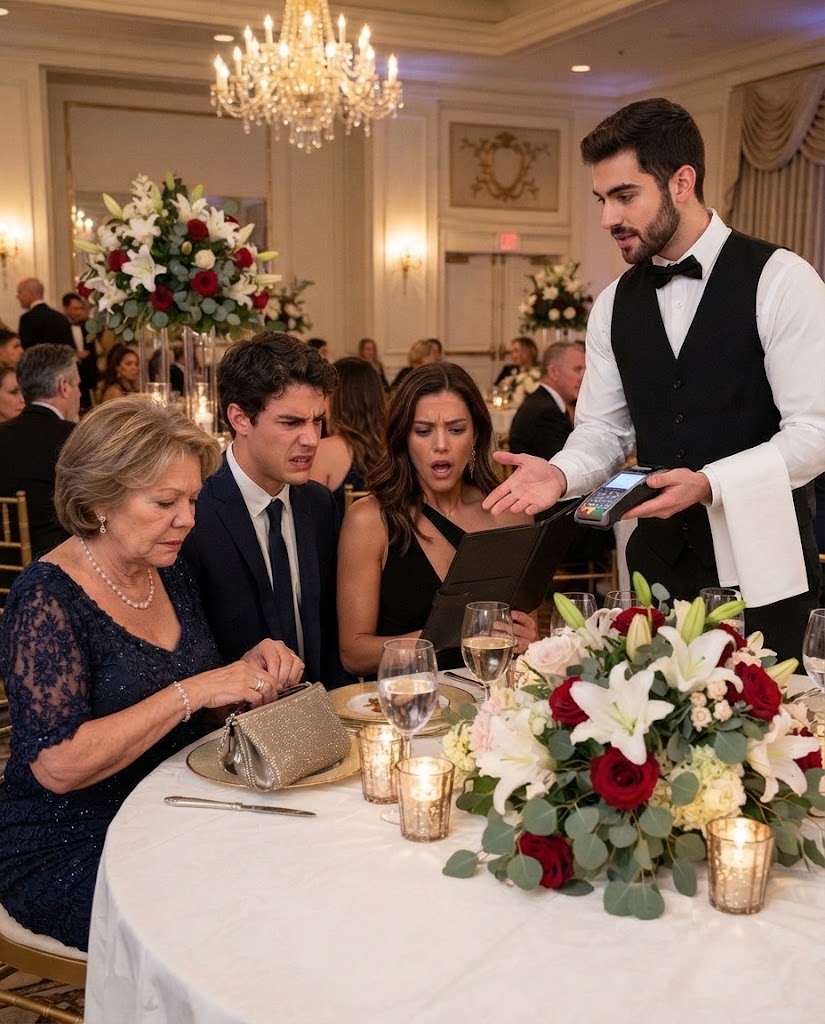
“Consider this the cost of being welcome at this table,” my daughter-in-law Sloane said as she pushed the leather bill folder toward me across the white silk tablecloth. Twenty-seven people had gone quiet enough for me to hear the tiny scrape of leather against fabric, the clink of crystal, and my own son’s breathing three seats away. “If you can’t cover this dinner,” she added, smiling, “then clearly you don’t belong here.” The total was nearly $3,000, and I could feel every eye at Vivian’s birthday dinner waiting to see whether the woman they believed was merely a cleaning lady could afford to stay in the room. I reached into my purse for the brown leather wallet Caleb had given me years earlier with his first real paycheck. Before I could open it, a young waiter named Julian leaned close enough that only I could hear him. “Ma’am, please don’t pay,” he whispered. “You need to see this first.” I opened the folder and found one word printed beneath the total in red: DECLINED.
Sloane and her mother Vivian had spent the entire evening treating money like a language they assumed I could not speak. Vivian asked whether I had ever managed to pay off my house and spoke vaguely about my “little cleaning service,” while Sloane reminded the table how “their family” helped children build a proper foundation. What neither woman knew was that I had spent thirty years building a commercial cleaning company from one battered van into a business large enough to service corporate offices, hotels, and restaurants across Charlotte. Laura, the restaurant where we were sitting, had just awarded my company a twelve-month contract covering five locations. I had never hidden my work from Caleb, but I had kept the scale of the business private because my late husband and I had agreed long ago that money should not become the reason people stayed close. What worried me that night was not their opinion of me. It was Caleb. His shoulders were hunched, his answers were careful, and every time Sloane spoke to him, I saw him become a little smaller. For two years he had been calling less, visiting less, and insisting he was fine. Sitting at that table, I finally understood that “fine” had become the word he used when telling the truth felt too expensive.
Once Sloane’s card was exposed, the evening collapsed quickly. Vivian’s cake deposit had also been declined, several guests stood up after realizing they had been invited to a supposedly hosted dinner that no one could pay for, and Sloane turned her humiliation on Caleb. She boasted that she had sacrificed to buy him an expensive watch; I recognized immediately that the second hand ticked like a cheap quartz movement rather than a mechanical luxury watch. Caleb admitted he had bought it himself for fifty dollars because Sloane kept asking where the real anniversary gift was. Then his own card declined. He opened his banking app and discovered that Sloane had emptied his last $5,000 paycheck the day before. Seconds later, a notification appeared on her phone saying their apartment was three months behind and legal proceedings had begun. Caleb stared at her and asked the question he had apparently been avoiding for months: “We don’t have a home to go back to, do we?” That was when I understood the dinner had never really been about Vivian’s birthday. It was a pressure campaign. They expected Caleb, cornered in public and financially desperate, to turn to me and ask me to rescue them.
When Sloane realized I still would not reach for the bill, she finally said what she thought of me. She called me “nothing but a cleaning woman,” said I smelled like bleach, and told me I had always been beneath her family. I felt no shame at all. I remembered the first dental office I cleaned alone for $280, my cracked windshield, my chapped hands, and the thirty years of payrolls, contracts, tax filings, equipment purchases, and twelve-hour nights that followed. Then Richard, Laura’s general manager, walked over and thanked me publicly for my company’s work and said he was looking forward to our expanded partnership. Sloane went silent. A moment later, she grabbed Caleb’s arm and hissed, “Get on your knees and beg her. Make her sign over the house.” Instead, my son stood. He took off his wedding ring and placed it on his dessert plate. He told Sloane he had spent two years calling fear “compromise” and cowardice “love,” and he was finished. I paid only for my meal and Caleb’s, tipped Julian generously for intervening, and left the remaining $2,840 balance to the restaurant to collect from the people who had actually incurred it. Richard informed Vivian and Sloane that management would handle the unpaid check according to policy and had contacted local authorities to assist if necessary.
Outside, Caleb asked me something I did not expect: why I had never told him how successful the company had become. I told him I never wanted money to be the reason anyone loved me, and that his father had believed the same. Caleb admitted shame—not Sloane alone—had kept him away. He had known his marriage was failing and could not bear hearing me ask how he was while he lied that everything was fine. Then he asked for a place to stay, not money, not a bailout, just somewhere to begin again. His old room was still there. Over the next months he found a simpler logistics job, cooked dinner on Tuesdays, repaired his father’s broken garden gate, and slowly stopped performing the version of himself he thought other people expected. One evening he sat at my kitchen table asking how commercial contracts, staffing models, and client acquisition actually worked. After two hours, he looked at the papers between us and said, almost shyly, “You built something real.” I told him his father and I had started it together, and I had kept going. That night, after he went to bed, I stood in the backyard looking at the repaired gate and thought about the dinner that had been designed to prove I did not belong. What survived it was not status, money, or anyone’s place at an expensive table. It was my son sleeping safely down the hall, two coffee cups drying by the sink, and the first honest conversation we had shared in years.

