
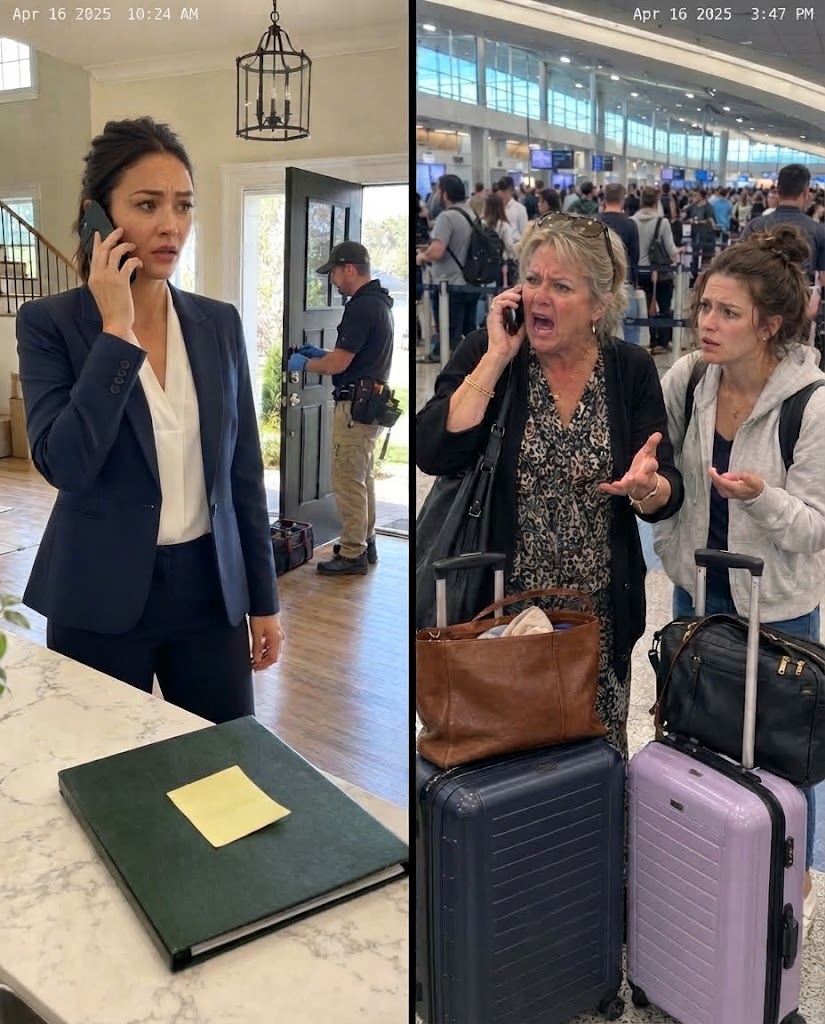
“Avery! What did you do to our accounts?” my mother shouted through the speaker while airport announcements crackled behind her. I was standing in a nearly empty kitchen, staring at the pale rectangles where my paintings had hung and the yellow note she had left on the counter: Don’t bother calling. We are finally choosing happiness. A police officer was photographing the damaged lock while, on a second phone, bank fraud investigator Naomi Ward listened with my consent. My mother demanded that I release the frozen money, insisting that the $500,000 she had transferred was “family money” and that my sister Brittany deserved a better life. When I asked how she had moved it, she said she had used the power of attorney I had supposedly signed in front of her best friend Elaine. Then she confidently described the signing in detail. The only problem was that on the date printed on the document, I had been nine hundred miles away in Denver, standing in front of forty-seven colleagues giving a recorded business presentation.
The truth had been waiting for me before I ever boarded that flight. Years earlier, during a medical procedure, I had temporarily authorized my mother to handle two bills if I became incapacitated; that limited authority had expired long ago. Three months before my Denver trip, after Brittany casually mentioned the exact balance of my savings at dinner, I had met with my banker, formally revoked any prior authority, added a verbal security password, and required direct confirmation for large transfers. While I was away, my mother and Brittany assembled a new “durable” power of attorney from pieces of the old document, obtained a false notarization from Elaine, and submitted it to the bank. Then they attacked the house itself. Security footage from a camera they overlooked showed a rented moving truck arriving two days after I left, a locksmith changing the side-door cylinder after my mother displayed paperwork, and movers carrying out furniture, electronics, artwork, rugs, jewelry, and family possessions for five hours. Brittany even noticed the hidden camera and waved at it. Most of my belongings went to a storage unit; some had already reached a consignment shop. My photographs, receipts, serial numbers, insurance inventory, and the moving-company invoice bearing Brittany’s signature gave detectives the paper trail they needed.
What my mother did not understand was that the $500,000 visible in the new account was only a provisional credit. Because the transfer was unusually large, the receiving account was new, and my fraud alerts were already on file, the transaction entered secondary review before final settlement. Naomi’s team found the altered document number, the inconsistent notary date, and my recorded revocation, then froze the receiving account and related accounts before the principal cleared. My mother and Brittany had already begun celebrating in Hawaii. When they tried to leave, investigators acting on the property-theft case recovered my jewelry box, my father’s watch, insured bracelets, and cash from items they had already sold. Elaine initially repeated my mother’s story until confronted with airline records, hotel logs, building security footage, and the recording of my Denver presentation; she then admitted she had notarized a signature she never witnessed. Brittany eventually cooperated too, providing messages showing months of planning and one sentence from my mother that explained more than she probably intended: She’ll complain for a month and then forgive us the way she always does. They had treated my forgiveness as a predictable asset.
The evidence left little room for interpretation. At a preliminary hearing, the bank presented my written revocation, the forged authorization, document metadata linking its creation to my mother’s home, the recorded airport call, and my travel records proving the alleged signing could not have happened. The court preserved the funds for restoration to me and barred further transfer or disposal of disputed property. Elaine surrendered her notary commission, accepted penalties, and cooperated with prosecutors. Brittany returned what she still possessed and, after entering a cooperation agreement, received a felony conviction, confinement followed by supervised probation, restitution obligations, and a no-contact order. My mother rejected early resolutions because each required her to admit the money and property had belonged to me. Eventually, confronted with the bank records, altered documents, moving-truck evidence, storage inventory, recorded statements, and Brittany’s testimony, she pleaded guilty to charges involving fraud, identity theft, and felony theft. The judge rejected her claim that she had only been trying to create “fairness” between her daughters, pointing out that fairness does not require forged signatures, locksmiths, secret transfers, or moving trucks. She received a custodial sentence followed by supervision and restitution, while the bank restored the full $500,000 because the transfer had never completed final settlement.
My father’s watch was the last thing returned to me. Its leather strap had been bent in the luggage and the hands had stopped at 3:17, but I asked the repairman to clean the mechanism without replacing the scratched case or worn band. “The scratches are the story,” he told me. “You don’t erase the story; you just make sure it keeps good time.” I rebuilt the house the same way. I replaced the damaged doors, changed the locks, chose different furniture, painted the rooms, and stopped trying to recreate what had been there before. The note my mother left behind went through the shredder. The watch went into a small glass case by the entryway where I see it whenever I come home. For years, I had mistaken peacekeeping for love and forgiveness for an obligation other people could budget around. The first night after the final court hearing, I ate pasta alone at my rebuilt kitchen table, with no demands coming through my phone and nobody explaining what I owed them. The silence did not feel like abandonment anymore. It felt like ownership.