
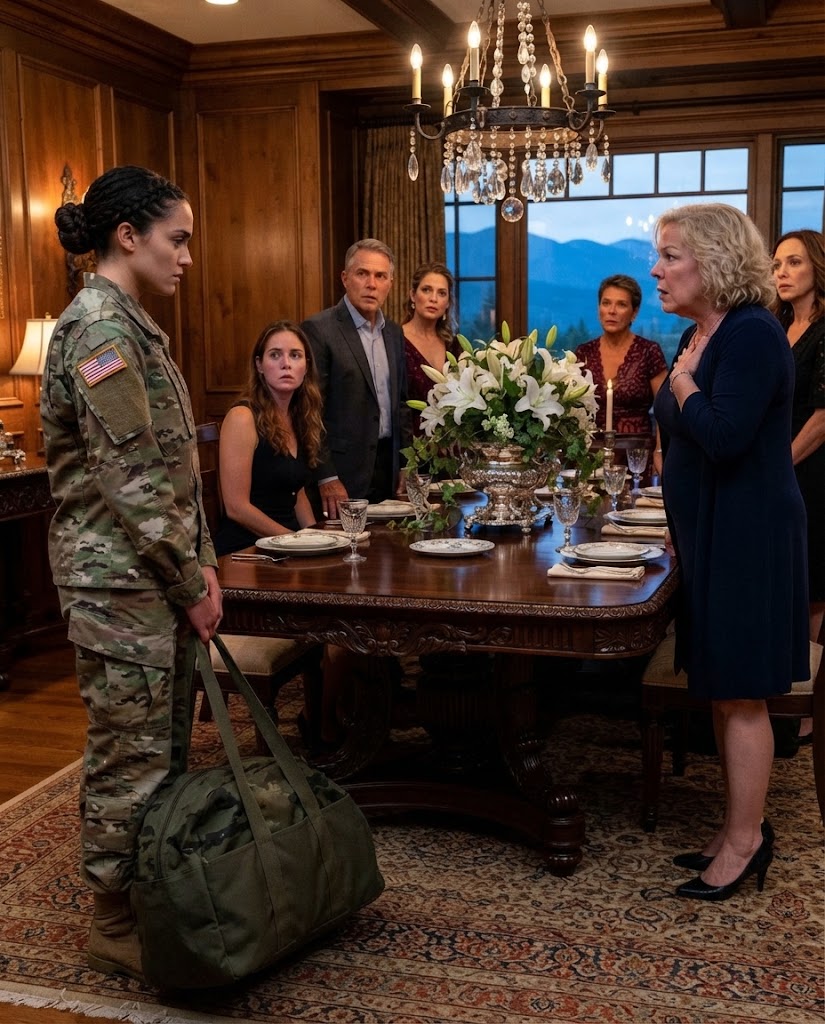
“She’s just my husband’s charity project.” I heard Diane say it from the hallway of the lake house while rain hammered the windows and my Army duffel bag was still wet from the drive. I had landed from Kuwait that afternoon after fourteen months overseas with the Army Corps of Engineers, rented a truck at Dulles, and driven four hours south because I thought surprising my family might feel like coming home. Instead, I stood unseen outside the dining room while Diane told a table full of guests that I was “not really family” and therefore had no place in estate decisions. My stepsister Chloe’s husband, Marcus, joked that I was better at “blowing things up” than managing assets, and people laughed politely over their wine. I had spent the previous year overseeing a $12.8 million infrastructure project, three hundred workers, a water-treatment plant, and miles of road in Iraq without losing a single worker to injury. But none of that mattered in that hallway. What mattered was that the man who had adopted me at four years old had been dead fifteen months, and the people sitting in his house believed his absence had finally made me removable.
Arthur Langford had never treated me as anything except his daughter. He had known my birth father, Daniel Reyes, from the Army, though the full story was something he kept from me until after his death. Arthur taught me to fish from the dock, read blueprints at the kitchen table, and believe I could go anywhere despite Diane’s quiet reminders that I was somehow lesser than Chloe. Before I deployed, while dying of pancreatic cancer, he pressed a sealed envelope into my hand and told me to open it only if Diane ever asked me for money. I understood why the next morning. Diane, Chloe, and Marcus presented me with a $4 million commercial loan guarantee for Marcus’s supposedly expanding development company. Because Arthur had given me a ten-percent interest in Langford Lake Holdings when I turned eighteen, they said the bank merely needed the “whole family” behind the deal. I read the documents instead of signing the tabs they marked. Marcus already had multiple loans in distress, and buried in the guarantee was language exposing my personal assets—including my ownership interest in the lake house—to collection ahead of his company. When I refused, Diane told me I owed the family for “taking a stray in” and threatened to remove me from the family trust and force a buyout of my share. I walked outside, opened Arthur’s envelope in the rain, and found three instructions: Go see Victor. Don’t tell Diane first. And don’t sign anything.
Victor Vance, Arthur’s old Army friend and attorney, had been waiting fifteen months for me to appear. In his office he showed me what Arthur had quietly uncovered during the last years of his life: Diane had rented the lake house for roughly $40,000 a week during summers Arthur believed she was visiting relatives, diverting nearly $900,000 into accounts she controlled and then wiring much of it to Marcus’s failing company. There was also a $600,000 home-equity line bearing Arthur’s forged signature, executed on a day hospital records showed he was receiving chemotherapy. Then Victor produced the document that changed everything. Eleven days before his death, Arthur amended the ownership structure of Langford Lake Holdings. Diane retained ten percent. I already owned ten. Arthur’s remaining eighty percent passed directly to me—not to the family trust Diane controlled—making me the ninety-percent owner and managing member of the company that owned the approximately $17 million lake property. In a cedar box, Arthur had also left my birth father’s dog tags and a letter explaining why he had adopted me: Daniel Reyes had once dragged Arthur from a burning military vehicle and later asked him to look after his daughter if anything happened. “That wasn’t charity,” Arthur wrote. “That was a promise. And after about three days, it wasn’t even a promise anymore. It was just love.”
Four days later, I returned to the lake house with Victor for the meeting Diane believed would formally push me out. Her lawyer, Gerald Whitcombe, slid across documents removing me from the family trust, buying out what everyone still thought was my ten-percent stake for $400,000, and requiring my signature on Marcus’s loan guarantee. I signed the trust removal because by then it meant almost nothing. Then Victor handed Gerald the recorded ownership amendment. I watched him read it twice before he looked up and whispered, “She’s the owner?” The Ridgemont loan officer immediately withdrew the proposed financing because the majority owner would not pledge the collateral. Victor then laid out the rental agreements, the $892,000 diverted to Marcus, the forged home-equity instrument, Arthur’s hospital records, and the handwriting analysis. Marcus’s loans were referred to recovery, his company later entered bankruptcy, and Chloe hired separate counsel before eventually filing for divorce. I chose not to send Diane straight into a criminal case. Instead, through counsel, she agreed to vacate the property within ninety days, repay the diverted rental proceeds under a documented repayment schedule, and sign an acknowledgment concerning the forged loan instrument that Victor would retain if she defaulted. It was not absolution. It was accountability structured in a way that preserved Arthur’s preference for peace while making further abuse impossible.
I kept the lake house, but not as a monument to wealth. With Victor and a veterans’ organization in Roanoke, I turned its seven bedrooms into a seasonal retreat for military families—children with deployed parents, spouses carrying the absence of someone overseas, and veterans who need a quiet week beside the water. We named it The Reyes-Langford House. A brass plaque on the dock carries both men’s names and two words beneath them: A promise kept. Chloe visits now, works for her own paycheck, and is slowly rebuilding a life that belongs to her instead of one financed by Marcus or managed by Diane. Diane makes her repayment every month and once sent me a Christmas card saying Arthur would have been proud of the retreat. I kept it. Most evenings in summer, I sit at the end of the dock where Arthur used to fish and watch other families use the house for exactly what he loved about it: safety, water, laughter, and time together. For most of my life, I thought I had to earn my place in that family because I had been taken in. Arthur understood something I did not. Love is not a loan, adoption is not a debt, and belonging is not something another person gets to repossess. He kept a promise to my father. Eventually, he taught me how to keep it for someone else.

