
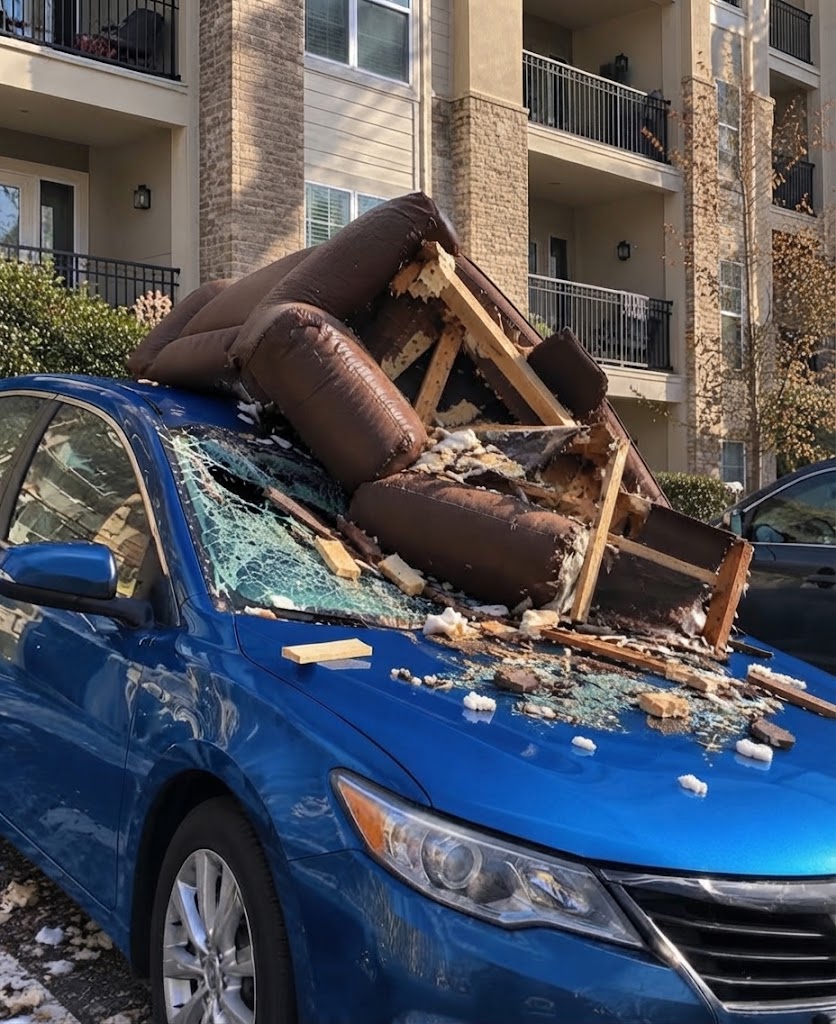
The sharp crash outside my apartment window made me freeze before I even reached the glass. It was around 9 p.m. on a Friday, and I had parked in my usual spot, the same place I had used for three years without a problem. When I looked outside, a wooden dining chair was shattered across my hood, while cracks spread across my windshield. Four floors above me, my neighbor Trevor leaned over his balcony and casually claimed the chair had “slipped.” I asked whether he would cover the damage, but he only said he would “think about it,” which told me almost everything I needed to know. I contacted my insurance company, filed a claim, and decided to leave the matter alone until morning. About an hour later, however, another crash echoed through the parking lot, and this time the damage was waiting for Trevor himself.
When I looked outside again, Trevor was standing in his pajamas beside his brand-new SUV, staring at a crushed roof and cracked windshield. Another wooden chair had landed on his vehicle, apparently from the same fourth-floor balcony, and his expression had completely changed. He immediately insisted someone had thrown it, but when I suggested calling the police, he suddenly wanted to “handle it” himself. The next morning, the apartment manager contacted me after Trevor had somehow complained that I had damaged his SUV. During our conversation, I learned the building had already warned him twice about using his balcony as storage for furniture, boxes, appliances, and heavy materials. Maintenance records showed concerns about the overloaded balcony, while another tenant said she had heard furniture being dragged shortly before the first crash. Then the manager revealed that an inspection had uncovered damage to Trevor’s balcony railing—and suddenly his refusal to take responsibility looked like it could become much more expensive.
My insurance adjuster later inspected my car and documented the damage, and I provided photographs showing pieces of the broken chair beneath Trevor’s SUV. Meanwhile, Trevor’s problems multiplied. His SUV was towed because he had failed to pay six months of parking fees, and when workers opened the vehicle, they found even more furniture and boxes inside. The building manager also informed him that the balcony had to be closed until repairs were completed because of the damage caused by months of improper storage. Trevor eventually faced repair bills, a tow bill, and the cost of repairing his own SUV, while my insurance claim moved forward. He could have hired an attorney or simply accepted responsibility from the beginning, but instead he created a trail of evidence that left little room for argument. There was no mortgage, investment, or estate issue involved, but the financial lesson was still painfully clear: avoiding one bill can sometimes create several larger ones.
A week later, Trevor came to my door looking exhausted and finally offered to pay for my car. He admitted he had been angry that night and had handled the situation badly, and this time his apology sounded sincere. Eventually, my windshield was replaced, the hood was repaired, the balcony was fixed, his SUV was dealt with, and his outstanding parking fees were paid. Our relationship never became particularly warm, but we became civil neighbors, which was enough for me. I never damaged his SUV, reported his balcony, or tried to make his situation worse; I simply documented what happened and let the insurance company, building management, and other responsible parties handle it. The next time I parked beneath his apartment, I looked up and noticed the balcony was completely empty—no chairs, boxes, or clutter. Trevor had learned a costly lesson without me having to teach it.

