
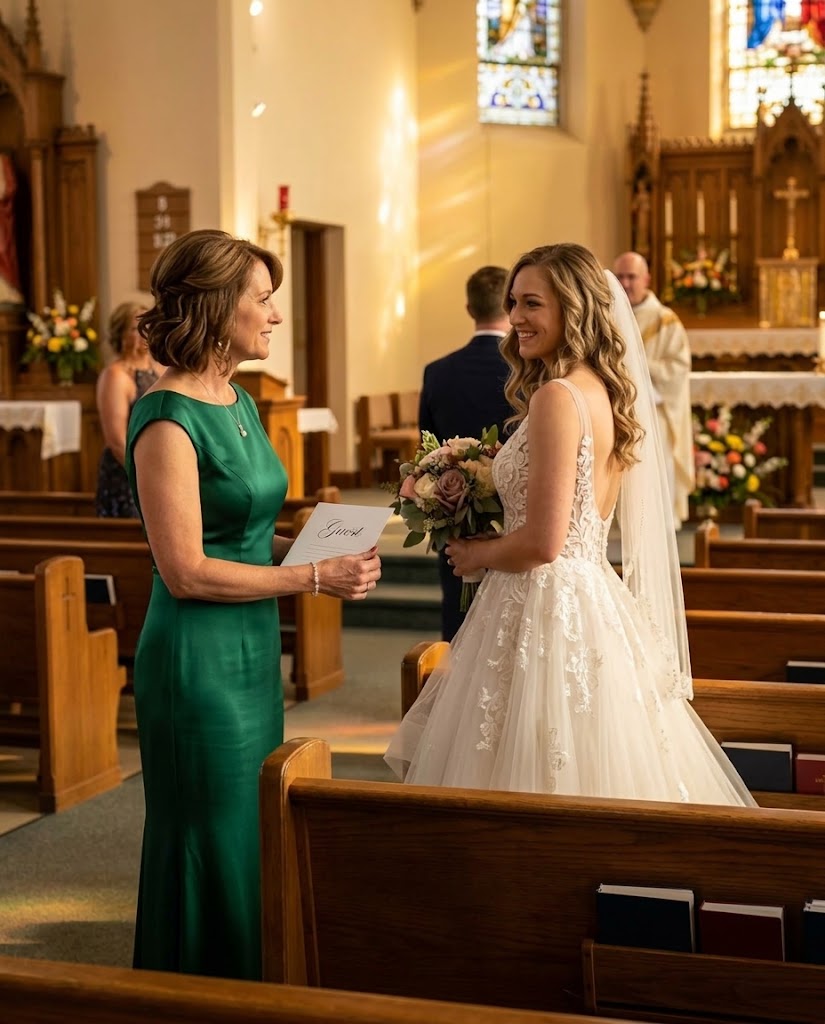
The gold-lettered card on the front pew read “MOTHER OF THE BRIDE,” but the name beneath it wasn’t mine. It belonged to Crystal Dunn, the woman who had given birth to Hannah and then disappeared from her life when she was four years old. I stood in the church clutching my dusty-rose beaded purse, searching the reserved seats for my own name until I discovered a plain white card in the very last row, beside the entrance. It said only “Guest.” Behind me, the heavy scent of gardenia perfume announced Crystal’s arrival before I heard her voice. Dressed in an expensive champagne-colored gown, she leaned toward my ear and whispered, “Real mothers sit up front. I’m sure you understand.” My hands trembled, but I quietly took my seat rather than create a confrontation on the wedding day of the girl I had raised for twenty-one years. I had no idea that within an hour, Hannah would stop halfway down the aisle in front of two hundred guests, turn around, and reveal a secret I had carried since she was seven years old.
My name is Laura, and I met Hannah’s father, Mark, at a church potluck in 2006, when his shy six-year-old daughter was hiding beneath a table with a one-eared stuffed rabbit named Mr. Hops. Her biological mother, Crystal, had abandoned the family two years earlier, leaving Mark to raise a frightened little girl who worried that anyone she loved might disappear. The first time I visited their home, Hannah asked whether I would leave too, and instead of offering promises I couldn’t guarantee, I told her I would return that Saturday. I did, carrying a second stuffed rabbit to keep Mr. Hops company, and I returned the following Saturday and countless Saturdays afterward. Mark and I married nine months later, and I became the person who packed Hannah’s lunches, attended her school events, comforted her through illnesses, taught her to drive, and sat beside her during the disappointments that come with growing up. Although I never had biological children, I loved Hannah as my own. She called me “Mama Laura” when she was little and eventually simply “Laura,” a change I accepted even though part of me missed those earlier words. What hurt most was watching her wait beside the mailbox every birthday, hoping Crystal would remember her. On her seventh birthday, after a wonderful backyard party, Hannah stood outside until dark, convinced her mother would send a card. None arrived. Unable to bear her disappointment, I made a decision that would shape our family for years: I secretly wrote a birthday card in disguised handwriting, signed it “Love always, Mom,” and asked my sister Denise in Tucson, Arizona, to mail it so Hannah would believe it came from Crystal. In one corner, I drew a tiny violet, the flower my own mother had taught me to sketch and embroider. The card arrived five days later, and Hannah was so happy she slept with it beneath her pillow. For eleven years, I repeated the gesture every birthday and Christmas, filling the cards with encouragement and details about her accomplishments, always signing them as her absent mother and always drawing that same violet. I stopped when Hannah turned eighteen, but she treasured the letters in a shoebox. Years later, after graduating from college and becoming a physical therapist at a children’s hospital, Hannah became engaged to Owen, a kind elementary school teacher. That was when Crystal suddenly reappeared, claiming she had never stopped thinking about her daughter. Hannah believed her, partly because of the cards, and welcomed her into the wedding preparations. Soon Crystal was attending dress fittings, choosing flowers, and organizing celebrations while I was quietly excluded, even from the bridal shower. Worse, she began telling Hannah that I had deliberately prevented her from visiting during childhood, accusations that were completely untrue. When Hannah confronted me, I denied the allegations but refused to expose the letters, fearing that revealing the deception would shatter the comfort they had given her. Mark wanted to confront Crystal, but I insisted that our daughter’s wedding should not become a battle over who deserved her love.
Three weeks before the ceremony, Hannah unexpectedly visited and asked whether I had something blue she could borrow for her wedding. I went upstairs and retrieved a pale-blue linen handkerchief that had belonged to my mother, who carried it at her own wedding in 1962. After her death, I had embroidered delicate violets around its edges, using the familiar pattern of three petals above, two below, and a small curl at the bottom of each stem. I had carried that handkerchief when I married Mark, with six-year-old Hannah standing beside us holding her two stuffed rabbits. When Hannah unfolded it, she stared at the flowers for an unusually long time, tracing one violet with her thumb before quietly thanking me and leaving. I assumed she was overwhelmed by wedding preparations, especially when she barely contacted me afterward. Now, sitting in the last pew of the church, I wondered whether she would even remember to carry it. As the organ began playing, guests stood and watched Mark escort Hannah through the doors, her white lace gown sweeping across the wooden floor and her bouquet filled with roses and lavender. She passed my seat without looking toward me, her eyes fixed on Owen at the altar. Then, halfway down the aisle, she stopped. The music faltered, and the church fell silent as Hannah looked toward the front row, searching for someone who wasn’t there. She turned slowly, scanning the pews until her eyes found me beside the entrance. Only then did I notice the pale-blue handkerchief tied around her bouquet, with my embroidered violets facing outward. Hannah held out her hand and called, “Mom.” For twenty-one years, she had never called me that without adding my name. When I finally reached her, she took both my hands, apologized for the seating arrangement, and asked Mark and me to walk her the rest of the way together. At the altar, she explained that she had requested two front-row seats, one for Crystal and one for me, and that someone had changed the arrangement without her knowledge. She calmly reclaimed the chair intended for me, while Crystal reluctantly moved to the neighboring seat. I believed that extraordinary moment was the end of the day’s surprises, until the reception began and Hannah stood before the guests holding a familiar old shoebox.
The reception took place in a countryside barn decorated with white lights and wildflowers, and after the customary speeches, Hannah unexpectedly asked for the microphone. She opened the shoebox containing every birthday and Christmas card she had received as a child and told the room how much those letters had meant to a little girl who believed her mother had abandoned her. Then she held up the first pink card, with its white rabbit illustration, and pointed to the tiny violet drawn inside. Next, she untied my mother’s blue handkerchief from her bouquet and displayed its embroidered flowers beside the card. The designs matched exactly. Three weeks earlier, she explained, she had recognized the flowers, gone home to compare the handkerchief with the old cards, and contacted my sister Denise, who tearfully confirmed that she had mailed every letter for me. At the rehearsal dinner, Hannah had tested Crystal by casually asking which flower she used to draw on the cards. Crystal answered roses, exposing the falsehood she had allowed Hannah to believe. Mark subsequently explained the entire history, including how I had refused to reveal the truth even after Crystal accused me of keeping them apart. Standing before everyone, Hannah thanked me for spending eleven years making sure she never felt forgotten, then knelt beside my chair and embraced me. She told the guests that she had always believed those letters were the greatest gift her mother had given her, only to discover that she had been thanking the wrong woman. Crystal quietly left the reception, while Hannah asked me to dance to “You Are My Sunshine,” the song I had sung beside her bed when she was sick as a child. Later, in the bridal room, Hannah admitted how deeply she regretted allowing Crystal’s false accusations to damage our relationship. I explained that I had stayed silent because I couldn’t bear the thought of her losing her biological mother a second time, especially just before her wedding. That evening, I found Crystal sitting alone outside the venue, her makeup streaked with tears, and she admitted that shame and selfishness had kept her away from Hannah for years. She had accepted credit for the cards because she wanted her daughter to believe she had been a loving mother, and she had invented stories about me because she couldn’t face the truth about her absence. When she asked whether she could still repair their relationship, I told her that forgiveness belonged to Hannah alone and that any reconciliation would require honesty, consistency, and a willingness to be present during ordinary days, not just celebrations. The following morning, Crystal called Hannah and apologized. Their relationship did not transform overnight, but they gradually began rebuilding it through weekly conversations and occasional visits. For the first time, Hannah had the freedom to know both women without being asked to choose between them.
The following May, on Mother’s Day, I walked down our driveway and discovered a pink envelope addressed to me in Hannah’s unmistakable handwriting. Its front displayed a little white rabbit, and inside was a message thanking the woman who had stood at the mailbox for her all those years. Hannah wrote that I had spent eleven years sending cards without signing my name, and now she wanted to sign hers: “Love always, your daughter, Hannah.” Beneath the message, she had drawn a violet, with slightly uneven petals and a curling stem just like the flowers my mother used to teach me. I stood there tracing the drawing with my fingertips, remembering every birthday, every lunchbox note, and every night I had spent comforting a child who feared she wasn’t worth remembering. Then I noticed something else tucked inside the envelope: a small black-and-white ultrasound photograph. On the back, Hannah had written that she and Owen were expecting a daughter in November, and they had already chosen her name. Violet. She added that I should begin practicing the silly song I once made up about a rabbit who wanted to fly, because the baby would need to hear it. My legs gave way, and I sat on the curb with the card and photograph in my lap, crying so hard that Mark came running out of the house in his socks, terrified that something terrible had happened. When I showed him the picture, he sat beside me and cried too. In the months since the wedding, I had come to understand that loving Hannah had never required erasing Crystal or competing for a title, just as welcoming Crystal back into her life did not diminish the years we had shared. Our family remained complicated, with old hurts that could not be repaired by a single apology or celebration, but there was room for honesty now, and perhaps for a gentler future. I thought of the little girl who once stood at the mailbox waiting for someone to remember her, and of the grown woman who had sent that love back to me in her own handwriting. Soon there would be another little girl in our family, carrying a name connected to three generations of women and a flower that had quietly traveled through our lives. I folded Hannah’s card carefully, held the photograph against my heart, and realized that I no longer needed a place card, a particular seat, or anyone else’s permission to know where I belonged.

