
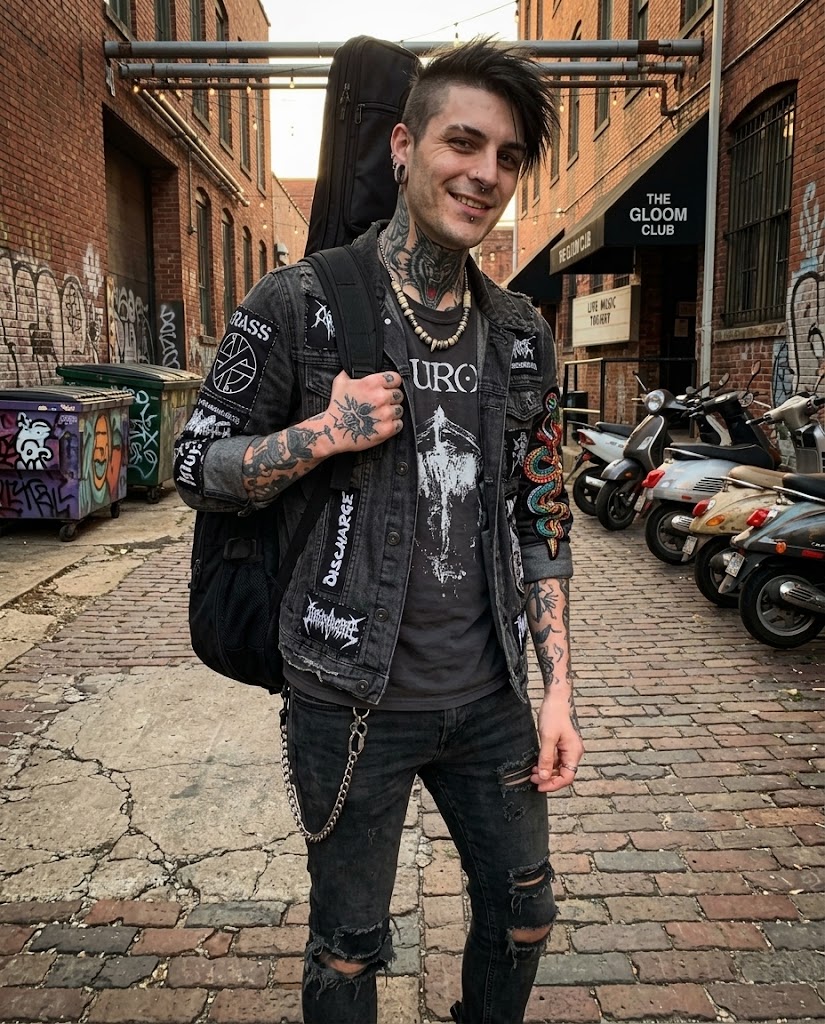
Harry stood outside my apartment door on a Saturday afternoon, his tattooed fingers gripping a phone and an expression on his face that made my stomach tighten. His leather jacket was covered in patches, a silver ring glinted beneath his lip, and for a moment I wondered whether the noisy neighbor I had spent weeks avoiding had come to complain about my daughter’s guitar playing. Instead, he asked whether Rory was home, then hesitated when I told him she was visiting a friend. “Your daughter asked me not to tell you,” he said quietly, “but I think you need to see this.” On his phone, my fifteen-year-old daughter stood beneath the bright lights of a crowded music venue on Fourth Street, clutching her battered secondhand guitar and singing with a determination I had never witnessed outside our living room. The audience was barely listening, yet she recovered from a missed chord and continued performing as though the song mattered more than the room’s indifference. Then the video showed an unfamiliar middle-aged man approaching Rory after she left the stage, speaking closely to her before handing her something. Harry identified him as Adrian, a local musician who presented himself as a mentor to young performers, and warned me that his reputation among other musicians was troubling. I had spent weeks believing Harry was the person I needed to protect my daughter from, but suddenly I was being forced to reconsider which adult in her life actually deserved my trust.
Raising Rory alone had made me cautious, perhaps more cautious than I realized, especially when it came to strangers who took an interest in her. Our apartment building was quiet until Harry moved across the hall with his patched jacket, heavy boots, tattooed arms, and a musical style that occasionally rattled the walls. I judged him almost immediately, assuming his appearance and loud music suggested trouble, while Rory was discovering her own love of playing guitar. She spent hours learning chords from online lessons, practicing until her fingertips grew sore and slowly gaining the courage to sing along. I knew music mattered to her, but I hadn’t understood how deeply she wanted to be heard. When I confronted her about the secret open-mic performance, she admitted that she had entered on her own because she wanted to know whether she could stand on a stage without my encouragement carrying her through it. She also confessed that Adrian had approached her afterward, praised her potential, and offered private guitar lessons. Rory was thrilled that an experienced musician had noticed her talent, and she became angry when I insisted on meeting him before agreeing to any arrangement. Harry’s warning, I reminded myself, was based on stories circulating among local musicians rather than something he had personally witnessed. Adrian, meanwhile, arrived the following Sunday in a pressed shirt, spoke politely about his performance experience, answered my questions, and apologized for not contacting me first. He seemed professional, reassuring, and entirely unlike the neighbor whose appearance had unsettled me. I allowed Rory to take lessons under arrangements I could supervise, and within several weeks, her technique noticeably improved. Her chord changes became smoother, her timing more confident, and she began singing without allowing her hair to fall across her face. Then one evening, she appeared in the kitchen holding her guitar and announced that she had written her first original song. Its melody was tender and memorable, while the lyrics described the loneliness of growing up feeling invisible and the longing to find a place where you belonged. I was deeply moved, and Rory shyly admitted that Adrian had been helping her develop its structure and arrangement. With my knowledge, she recorded the song and sent him a copy so they could continue refining it between lessons. I believed I was watching a talented young girl receive the guidance she needed, unaware that the very recording she had shared would soon become the center of a painful betrayal.
A few days later, Harry stopped me near the apartment mailboxes and advised me to make certain Rory kept her original recordings, explaining that inexperienced musicians sometimes surrendered more than they realized when someone influential showed an interest in their work. I passed along his advice, but Rory dismissed it, insisting that Adrian had done more for her musical development in three weeks than anyone else had managed in a year. Shortly afterward, she left for a lesson carrying her guitar case and returned less than an hour later with tears streaming down her face. She had arrived early and heard musicians rehearsing behind Adrian’s door, playing a melody she recognized before the first chorus was finished. It was her song, with a few lyrical changes and a more elaborate instrumental arrangement. At first, she told me, hearing professional musicians perform something she had created almost made her happy. Then she heard Adrian introduce it as his latest original composition. When she confronted him, he claimed that she had merely supplied a rough idea and that his professional arrangement had transformed it into a legitimate song. He intended to perform it at an upcoming music event, but when Rory asked whether she could sing it herself, he laughed and told her that audiences weren’t interested in songs written by teenage girls. He pointed to the indifferent crowd at her first open mic as proof that she was not ready for a real audience, then abruptly ended their lessons. Sitting beside me on the couch, Rory admitted that she was beginning to believe him. “What if I can write songs,” she whispered, “but I’m just not good enough to sing them?” I wanted to march straight to Adrian’s studio and demand an explanation, but she begged me not to make matters worse. Instead, I found myself crossing the hallway to knock on Harry’s door. He listened without satisfaction or judgment, asked whether Rory had preserved her original recording, and offered to hear it only if she was comfortable sharing it. When he came over, he sat cross-legged on our living room floor, listened carefully, and asked Rory specific questions about her melody, chord choices, and the unusual pause before the chorus. As she explained her decisions, the confidence Adrian had stripped away began returning to her voice. Harry told her that the song’s distinctive qualities were hers, not something added by another musician, and revealed that his band would perform immediately before Adrian at the same upcoming event. Then he offered Rory part of their set to perform her original composition. She initially refused, terrified of humiliating herself before a larger crowd, until Harry sent us a screenshot of Adrian publicly advertising her song under his own name. Rory stared at the announcement for a long time before quietly saying that if she remained silent, everyone would believe he had written it. What frightened her now was not simply performing in front of strangers, but losing the courage to claim something she had created herself.
On the evening of the event, Rory carried her worn guitar through the backstage entrance, her hands trembling despite days of rehearsal. Adrian spotted her almost immediately and approached with the polished confidence that had once impressed me, warning that performing the song would be a serious mistake. He repeated his claim that his arrangement made the composition his own and suggested that the audience might accuse Rory of copying him. I reminded him that we possessed dated recordings showing Rory singing the original melody and lyrics before his involvement, while Harry made it clear that she had never agreed to transfer ownership of her work. Although copyright questions involving musical arrangements and original compositions can require careful legal analysis, Rory’s recordings, messages, and earlier drafts provided valuable evidence of what she had created and when. Adrian had no signed assignment of her rights, and his professional status alone did not entitle him to claim sole authorship of her song. When he continued speaking to my daughter in a belittling tone, I told him to leave her alone. He walked away, but not before reminding her of the indifferent audience at her first performance and predicting that she would embarrass herself again. Rory stood frozen, staring at the scratched wood of her guitar, until Harry quietly reminded her that she had kept singing that first night even when nobody seemed interested. I told her she could walk away without disappointing me, but after a long moment she lifted her head and said she wanted to perform. Harry’s band opened with a loud, energetic number that brought the room to life, then he stepped to the microphone and introduced Rory as a young songwriter whose original work deserved to be heard. She walked into the lights, adjusted the guitar strap across her shoulder, and began playing. At first the audience continued talking, and I felt the familiar ache of watching my daughter try to make herself heard above the noise. Her opening notes were tentative, but she steadied herself and began singing the words I had first heard in our kitchen. As the chorus approached, people near the stage turned toward her, conversations gradually faded, and the room grew attentive. By the final verse, the audience had fallen almost completely silent. Rory held the last chord until it disappeared, and for one suspended moment nobody moved. Then applause swept through the venue, followed by cheers that left my daughter staring into the crowd in disbelief. Harry and his bandmates celebrated from the side of the stage, while Adrian stood nearby looking distinctly uncomfortable. The performance did not automatically settle every possible dispute about authorship, but it publicly established Rory’s connection to the song and gave her something no mentor could legitimately provide through intimidation: the confidence to stand behind her own work.
When Rory came offstage, I wrapped my arms around her so tightly that she laughed and told me I was embarrassing her. She was still shaking from the performance, but the expression on her face was different from the one she had worn when Adrian sent her home in tears. She looked relieved, astonished, and already eager to try again. After thanking Harry, she carefully placed her guitar in its case and asked whether he knew of any more open-mic nights where she might perform. He grinned and assured her that he knew several. Watching them talk, I felt embarrassed by how quickly I had judged the man across the hall and how readily I had trusted someone simply because he dressed professionally and spoke with practiced charm. Harry had never promised Rory fame, demanded control over her music, or asked her to prove her gratitude. He had listened, respected her choices, and offered an opportunity without insisting that she surrender the work that made the opportunity possible. Adrian had possessed the appearance of authority, but Harry had demonstrated the character I should have been looking for from the beginning. In the weeks that followed, Rory continued writing, practicing, and performing whenever she found a suitable opportunity. We kept her original recordings and correspondence organized, and I became more attentive to the importance of understanding agreements before sharing creative work with people who might have commercial interests in it. I also began leaving my door open when Harry stopped by to discuss music, no longer treating his tattoos, piercings, or clothing as evidence of danger. He remained the same loud, unconventional musician I had first met, but I had changed enough to recognize the thoughtful neighbor beneath the leather jacket. Rory, meanwhile, learned that a disappointing experience with one mentor did not mean her talent was imaginary or her ambitions foolish. She still had difficult performances, missed notes, and moments when an audience seemed more interested in its conversations than her songs, but those setbacks no longer defined what she believed she was capable of becoming. One evening, I heard her practicing a new melody through her bedroom door, stopping occasionally to adjust a lyric and begin again. Across the hall, Harry’s guitar answered with a few playful chords, and I found myself smiling at the noise I once resented. I had spent years believing that protecting my daughter meant identifying everyone who might hurt her and keeping them at a distance. Now I understood that it also meant helping her recognize the difference between people who wanted to control her gifts and people who genuinely wanted to see her develop them. Sometimes the person who looks least like a respectable mentor is the one who understands that encouragement should leave a young artist standing taller, not smaller. And sometimes a mother’s most important lesson comes from admitting that she judged the wrong person.

