
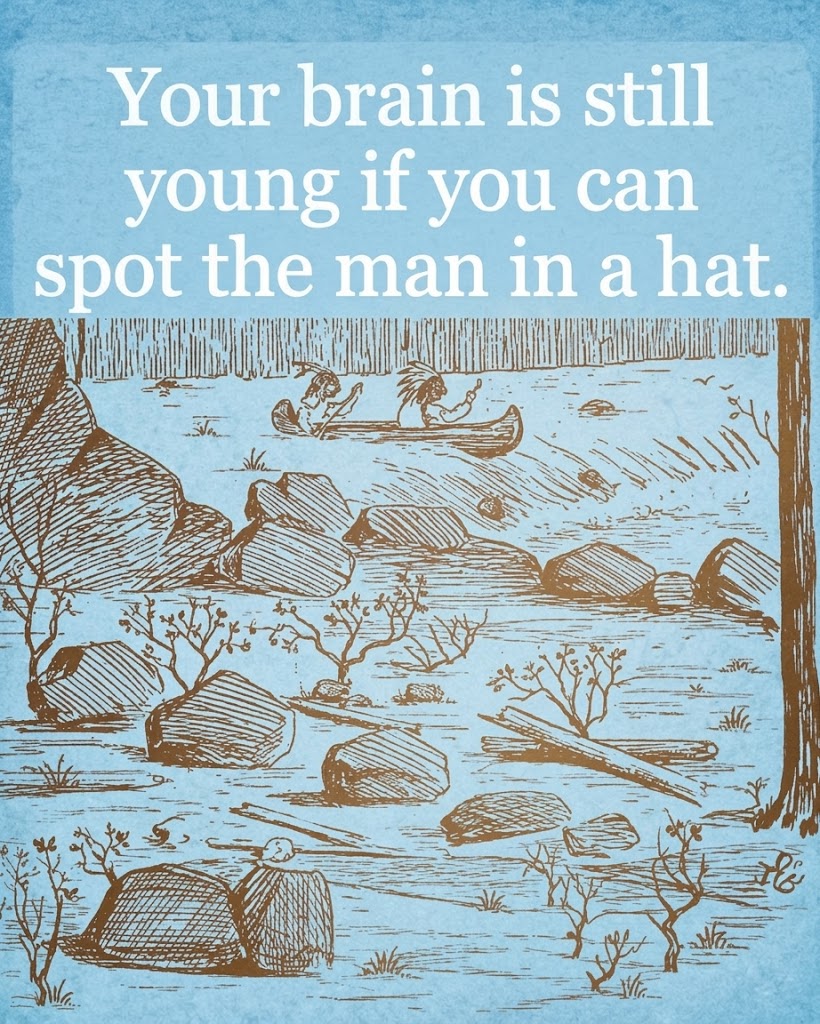
At first glance, the vintage illustration looks like a peaceful scene pulled from another era, with rugged rocks, fallen logs, scattered trees, and still water stretching into the distance. A small canoe carrying two people glides across the water, making the picture appear like an ordinary countryside painting. But something unexpected is hiding in plain sight, and many viewers overlook it on their first attempt. Somewhere among the shadows, rocky edges, and unusual shapes is the face of a man wearing a hat. The challenge is to discover his features without mistaking the surrounding landscape for the entire picture. Some people claim that spotting him quickly means your brain is young, but the puzzle is really an entertaining test of visual perception rather than a scientifically proven measure of brain age.
The trick is that the man’s face is not drawn as a separate person standing among the rocks. Instead, the artist uses the landscape itself to create the illusion, allowing shadows and curved formations to suggest a forehead, nose, cheeks, jawline, and hat. Your brain initially identifies the most familiar objects, such as trees and stones, before considering an entirely different interpretation. This natural tendency to recognize familiar shapes in ambiguous images is known as pareidolia, which also explains why people sometimes notice faces in clouds or patterns in tree bark. If you are struggling to find the hidden figure, try looking at the picture from a little farther away. You might discover that the secret is not hidden in one particular rock, but in the way several shapes work together.
To improve your chances, stop examining every small detail and concentrate on the overall composition. Slightly narrowing your eyes may help you ignore distracting textures and notice the larger outlines. Pay attention to the empty spaces between rocks, too, because these gaps can form important parts of the man’s features. A dark patch might suggest an eye socket, while a lighter section could help define his cheek or the bridge of his nose. You can also briefly turn the picture upside down before looking at it normally again. This simple change may interrupt your first interpretation and encourage you to notice shapes you previously overlooked. Unlike a formal vision assessment or a medical evaluation, however, this puzzle cannot establish your intelligence, cognitive health, or biological age.
The most satisfying moment arrives when the hidden face finally emerges from the scenery. Suddenly, the rocks and shadows seem to fit together, and the image becomes much more than a peaceful landscape. Some viewers recognize the man almost immediately, while others need several attempts, and neither result should be treated as a judgment of mental ability. The enjoyment comes from discovering how differently the same picture can be interpreted. Take another look, focus on the spaces between the objects, and see whether you can uncover the face. Once you spot it, you may find yourself wondering how you missed something that seemed so obvious afterward.

