
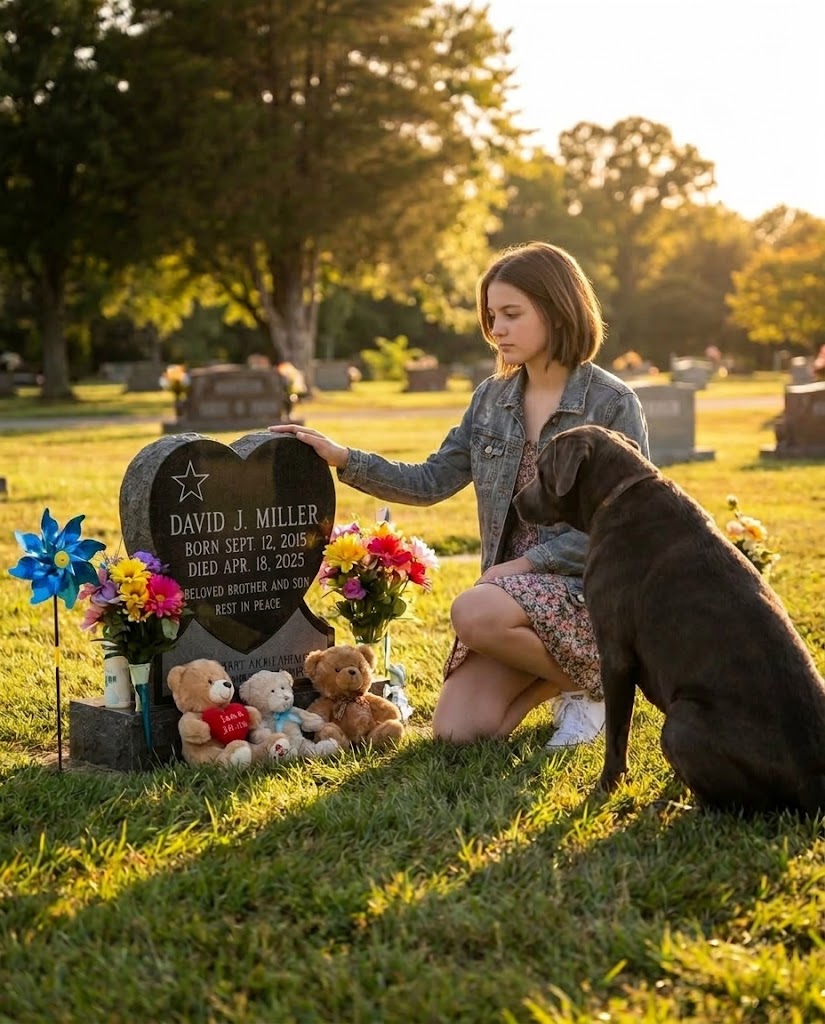
The little brown dog rose from the grass beside my son’s headstone, stretched his stiff legs, and began walking toward the cemetery gates. I set my paper coffee cup on the ground, picked up my purse, and followed him before I could talk myself out of it. For four months, I’d found him waiting beside Caleb’s grave almost every Sunday, his scruffy coat damp with morning dew and one floppy ear hanging lower than the other. He never barked, begged, or wandered among the surrounding graves; he simply settled against my son’s stone as though he’d been given a place to keep watch. Now he crossed Maple Avenue with surprising confidence, turned down Sixth Street, and continued through an unfamiliar neighborhood without once stopping to investigate a mailbox or chase a squirrel. I was fifty-two years old, a county clerk with a bad knee and a mortgage, and following a stray dog through town was easily the most impulsive thing I’d done in years. But something about the certainty of his movements convinced me that he knew exactly where he was going. Twenty minutes later, when he scratched at the door of a narrow little house with crooked shutters and two pots of red geraniums, I was about to discover that my son’s life had held a secret far greater than anything I could have imagined.
My name is Diane, and three years earlier, my only son, Caleb, had been killed in a car accident when he was nineteen. He’d borrowed my car on a rainy evening to visit a friend across town, promising to be home in twenty minutes. At half past nine, he called to say he was leaving, laughed when I reminded him to drive carefully, and ended with the words, “Love you, Mom. See you in twenty.” An hour later, I was still watching the driveway. At 11:14, a police officer arrived at my door to explain that another driver had run a red light and struck Caleb’s car. The doctors said his death had been instantaneous, a small mercy I chose to believe because the alternative was unbearable. My sister, Joanne, came over in her pajamas that night and stayed until morning, but even her presence couldn’t quiet the emptiness that settled into my house. For months, Caleb’s sneakers remained beside the garage door, his gray hoodie hung behind his bedroom door, and I kept a grocery receipt bearing his untidy handwriting because it was one of the last ordinary things he’d touched. I’d spent nineteen years watching him grow from a curious little boy into a young man who sent me photographs of disastrous dinners and occasionally asked for twenty dollars even when I’d already given him more. I could still hear his laugh when something caught me by surprise, and sometimes I reached for my phone before remembering there would be no new messages from him. The cemetery became the one place where I didn’t have to disguise how much I missed him. I visited every Sunday, usually carrying yellow carnations because Caleb had always said roses were boring. Then, one spring morning, I noticed a scruffy dog lying beside his headstone. When I knelt to arrange the flowers, the animal moved a few feet away but didn’t leave. His quiet company made me smile for the first time in months, and before long, I began bringing treats in my purse. The dog accepted them with extraordinary gentleness, stretching his neck forward and taking each one carefully from my fingers. He seemed neither hungry enough to be a stray nor interested in the attention other visitors might offer. He simply returned to Caleb’s grave, week after week. Edwin, the elderly cemetery groundskeeper, told me the dog appeared mainly on Sundays, sometimes on Saturdays, and usually disappeared by afternoon. Nobody knew where he lived. The regularity puzzled me, particularly because the cemetery covered several sections and hundreds of graves, yet he always chose the same spot. One Wednesday evening, I went into Caleb’s bedroom and found an old receipt inside the pocket of his gray hoodie. It was for a sixteen-pound bag of dog food purchased during the summer before his senior year of high school. We had never owned a dog because I’d suffered from allergies when Caleb was young, but I suddenly remembered how he’d occasionally come home with dirt on his knees that summer and how food kept for a neighbor’s beagle seemed to disappear from our garage. At the time, I’d assumed he’d been helping someone with a pet. Now I wondered whether the animal at the cemetery might have known him. That Sunday, instead of leaving at my usual hour, I sat beneath a nearby oak tree and waited. Around half past one, the dog stood up, stretched, looked once more toward Caleb’s headstone, and began his determined walk toward town. I followed at a distance, feeling increasingly foolish until he reached that house at the end of a dead-end street and sat patiently on its welcome mat.
The door opened a few inches, and a young woman appeared with a dish towel over her shoulder. For a moment, neither of us spoke. Then she stared at me in disbelief and said, “Ms. Diane?” It took several seconds for me to recognize Sadie Morrison, the girl Caleb had dated during his senior year of high school. She’d once been a familiar presence in my home, joining us for Tuesday dinners, watching movies on our couch, and helping me prepare lasagna. Caleb and Sadie had broken up shortly before graduation, and she’d disappeared from our lives afterward, never attending his funeral. I’d wondered why, then buried the question beneath the many others grief had left unanswered. Now she stood before me, older and thinner, while the dog slipped past her legs and trotted inside. She called him Jasper, and when I explained that he’d been visiting Caleb’s grave every Sunday, her face drained of color. She invited me inside with the anxious expression of someone who knew a long-delayed conversation could no longer be avoided. Her living room was small but tidy, with a worn plaid sofa and a television beside a plastic crate overflowing with children’s books. Then I saw a pair of tiny blue sneakers near the hallway, the sort with Velcro straps and lights in the heels. Before I could ask about them, a sleepy little voice called, “Mommy?” A boy of about three wandered into the room wearing dinosaur pajamas, his brown hair sticking up on one side. He looked at me with large brown eyes and raised one eyebrow slightly higher than the other, exactly as Caleb had done from the time he was a toddler. My knees weakened. The child’s mouth, the easy smile that followed, and the familiar expression of mild confusion seemed to bring my son into the room in a way no photograph ever could. Sadie introduced him as Beau and gently sent him toward the kitchen with the promise of crackers. Then she sat on the edge of the sofa and told me that Beau was Caleb’s son. She had discovered the pregnancy three weeks after the accident, when she was eighteen, grieving a boy with whom she’d recently quarreled, and terrified of becoming a mother. Her parents had advised her not to contact me, insisting that the news would deepen my grief. She had accepted their advice at first, then found it increasingly difficult to explain the silence as months turned into years. She eventually moved out with Beau and Jasper, supporting them through night shifts at a nursing home while a neighbor helped with childcare. I listened in disbelief, overcome by anger at the three birthdays, first steps, and ordinary childhood moments I’d missed. Sadie wept as she explained how often she’d considered calling, only to lose her courage when she imagined my reaction. She’d never told me because she feared I would blame her for the breakup and resent her for appearing with a baby after Caleb’s death. I asked why Jasper went to the cemetery, and she finally explained the dog’s connection to my son. Caleb had found him abandoned behind a grocery store during the summer before senior year. Knowing my allergies made keeping a dog at home difficult, he’d secretly cared for the puppy behind Sadie’s parents’ shed, bringing food and visiting every evening until her father agreed that she could keep him. Jasper had been Caleb’s dog in every meaningful way, even though he’d never officially lived with us. Sadie sometimes took Beau to the cemetery early on Saturdays so he could visit his father’s grave, and Jasper had accompanied them until he learned the route well enough to make the journey on his own. Suddenly the receipt in Caleb’s hoodie, his muddy knees, and the dog’s patient presence beside the headstone all made sense. Beau returned from the kitchen with crackers in both hands and asked whether I’d known his daddy. I knelt before him and said that I’d known Caleb better than almost anyone because he’d been my little boy. Beau considered this carefully, then brightened. “So you’re my grandma?” he asked. I nodded, unable to speak, and he wrapped his arms around my neck, scattering cracker crumbs down the back of my collar. For three years, I’d believed the accident had taken away every possibility of seeing Caleb become a father; now his little boy was holding me, and I could scarcely bear the mixture of joy and sorrow.
Sadie and I spent the remainder of that afternoon talking while Beau played on the floor with Jasper and his collection of dinosaurs. She showed me photographs of Caleb from school, summer gatherings, and quiet afternoons I’d never known about, followed by pictures of Beau’s first birthdays and the milestones I’d missed. The resemblance between father and son appeared in small details I recognized immediately: a particular crooked grin, the lifted eyebrow, and the determined way Beau examined something he couldn’t quite understand. Sadie admitted that her parents had been furious when she became pregnant, especially because her relationship with Caleb had ended shortly before his death. They feared she would struggle alone and believed that reaching out to me would reopen wounds that had barely begun to heal. They later moved to Arizona, but Sadie refused to leave town because she wanted Beau to grow up knowing where his father was buried. I told her plainly that I was still angry about the years we’d lost. I couldn’t pretend that missing my grandson’s first word, first steps, and three birthdays was a small thing, and I wasn’t prepared to excuse the silence simply because I understood how frightened she’d been. But I also told her that anger would not prevent me from being part of Beau’s life if she welcomed me. Caleb had loved her, even after the breakup, and she was raising his son with limited resources and little support. Sadie reached across the kitchen table and took my hand, admitting that she’d wanted to contact me for years but no longer knew how to begin. Before I left, we exchanged telephone numbers, and she called mine immediately to make certain the connection was real. When Beau asked whether I would return, I promised I would as soon as his mother agreed, and Sadie invited me back the following evening. I drove home in silence, carrying the knowledge that I had a grandson and that my son had once rescued the animal who’d led me to him. In Caleb’s bedroom, I picked up the faded dog food receipt and cried, this time with feelings I could barely separate. The grief was still there, as deep as ever, but for the first time in years it seemed to have made room for something unexpected. Later that night, I called Joanne and told her to sit down before explaining everything. She wept when I described Beau’s resemblance to Caleb, particularly that crooked eyebrow she’d always teased him about. The next evening, I arrived at Sadie’s house with pizza, dog treats, and a stuffed triceratops I’d bought during my lunch break. Beau named the toy Harold because, he explained, it looked like a Harold. His reasoning was so perfectly Caleb that I had to turn away for a moment. I returned again later that week, and Sadie and I spent evenings exchanging stories about the young man we’d both loved. She told me Caleb sang off-key in the car and cried during dog movies; I told her he’d done the same at home and had once been devastated by the ending of Charlotte’s Web. We discovered parts of him that neither of us had known alone. The following Saturday, Sadie brought Beau and Jasper to my house. Beau hurried from room to room, delighted by its size, until he reached Caleb’s bedroom and stopped. He studied the old posters, baseball glove, and gray hoodie hanging behind the door, then asked whether this had been his father’s room. I told him it had, from childhood until the day Caleb died. Beau sat carefully on the bed and asked whether he could sleep there sometimes. I held the doorframe to steady myself and told him he could stay whenever his mother was comfortable with it. The next morning, I stopped at the coffee shop on Elm Street as I always did before visiting the cemetery. The young woman behind the counter began preparing my usual order, black coffee with one sugar, but I surprised her by asking for a small hot chocolate as well. When she asked who it was for, I answered, “My grandson.” Saying the words aloud made them feel newly real. I collected Sadie, Beau, and Jasper, and we drove to the cemetery together. Jasper ran ahead across the grass toward Section Four, settling immediately beside Caleb’s headstone, while Beau held my hand along the familiar path. When we reached the grave, Beau placed his small palm against the engraved name and announced, “Hi, Daddy. I brought Grandma.” Sadie began to cry quietly beside me, and I reached for her hand. Then I knelt next to Beau and told Caleb about his son, the forty-one dinosaurs he’d collected, the stegosaurus named Kevin, and the stuffed triceratops he’d christened Harold. I also thanked him for finding such a loyal dog. When we finally stood to leave, Jasper rose from the grass, stretched, and walked beside us to the car. For the first time since I’d met him, he didn’t disappear before I could say goodbye.
Six months have passed since Jasper led me to Sadie’s house, and our lives have settled into a new arrangement that neither of us could have anticipated. Beau sleeps in Caleb’s old bedroom every other Saturday night, often wearing his father’s gray hoodie like a nightgown because it reaches nearly to his ankles. Jasper curls up at the foot of the bed, and sometimes I stand in the hallway listening to Beau talk softly to him before falling asleep. Sadie and I have dinner together every Wednesday, and although our relationship has grown warmer, there are still moments when the years she kept Beau from me rise between us. We don’t pretend those feelings have vanished. We talk about them, sometimes awkwardly, and then we wash the dishes or compare memories of Caleb until the difficult moment passes. Sadie’s parents visited from Arizona after her mother called to apologize for encouraging her to remain silent. That conversation was painful, but it allowed us to begin addressing the fear and misunderstanding that had kept our families apart. Joanne met Beau at Easter and prepared enough food for a gathering three times the size of ours. He ate too many deviled eggs and became sick on her porch, which she later described, with tears in her eyes, as the happiest Easter she’d had in years. These are ordinary family memories, the sort I once assumed would never include a grandson. I remain aware that Beau isn’t a replacement for Caleb and that no amount of love for this little boy will erase the pain of losing my son. There are still mornings when I reach for my phone before remembering, and some days I find myself grieving the father Caleb might have become. Yet Beau gives me a chance to share the stories, habits, and small family traditions that might otherwise have stayed locked inside my memory. He asks about his father’s childhood, his favorite foods, the things that made him laugh, and whether he was afraid of the dark. I answer as honestly as I can, sometimes telling stories that make Beau laugh and others that leave me blinking away tears. We now visit the cemetery together every Sunday. I buy my usual coffee and a small hot chocolate for Beau, Sadie brings flowers, and Jasper rides in the back seat until he sees the gates. He still runs directly to Caleb’s headstone and settles against it, his tail tapping the grass when we arrive. But when it’s time to go, he rises and comes home with us. Last Sunday, Beau asked why Jasper had gone to visit his daddy all by himself before we found one another. I looked at the little dog lying against the stone and thought about Caleb bringing food to an abandoned puppy behind a grocery store, caring for him quietly because he couldn’t bring him home. I thought about Sadie raising Beau while frightened of reaching out, and about the Sundays I’d spent wondering whether anything meaningful could still happen in a life so changed by loss. I told Beau that Jasper must have loved his father very much and that sometimes love makes us return to the same place even when no one is there to see us. Beau considered that for a moment, then knelt and stroked Jasper’s scruffy head. “Good boy,” he whispered. Jasper’s tail moved once against the grass. I watched them together and felt grateful that, on one Sunday afternoon, I’d followed a little dog instead of going straight home. It led me not to a way of forgetting Caleb, but to a part of his life I had never known—and to two people who now have a place in mine.

