
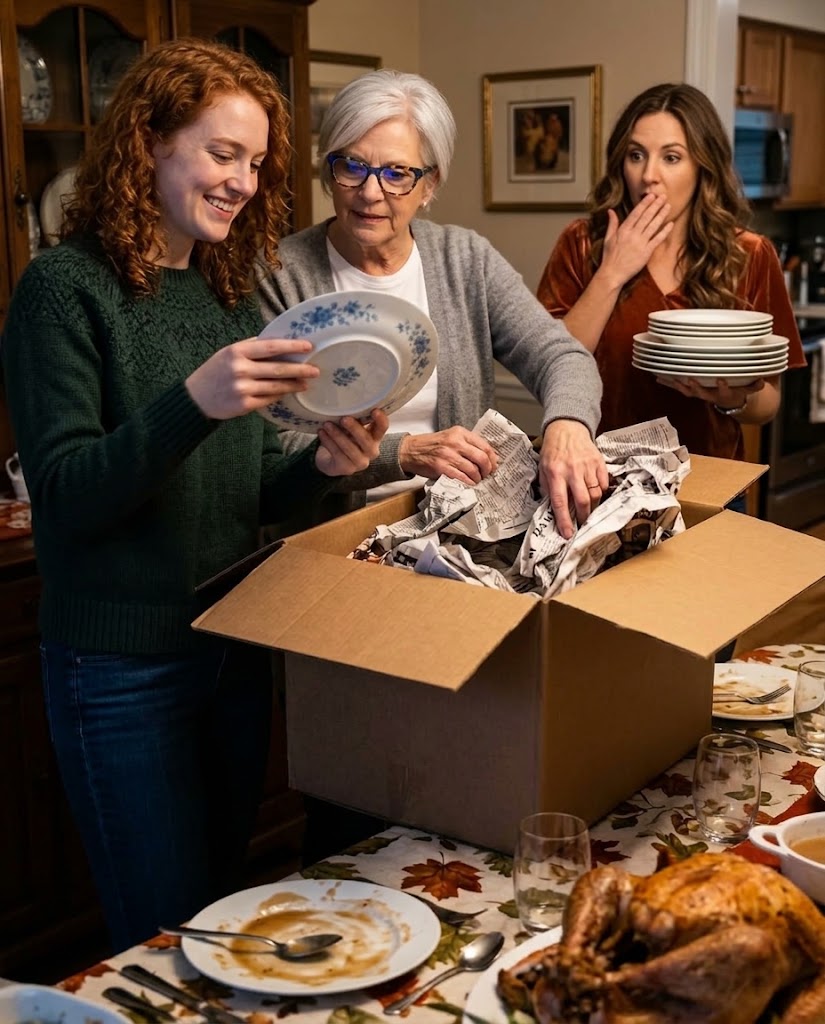
“Sorry, Joan. You always break things.” My daughter-in-law’s voice carried the length of the Thanksgiving table as she placed a flimsy paper plate in front of me. Around us, nineteen relatives were eating from proper dinnerware, while eight carefully selected guests had been given the delicate antique china Brittany had spent years collecting. Someone gave a nervous little laugh, and her mother murmured that Brittany had a point. I looked toward my son, Kevin, who stood at the head of the table holding his father’s old carving knife, but he lowered his eyes to the turkey and said nothing. My sixteen-year-old granddaughter, Emily, immediately offered me her own china plate, only to be sharply ordered by her mother to put it back. I held the paper plate with both hands, afraid it would collapse beneath the gravy, and ate my dinner without complaining. Beneath my chair sat a heavy cardboard box containing something Brittany had searched six years to find—and before the evening ended, I would have to decide whether to give it to the woman who had humiliated me or to the granddaughter who had tried to protect me.
I’m seventy-four, and for seventeen years, I’ve struggled to understand why Brittany has never been comfortable with me. She was twenty-five when she married Kevin, my only child, and I admired how efficiently she managed a busy household while working at a dental practice and raising their two children, Emily and Tyler. But our relationship remained distant. At the wedding, she seemed irritated when I adjusted her veil. That first Christmas, she put the pie I’d baked near the back door and never served it. When Emily was born, she declined my offer to stay and help, and eventually I stopped offering because I didn’t want to intrude. My husband, Frank, always believed we’d grow closer with time, but he died five years ago, before that could happen. Kevin supported me through the funeral and called frequently afterward, yet gradually our conversations dwindled to ten minutes most Sundays, usually while he was driving somewhere. I told myself that was simply how family life changed as children grew older. Last spring, however, I received news I kept even from him. My doctor diagnosed essential tremor, a neurological condition that causes involuntary shaking, particularly noticeable in my hands. It wasn’t Parkinson’s disease, and medication helped somewhat, but everyday tasks such as carrying glasses and serving food were becoming more difficult. At Easter, while visiting Kevin and Brittany, I dropped a drinking glass when my hand suddenly jerked. Brittany hurried to sweep up the fragments, speaking to me as though I were incapable of moving safely, while her mother made a remark about the clumsiness of old age. I was embarrassed and said nothing about the diagnosis. Emily, then fifteen, helped gather the pieces and quietly squeezed my shoulder afterward. That small gesture stayed with me. She had always been thoughtful, calling every Wednesday to talk about school, visiting on her bicycle to help in my garden, and patiently teaching me how to send photographs on my phone. She wanted to become a nurse, and I could already see the kindness that would make her good at it. Three weeks before Thanksgiving, Kevin called to tell me Brittany was excited because she’d found another plate in an antique pattern she’d been collecting for six years. When he sent me a photograph, I stared at the screen in disbelief. The plate was white, edged with tiny blue forget-me-nots and a narrow gold rim worn slightly from years of use. I went straight to my basement and opened four cardboard boxes that had been stored behind the Christmas decorations since my mother, Rose Kowalski, moved into assisted living almost twenty years earlier. Inside was her wedding china, given to her in 1957: twelve dinner plates, twelve salad plates, twelve bowls, twelve cups and saucers, a gravy boat, a sugar bowl, and two serving platters. Every piece bore the same forget-me-not pattern Brittany had spent years searching for. My mother had used those dishes every Sunday of my childhood because she believed beautiful things ought to be enjoyed by the people you loved, not saved for visitors. Among them was a dinner plate with a barely visible repair running through the painted flowers. I’d broken it when I was nine, after tripping while carrying two plates to the Easter table. My aunt had scolded me for being careless, but Mother knelt beside me, checked that I wasn’t hurt, and gathered the pieces. “Dishes are for people,” she told me. “People are not for dishes.” She carefully glued the plate together and set it before me at every family meal afterward, explaining that she wanted me to remember not my mistake, but how little a broken dish mattered compared with the child who’d dropped it. I spent the weeks before Thanksgiving washing and inspecting the china, remembering those dinners and wondering whether giving the collection to Brittany might finally bring us closer. I wrote her a letter explaining its history and offering her the entire set. Then I wrote another letter, addressed to Emily, because I couldn’t forget the kindness she’d shown me when the glass broke at Easter. On Thanksgiving morning, I put Brittany’s letter in my purse and Emily’s on top of the china inside a carefully packed box. I hadn’t decided which letter I would give away.
Brittany’s house was crowded and warm when I arrived, with children running through the hallways, football on television, and the smell of roast turkey mingling with cinnamon candles. I carried the box inside myself, despite its weight and the trembling in my hands, and placed it beneath my chair at the far end of the dining table. Brittany had arranged everything beautifully: burgundy napkins, white candles, gold-lettered place cards, and the antique forget-me-not plates gleaming at the adults’ end. My place was near the children, beside Emily, who greeted me with a kiss and immediately offered to help with the box. Before dinner, Brittany proudly told the family how she’d discovered the pattern during an anniversary trip to Maine, when Kevin had stopped in an antique shop because a plate reminded him of his grandmother’s house. She’d bought it for thirty dollars and begun searching for others, traveling to estate sales and antique stores in several states. Now she had eight, including a recent find from Michigan, and she hoped eventually to collect twelve. I listened with unexpected tenderness. Kevin had been six when my mother last hosted Christmas dinner, and although he barely remembered her china, something about it had stayed with him. Brittany had spent six years searching for a childhood memory that was waiting in boxes twenty minutes away, because neither of them had ever thought to ask me about it. When the meal began, she distributed the china to selected family members and sturdier disposable plates to the younger children. Emily received one of the antiques, along with a warning to be careful. Then Brittany reached me and held out a thin paper plate. Her remark about my tendency to break things was deliberate and loud enough for everyone to hear. I waited for Kevin to object, but he stared at the turkey. Emily’s instinctive attempt to exchange plates with me was met with a command from her mother, and I felt her disappointment as surely as my own. Under the table, she found my hand and held it. I ate quietly while the conversation moved around me, maintaining my grip on the paper plate as the gravy softened its center. My hands shook with the effort of keeping it steady. When dinner ended, I thanked Brittany for the food, even complimenting her sweet potatoes, and waited until the guests began gathering their coats. Then I pulled the box from beneath my chair and asked Emily to help lift it onto the table. I told her it was a gift for her and asked her to open it there. As she peeled away the yellowed newspaper wrapping, the first plate emerged, its blue flowers and faded gold rim catching the candlelight. Brittany stopped clearing dishes. Kevin stared at the pattern in his daughter’s hands. Emily discovered the remaining pieces and the envelope I’d placed on top, addressed to her with instructions to read the letter aloud. She began with the story of Rose Kowalski’s wedding china, the family dinners, and the Easter when I’d broken a plate at nine years old. Then she read about my essential tremor, the broken juice glass, and the quiet kindness she’d shown when everyone else had made me feel ashamed. I explained that I was giving her the collection because I trusted her to use it, not merely display it, and because she’d already understood the lesson my mother had taught me decades earlier. As Emily reached the final lines, her voice faltered. The dining room had fallen silent, and Brittany was standing by the kitchen door, staring at a complete collection of the china she’d hunted for years. Kevin finally asked why I’d never told them I owned it. “Nobody asked me, honey,” I answered. Emily came around the table and hugged me, crying, while I gathered my coat and purse. Brittany remained silent. Outside, Kevin followed me into the cold driveway and apologized for not knowing about the dishes or my diagnosis. I asked whether knowing would have made him speak up when his wife handed me that paper plate. He stopped, unable to answer. I drove away without feeling the satisfaction I’d expected. In the empty parking lot of a Methodist church, I sat for a long time, looking at my shaking hands and thinking about Frank. He would have gone into the kitchen, brought me a proper plate, and ended the embarrassment without allowing it to become a family spectacle. Kevin hadn’t moved. That silence hurt more than Brittany’s remark, and I wondered whether the gift I’d intended as a bridge between us had instead exposed how far apart we’d become.
Brittany telephoned early the next morning, furious that I’d humiliated her before her relatives. She insisted the paper plate had been a joke and accused me of deliberately waiting until the end of dinner to reveal the china. I reminded her that Emily had offered me her own plate and that Brittany had forbidden the exchange. If she truly believed the situation harmless, I asked, why hadn’t she offered me her own china plate? Brittany had no answer. Instead, she complained that I’d kept a complete set hidden while she spent six years searching for the pattern. I explained that I’d only learned of her collection three weeks earlier and that, in seventeen years, she’d never asked about my mother, my childhood, or the family history attached to the dishes. She insisted that Emily was too young to own such valuable china and that the set belonged with the plates already in her dining room. I told her the gift was Emily’s and that she should respect her daughter’s ownership. Later that day, Kevin came to my house alone. He admitted that he’d known immediately how cruel the paper-plate remark was but had chosen to look away rather than challenge his wife. He recognized the same pattern throughout our family history: the pie left untouched at Christmas, my exclusion after Emily’s birth, the embarrassing incident at Easter, and years of comments he’d dismissed because it was easier to assume I didn’t mind. I told him I had minded, deeply, and that his silence had made me feel increasingly unwelcome. Then I explained my diagnosis, how the tremor affected everyday activities, and how ashamed I’d been when it became noticeable. Kevin took my shaking hand between his palms and apologized. He could not undo the holiday dinner, but I believed he finally understood what it had cost me. A few days later, Emily visited after school and told me she’d argued with Brittany over the china. Her mother wanted the collection displayed with her own plates, while Emily wanted to keep it at my house and use it for Sunday dinners, just as Rose had done. We unpacked the box together, and when she found the plate with the old repair, she held it to the light and traced the thin line through the forget-me-nots. Then she set it before my chair and said it should be mine whenever we ate together. That Sunday, she came over and laid two places with my mother’s china. I made pot roast, she folded paper napkins into triangles, and when my trembling hand spilled a little water, she simply offered me a napkin and continued talking about her chemistry exam. The following week, Tyler joined us. Soon afterward, Kevin arrived with an apple pie from the bakery, and as he stood beside the table, he remembered sitting on telephone books at Rose’s house when he was small. For the first time in years, he seemed able to speak openly about the family he’d grown up in and the people we’d lost. Brittany didn’t join us. Kevin later told me she’d begun seeing a counselor and was working through difficulties connected to her childhood, particularly her relationship with her mother, Diane. I didn’t ask for details. I wanted things to improve, but I knew that repairing seventeen years of distance would require more than one apology. Then, on the Saturday before Christmas, Brittany arrived unexpectedly in the snow carrying a cardboard box. She looked exhausted and nervous, and when I invited her into my kitchen, she confessed that her mother had humiliated her in almost exactly the same way when she was young. Brittany had been a clumsy child who spilled drinks and knocked things over, so Diane routinely gave her a plastic cup with a lid at family gatherings, even when she was fourteen, joking before the relatives that Brittany couldn’t be trusted with anything breakable. She remembered how desperately she’d wanted her mother’s approval and how good it had felt, for one brief moment on Thanksgiving, when Diane laughed with her rather than at her. In counseling, she’d recognized that she had repeated the same cruelty toward me. She apologized for the paper plate and the many smaller slights that had preceded it, admitting that she’d often felt intimidated by my confidence as a mother and had tried to keep her distance because she feared being judged. Inside the box she’d brought were the eight forget-me-not plates she’d collected. She wanted Emily to have them, completing the set rather than leaving them in her cabinet as trophies. I listened, then went to my bedroom and retrieved the letter I’d written for Brittany before Thanksgiving. She read the two pages in silence, discovering that I’d originally intended to give the entire collection to her because I hoped our shared affection for the china might bring us closer. When she reached the final lines, she began crying. “You were going to give them to me,” she whispered. I nodded. I told her I’d made the decision at the Thanksgiving table, after seeing how she treated me, and that the gift now belonged to Emily. Brittany accepted that. I put my trembling hand over hers and invited her to join us for Sunday dinner, asking her to bring the sweet potatoes she made so well. The following week, she came. Emily set the table with all twenty forget-me-not plates, mixing Brittany’s discoveries with Rose’s original collection. Kevin brought his father’s bone-handled carving knife, an heirloom passed down through the family, and used it to carve a small turkey breast. When Brittany served me, she placed the repaired plate from my childhood carefully before me, then sat beside me and quietly steadied the serving dish when my hand trembled. There was no announcement, no public apology repeated for an audience. Just a family eating together, paying attention to one another in a way we hadn’t managed for years.
Nearly a year has passed since that Thanksgiving, and our Sunday dinners have become a familiar part of life again. We don’t gather every week because everyone has commitments, and Brittany is still working through the habits that shaped her relationship with me, but most Sundays there are enough people around my table to make the kitchen feel lively. Emily continues studying for a career in nursing, and she’s become the unofficial keeper of Rose’s china, carefully washing each piece by hand and returning it to the cabinet after dinner. Kevin calls more often now, sometimes simply to ask how I’m doing rather than speaking while he drives somewhere. Brittany has gradually become more comfortable in my kitchen, and we’ve had conversations about raising children, managing work, and learning how to live with mistakes. I don’t pretend we’ve become the closest of friends overnight. There are still awkward moments, and occasionally one of us says something that lands badly. But we’re learning to address those moments instead of letting them settle into years of silence. My tremor has progressed somewhat, and I’ve stopped trying to conceal it from everyone. I use lighter cups when I need to and ask for help when carrying something heavy. The family no longer treats a spill as a disaster, and that change has made ordinary meals far less exhausting. Two months ago, Tyler was helping set the table and tried to carry two salad plates at once, just as I’d done when I was nine. One slipped from his hands and broke against the kitchen floor. I heard the crash from the living room and the terrible silence that followed, and for an instant I was back in my mother’s dining room, staring at the two halves of the plate I’d dropped in 1961. By the time I reached the kitchen, Brittany was already kneeling beside her son, checking his hands for cuts. She picked up the broken pieces and fitted them together, then told him gently that dishes were made to serve people, not the other way around. Tyler apologized, frightened that he’d ruined something important, but Brittany assured him that the plate mattered far less than his safety. That evening, she carefully repaired it at the kitchen table while I dried the remaining dishes. The mended plate now sits in front of Tyler on Sundays, directly across from mine. Two plates carry thin lines through the painted flowers, while the others remain unbroken. Emily likes to say that if she ever gets married, she’ll use the entire collection at her reception, including the repaired pieces, because she wants the people she loves to understand what the dishes mean. I hope I’m there to see it. I still think about the Thanksgiving when I held a paper plate while everyone else ate from fine china, and I remember the humiliation of looking toward my son and watching him turn away. But I also remember my granddaughter reaching for her own plate, offering it without hesitation, and I know that kindness changed the course of our family. The china was never valuable to Rose because it was rare or expensive. She loved it because it was part of the life she shared with us, and because she believed the people around her table mattered more than anything placed upon it. I spent years keeping those dishes packed away in my basement, afraid of breaking them or losing the memories attached to them. Now they are used regularly, carried by trembling hands and impatient children’s fingers, and occasionally repaired after an accident. The gold rims have grown a little more worn, but the blue forget-me-nots still circle every plate. Sometimes, when dinner is over and Emily helps me wash them, I hold the one I broke as a child and run my thumb lightly over the repaired line. I can almost hear my mother telling me not to cry over a dish. Then I put it carefully back in the cabinet, ready for the next time someone comes to dinner.

