
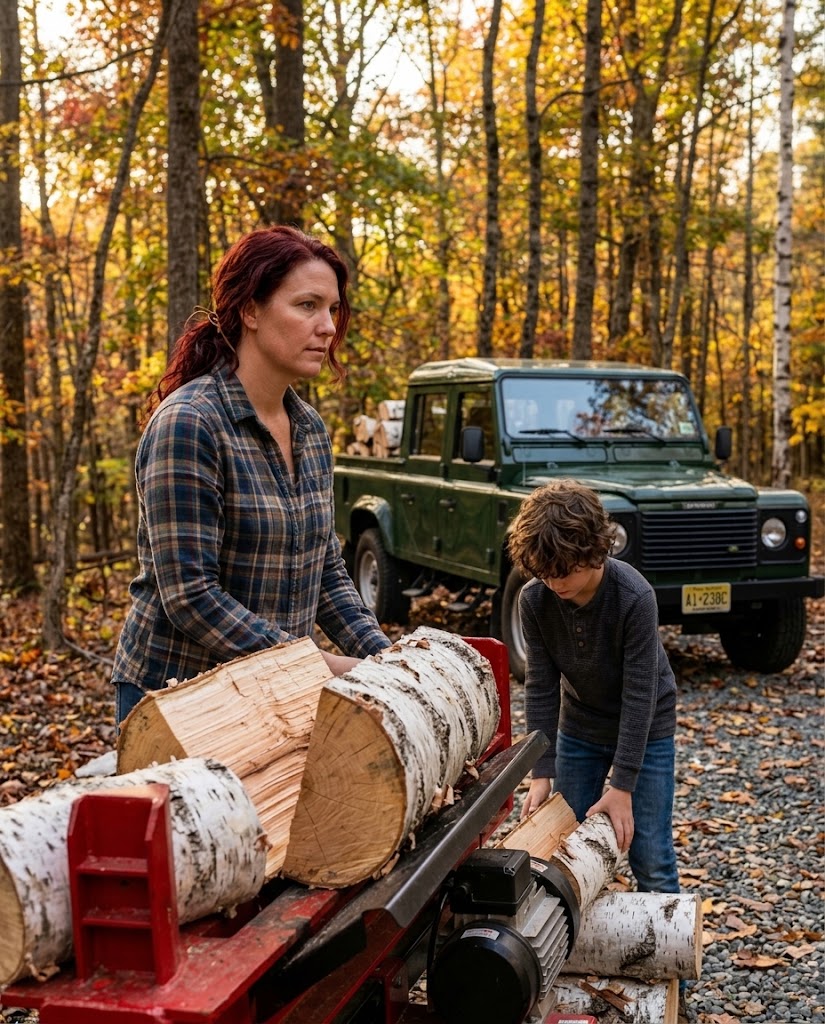
“Forty dollars for the afternoon,” Dale said, resting his hand on the red log splitter as though it belonged to him. The October wind swept through his open shed, carrying the smell of cold earth, motor oil, and pine needles from the woods beyond Otter Creek Road. I stared at the machine, a twenty-seven-ton splitter with a Honda engine that my husband, Jim, had bought six years earlier for $1,400 and paid off with money earned selling firewood. Jim’s handwriting was still visible on the hydraulic tank, where he’d recorded every oil change in neat white paint marker. He’d been dead only six months, and his older brother was asking me to pay rent on a machine that had never been Dale’s to begin with. My sixteen-year-old son, Cole, waited in the pickup outside, the heater running against the Wisconsin cold, while I struggled to keep my voice steady. Instead of arguing, I handed Dale two twenty-dollar bills and asked him to write me a receipt. He laughed as he signed it, unaware that by Monday morning his own handwriting would be pinned to the feed-store bulletin board for everyone along our road to read.
My name is Becky Thorson, and I was forty-four that autumn, working long days delivering propane for the local cooperative while trying to keep our household together after Jim’s death. He’d been forty-eight when his heart failed one April morning as he sat at our kitchen table lacing his work boots. He managed to say my name before collapsing, and though the ambulance arrived quickly, the doctors told me there was nothing I could have done to save him. Jim had driven logging trucks, cut firewood for extra money, and kept our house warm with a wood stove he’d installed the year Cole was born. He was practical, quiet, and generous in ways that rarely attracted attention. His brother Dale lived half a mile down Otter Creek Road, earning a living repairing equipment in the pole shed behind his house. During the week of Jim’s funeral, Dale offered to move the log splitter to his shed for safekeeping, explaining that an unattended machine could easily disappear while I was at work and Cole was at school. I thanked him because I was exhausted and grateful for anyone willing to take a responsibility off my hands. Through the summer, I worked every overtime shift the co-op offered, knowing our household now depended on one paycheck. By October, I had to think seriously about fuel for winter. Although I delivered propane for a living, we relied heavily on the wood stove because I knew exactly how expensive heating a house with propane could become. Jim had left six face cords of split firewood stacked beneath the lean-to, enough to last roughly until Christmas. Along the north fence, however, he had stored a much larger supply of red oak he’d cut into sixteen-inch rounds after felling nine trees threatened by oak wilt. The rounds were dry and ready to burn, but most were too large for our stove. I could split some with a maul, yet there was no realistic way to prepare fifteen cords of oak by hand during the few weekends remaining before snowfall. So I telephoned Dale and said I’d collect the splitter Saturday morning. He told me to come down and discuss it. When I arrived, he announced the $40 charge and explained that a commercial rental in Rhinelander would cost more than twice as much. I wanted to remind him that he’d taken the machine from my yard for safekeeping, not purchased it, and that Jim had paid for it himself. But Cole was watching from the truck, and I couldn’t face an argument that might consume the daylight we needed for splitting wood. I paid the charge on the condition that Dale provide a written receipt. He tore a sheet from his repair-ticket pad and wrote that he’d received $40 from Becky Thorson for an afternoon’s rental of a log splitter, signing and dating it in his own hand. After he helped attach the machine to our trailer hitch and checked the safety chains, I drove home with Cole, who was furious that I’d paid to use his father’s equipment. I told him the most useful thing we could do that day was turn our anger into firewood. We backed the splitter beside the oak rounds, checked the engine and hydraulic oil, and started working. Jim had kept the machine well maintained, and its familiar engine caught almost immediately. Cole discovered the column of service dates written on the tank and, beneath them, a separate note in his father’s handwriting: “Cole. First cord. Age 11.” My son rested his gloved hand on the words, and I saw his eyes redden. Since Jim’s death, he’d been irritable with everyone, especially me, but that afternoon he worked steadily, feeding oak rounds onto the beam while I operated the hydraulic ram and stacked the split pieces. The wood cracked apart beneath the wedge, releasing that sharp, slightly sour smell of fresh red oak. We traded jobs whenever one of us grew tired and spoke little over the noise of the engine. By midafternoon, we had made good progress, but my shoulders were aching and the light was already beginning to fade. I went into the lean-to to fetch water and noticed something written on the exposed wall studs beside Jim’s old splitting maul. It was the list he’d renewed in carpenter’s pencil every autumn: Mrs. Hartmann, Donna Peterson, and Marlene Olson, one cord each. They were three widows living along Otter Creek Road, and for years Jim had delivered their firewood before stacking our own. He never charged them, accepting a pie only if one happened to be ready. I stood studying his handwriting and remembered that none of those women had called since he died, although they must have been wondering how they’d heat their homes. I realized they were probably too considerate to ask a new widow for the free firewood her husband had always supplied. When I returned outside, I told Cole that three of the cords we split would be delivered down the road. He knew the names without asking. We worked until almost dark, finishing four face cords before returning Dale’s splitter. He seemed surprised that we’d accomplished so much and offered to rent it to us again the following Saturday. I thanked him without agreeing. Then, with one cord loaded in the pickup, Cole and I drove past our own driveway toward Mrs. Hartmann’s house at the far end of the road. She was eighty-six, a retired schoolteacher who had taught Jim and Dale when they were boys. Her home felt nearly as cold as the outside air when she opened the door, and she admitted she’d been keeping the propane thermostat at fifty-eight degrees to save money. She hadn’t expected us because she knew how much we’d lost. Cole stacked the oak beside her front door and built a fire in her stove while she watched him, tears gathering in her eyes. She told him he stacked wood just as his father had, a little crooked but always securely. The following day, we delivered another cord to Donna Peterson and a third to Marlene Olson, carrying Marlene’s wood into her back entry because of her bad hip. Marlene handed us a pie she’d baked in hope that someone might stop by. On Sunday evening, I sat at the kitchen table with Dale’s receipt and wrote a notice offering free split oak to widows and housebound neighbors before winter. Beneath it, I included my phone number and explained that the wood would be prepared using Jim Thorson’s splitter. At seven o’clock Monday morning, I pinned the notice to the bulletin board at the feed store. Then I pinned Dale’s receipt beside it, leaving his exact words and signature visible. I didn’t add a single accusation. I simply went to work, knowing that anyone who read the two pieces of paper would understand what had happened.
News traveled quickly through our part of northern Wisconsin. By Wednesday, customers on my propane route were coming out of their houses with questions about the splitter, and several men offered to lend me their own equipment. One neighbor said I could keep his thirty-ton machine until spring. I appreciated those offers, but I didn’t want another splitter. I wanted the one Jim had bought, maintained, and used with our son. Cole came home from school angry that everyone knew his uncle had charged me money, and he asked why I didn’t tell people outright how badly Dale had behaved. I explained that the receipt told the truth without my needing to humiliate his father’s brother any further. Dale had helped Jim through difficult winters, taught him to drive, and stood beside me at the funeral unable to finish the Lord’s Prayer. Whatever had prompted the rental charge, I didn’t believe one ugly decision represented everything he was. On Thursday, Dale went into the feed store for hydraulic fittings and found several men standing near the counter, unusually quiet. According to Ray, the storekeeper, Dale followed their glances to the bulletin board and read the notice and receipt without moving. He left without confronting anyone. On Friday evening, headlights slowed at the end of my driveway and stopped for almost a minute before continuing down the road. I suspected Dale had come and lost his nerve. The following afternoon, I was driving home from work when I noticed Mrs. Hartmann walking along the gravel shoulder with her cane, wearing a wool coat and a plastic rain bonnet despite the clear weather. I pulled over and asked where she was going. She informed me that she intended to visit Dale, who had been her pupil decades earlier, and suggested that I might drive her rather than make her walk another half mile. I helped her into the pickup, telling her I didn’t want her fighting my battles. She replied that she wasn’t going to fight; she wanted to ask a former student a question. Dale was working beneath the hood of a car when we arrived. The sight of Mrs. Hartmann climbing out of my truck stopped him where he stood, and he removed his cap as she approached. She told him she’d burned Jim’s wood for eleven winters and was burning another cord now, split by a widow who’d paid him $40 for the privilege of using her own husband’s equipment. Then she reminded him that, even as a child, he’d been too proud to ask for help, preferring to take a failing grade rather than borrow a pencil. She said she didn’t believe he’d charged me because he needed forty dollars. She believed there was something he was ashamed to ask for, and she wanted him to tell me what it was. Dale stared at the ground for a long time before admitting that Jim had owed him $600. In February, the rear axle of Jim’s plow truck had failed, and Dale found a replacement at a salvage yard in Antigo. He put the part on his credit card and spent two nights installing it without charging for his labor. Jim promised to repay the cost after the spring road restrictions were lifted and he returned to hauling logs. He died before that happened. Dale had been left with the credit-card balance, but couldn’t bring himself to approach me for payment while I was grieving and struggling to support Cole. He’d moved the splitter to his shed partly as security for the debt, expecting that when I eventually asked for it, he’d finally explain what Jim owed. Instead, he panicked and invented the forty-dollar rental fee, privately calculating that fifteen afternoons would recover the six hundred dollars without his having to discuss the debt directly. He admitted that the arrangement had sounded reasonable only until he saw me hand over the money. Reading his own receipt on the bulletin board forced him to recognize what he’d done. I was still angry because Jim’s unpaid debt hadn’t given Dale the right to withhold our equipment or charge me rent without explanation. But I could also see the resemblance between the brothers: Jim had hidden the repair because he didn’t want me to worry, while Dale had hidden the debt because he couldn’t bear to ask a widow for money. Their silence had created a problem neither man intended. I drove home and retrieved the coffee can Jim kept above our refrigerator, where he stored the cash from selling firewood to people with cabins on the lake. I hadn’t opened it since his death. Back at Dale’s shed, with Mrs. Hartmann watching, I removed the lid and counted $640 in mostly twenty-dollar bills, still faintly dusty with sawdust. I handed Dale six hundred dollars and told him it was money Jim had earned, money he’d have used to repay his brother once the roads opened. Dale hesitated, then accepted it. Afterward, he reached into his shirt pocket and produced the same two twenty-dollar bills I’d given him the previous Saturday. He hadn’t spent them. He returned the forty dollars and apologized for taking the splitter from my yard, for charging me to use it, and for failing to tell me the truth. I accepted the apology, though I didn’t pretend the matter had been harmless. He helped hitch the machine to my pickup, checking the trailer coupling and safety chains before stepping back. Mrs. Hartmann reminded him that Cole and I still had a long row of oak rounds to split and suggested he might find a way to help. She didn’t need to say more. On the way home, I stopped at the feed store and removed Dale’s receipt from the bulletin board. I left the notice offering free firewood where it was. When Ray asked whether everything had been settled, I explained, loudly enough for the men at the counter to hear, that Jim had owed Dale for a truck repair and that the debt was now paid. Since I’d allowed the town to see the receipt, I thought it only fair that people hear the truth about why Dale had taken the splitter. I wasn’t going to let the matter end with my brother-in-law known only for a mistake he’d finally admitted. The next Saturday at eight in the morning, Dale’s truck pulled into our driveway. He brought his chainsaw and began cutting the largest oak rounds into manageable pieces before Cole and I had even finished breakfast. We worked together until evening and again on the following two Saturdays, stacking enough firewood for our own winter and preparing additional cords for neighbors who’d contacted me after seeing the notice. The remaining wood went to a widower on Spring Lake, a young mother whose husband was deployed overseas, and several other households facing a difficult winter. Dale taught Cole how to file a chainsaw chain properly, and by the third Saturday they were arguing about sharpening angles with the easy stubbornness Jim would have recognized. Listening to them, I realized that something had begun to mend between my son and the uncle he’d been furious with only weeks earlier. We hadn’t forgotten what happened, but we’d found work we could do together.
A year later, the red log splitter was back in our own shed, where it belonged. Cole was seventeen and growing taller than both his father and his uncle had been, with broad shoulders and an increasingly confident way of handling the wood. I continued driving propane deliveries, though I no longer accepted every overtime shift simply to avoid sitting in a quiet house. We had managed the first winter without Jim, then another spring and summer, learning which jobs could be handled by the two of us and which required someone else’s help. The wood stove still warmed our living room, and on cold mornings I could hear its familiar ticking as the iron heated. Sometimes that sound made me miss Jim more sharply than looking at photographs did. He’d been the person who split the wood, stacked it beneath the lean-to, and checked the stove before bed, never making much of the effort. Now I understood how many small tasks had quietly held our lives together. I also understood that some of what he’d left us couldn’t be measured in equipment, savings, or firewood. His habit of helping people along Otter Creek Road had created relationships that endured after his death. Mrs. Hartmann still asked after Cole and complained that he didn’t visit enough, although she always had something for him to carry or repair when he did. Donna Peterson invited us for coffee when we delivered her winter wood, and Marlene Olson continued baking pies as though the deliveries were a standing appointment. Those women had known Jim as a child, a husband, and a neighbor, and through their memories Cole heard stories about his father that I might never have thought to tell him. Mrs. Hartmann remembered teaching both brothers in elementary school and how Dale would rather struggle alone than admit he needed something. That little story stayed with me because I’d seen the same stubborn pride nearly destroy our relationship. I didn’t excuse Dale’s conduct, and I never came to believe I should have paid rent for the splitter in the first place. But I was grateful that he eventually explained himself instead of allowing the resentment to grow. The $600 debt had been real, and I was glad we’d paid it from Jim’s own firewood money. It mattered to me that my husband’s final obligations were settled honorably, just as he’d always intended. The forty dollars Dale returned remained in the coffee can for a while, along with the last few bills Jim had folded and tucked away. Eventually I used some of that money to buy oil and replacement parts for the splitter, an ordinary expense that somehow felt like continuing one of his routines. I kept the receipt Dale had written, folded in a small envelope with Jim’s other equipment records. I no longer needed to display it for anyone, but I didn’t throw it away. It reminded me that I could insist on the truth without making every disagreement a permanent division. That October, as the leaves began to fall and the air took on the first sharp smell of winter, I went into the lean-to and renewed Jim’s list on the wall. I pressed the carpenter’s pencil firmly over the names he’d written year after year: Mrs. Hartmann, Donna Peterson, and Marlene Olson, one cord each. I considered adding more names, because the requests for firewood had grown after the previous year’s notice, but I wanted to keep his original list recognizable. Before I’d started the splitter that first Saturday, I heard a pickup turn into the driveway. Dale climbed out carrying his chainsaw and a pie wrapped in plastic. Mrs. Hartmann had sent it, he explained, with instructions that it was for whoever did the stacking. Cole came out of the house, took the pie and saw from his uncle, and handed him a pair of work gloves. The two of them immediately began discussing which oak rounds needed to be cut smaller before we could put them on the beam. I watched them for a moment, hearing Jim’s voice in the way Cole corrected his uncle and Dale’s amused answer. Then I stepped back into the lean-to to fetch the water jug. The names on the wall were dark beneath my pencil, and the space below them was still blank. For a long time, I hadn’t been sure whether I should add anything to a list Jim had kept for so many years. It had felt like changing something that belonged to him. But the work had changed since his death, and Cole and Dale were part of keeping it going. I picked up the pencil again and wrote one more line beneath the three women’s names: “Dale brings the saw.” My handwriting was less square and careful than Jim’s, but it looked right alongside his. Outside, the splitter engine started, followed by the first familiar crack of oak breaking apart. I put the pencil back on its nail, carried the water jug into the yard, and joined them.

