
“What do you mean the kitchen works fine?” I asked, standing in our driveway with a gallon of milk in one hand and ten pounds of potatoes in the other. The late-April sunshine flashed across the green-and-silver fishing boat parked beside our garage, making its metallic paint glitter as though someone had scattered sequins over the hull. A 150-horsepower Mercury motor hung from the stern, and one tire on the trailer sagged lower than the other. My husband, Rick, rested a hand on the boat’s side and explained that our old cabinets still closed and the stove still heated, adding that his mother had cooked in a worse kitchen for forty years. Behind him, the kitchen window caught the afternoon light, and I could almost picture the contractor’s $11,000 estimate still hanging on our refrigerator. For six years, I’d transferred forty dollars from every weekly paycheck into a savings account specifically for that renovation, and now I understood exactly where the money had gone. Rick admitted he’d withdrawn it through another bank branch because he knew better than to visit the one where I worked, and he’d already completed the purchase from a man who was moving out of state. I set down my groceries, looked at the boat that had replaced the kitchen I’d saved for, and decided that instead of arguing, I was going to make certain my husband saw his purchase from a very different perspective.
My name is Karen Schmitz, and at fifty-three, I’d spent twenty-two years working as a teller at First State Bank in Cambridge, Iowa. Rick and I had been married for thirty-two years, raised our son Tyler, and built the sort of practical, hardworking life common in our part of the Midwest. Rick was a journeyman lineman for the rural electric cooperative, a demanding job he’d held for three decades. When ice storms brought down power lines, he went out in bitter weather to repair them. During one particularly severe winter, he worked away from home for eleven days and returned with frostbite on two fingers. After a devastating summer windstorm, he spent weeks working sixteen-hour shifts, rebuilding electrical lines and replacing damaged poles while exhausted families waited for their lights to come back on. I was proud of him, and I never doubted that he loved us. He was dependable, the kind of man who’d help a neighbor move a refrigerator or repair a gate without expecting payment. Yet he had a stubborn streak, particularly when it came to money and the things he believed a man should be allowed to want. His father, Walt, had farmed two hundred acres south of town and raised Rick to think that spending money on personal pleasure was a sign of weakness. When Rick was fourteen, he saved two hundred dollars from detasseling corn and bought a used red Honda minibike. The following spring, his father sold it at a farm auction without asking him. Rick came home from school to discover that the little machine he’d worked all summer to purchase was gone. He rarely talked about it, but I remembered the story because of the quiet hurt in his voice when he told me. Throughout our marriage, Rick avoided buying himself anything extravagant. He drove old trucks, skipped hunting trips with friends, and kept a recliner that tipped sideways whenever he leaned back too far. He seemed to regard wanting something for himself as a weakness he had to overcome. Our house had been built in 1978, and its kitchen looked much the same as it had when we moved in. The cabinets were dark brown and heavy, several doors hung crookedly, and one beside the sink refused to stay closed unless I pushed it with my knee. The range had four burners, but only one worked, and it had two settings: off and high. I’d spent years stirring gravy constantly to keep it from burning, maneuvering pans around broken burners, and finding ways to make holiday meals with equipment that had long since passed its useful life. Six years earlier, I decided we needed a proper kitchen. I opened a savings account designated for the project and arranged an automatic transfer of forty dollars every Friday. It wasn’t a large amount, but I believed consistency would eventually make the renovation possible. Some weeks we faced emergencies: our son Tyler needed help after his transmission failed, and one winter the water heater flooded the basement. I occasionally had to withdraw money from the account, but I always restored it as soon as possible. By that April, we’d accumulated $11,012. The contractor’s estimate was $11,000, covering new oak cabinets, a laminate countertop, a dependable range, and installation labor. I kept the estimate on the refrigerator beneath an ear-of-corn magnet, where I could see it whenever I prepared dinner. The kitchen account was jointly owned, which meant Rick could legally withdraw the funds, but we’d always discussed that money as the savings for our renovation. He hadn’t asked whether I agreed to use it for anything else. Instead, he obtained a cashier’s check from the bank branch in Nevada, Iowa, bought the fishing boat from a man in Story City, and brought it home on a Saturday afternoon while I was grocery shopping. When I asked why, he said the kitchen still functioned well enough and that he had wanted the boat for years. He also explained that the seller was moving to Missouri and had already left town, leaving us without a simple way to reverse the transaction. I could see Rick bracing himself for an argument. I had plenty I wanted to say, but I also knew that shouting wouldn’t restore the money or make him understand what he’d done. So I carried the groceries inside and prepared our usual Saturday pot roast, with carrots, potatoes, onions, and gravy simmering over the one functioning burner. At ten minutes to six, I took the red-and-white checked tablecloth my mother had given me as a wedding present in 1994 and carried it outside. I moved our maple kitchen table and two chairs into the driveway beside the boat. Rick came out of the garage and helped me maneuver the heavy furniture through the doorway, asking what I was doing. I told him I was setting the table. Then I climbed into the bass boat, spread my mother’s tablecloth over the padded bench between the consoles, and arranged two plates, glasses, cutlery, and the pot roast. The maple table stood nearby holding the bread, butter, and gravy boat. When Rick asked why we were eating outside, I invited him to sit down before supper got cold. He hesitated, then climbed aboard and settled into the driver’s seat opposite me. We ate almost silently while a robin hopped through the grass and a neighbor mowed his lawn down the street. Afterward, I brought the dishes inside and washed them at the old sink, nudging the stubborn cabinet door closed three times with my knee. Rick picked up a dish towel and helped dry. Neither of us mentioned the boat.
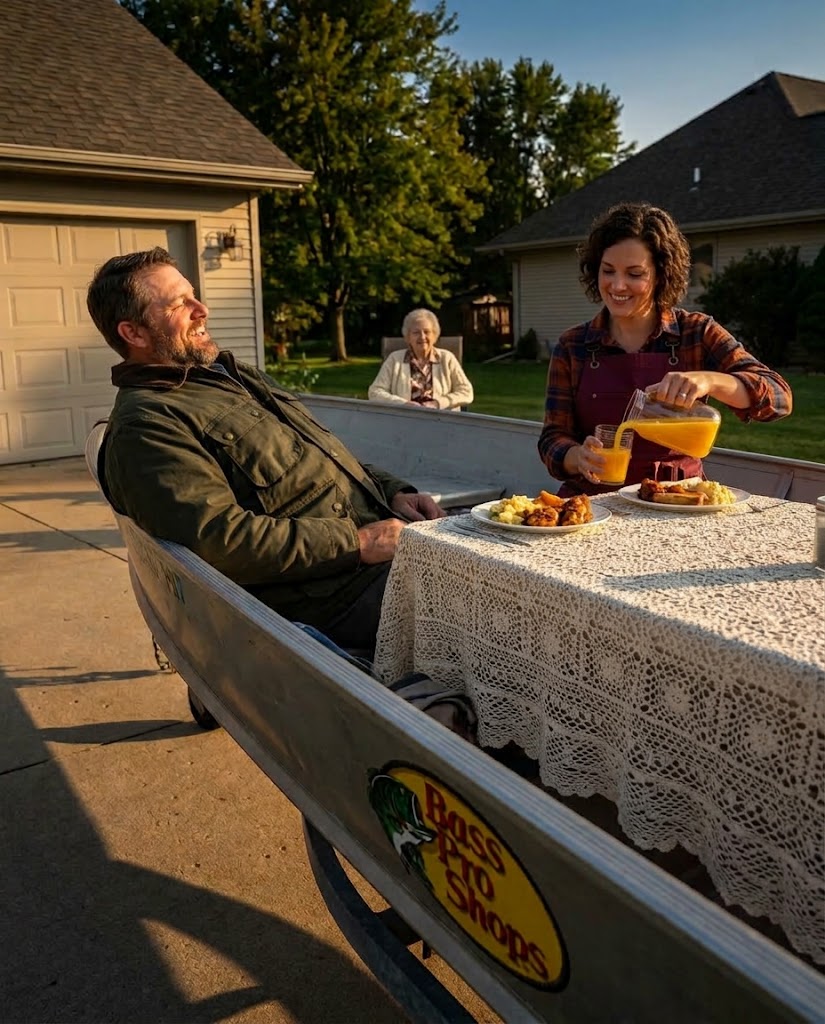
I served dinner in that boat again the following evening. This time I made meatloaf, baked potatoes, and green beans, then placed a small vanilla candle inside a Mason jar in the cup holder near the steering wheel. Across the street, our seventy-four-year-old neighbor, Marlys Henning, carried a folding lawn chair onto her porch and settled down with a cup of coffee to watch. She’d lived in her white ranch house longer than we’d been married and had an extraordinary ability to notice anything unusual on our block. Rick saw her sitting there and muttered that she was watching us. I told him she was watching the boat because it was a very attractive boat. By the third evening, Marlys was bringing her own supper outside, and the neighborhood had begun discussing our unusual dining arrangement. When I took her a slice of rhubarb pie, she asked how long I intended to continue. I told her I’d know when it was finished. That answer probably sounded mysterious, but it was the closest I could come to explaining what I was doing. I didn’t want to humiliate Rick for the sake of entertaining the neighbors, though I understood that our dinners had attracted attention. I wanted him to sit across from me each evening, surrounded by the thing he’d bought, and recognize what it represented. The boat itself wasn’t the problem. I knew he’d dreamed of owning one for years and had denied himself almost every personal luxury throughout our marriage. The problem was that he’d taken the money I’d spent six years saving for something we both needed and used it without telling me. He’d even gone to a different bank branch because he understood I’d object. That made his claim that the kitchen worked fine particularly painful. On the fourth night, two of Rick’s longtime fishing friends, Duane Becker and Lyle Ostrander, arrived after hearing about the dinners at the cooperative and the local gas station. I invited them to join us for chicken and noodles, bringing out extra plates while they perched on the boat’s casting decks with their meals balanced on their knees. Marlys watched from across the street, the Mason jar candle flickered beside the steering wheel, and the four of us ate as though dining in a bass boat in a driveway were an ordinary Iowa tradition. Duane said it was the best boat he’d ever eaten in, and Lyle asked for seconds. Rick laughed genuinely for the first time since bringing the boat home, then glanced across the makeshift table at me and grew quiet. When his friends left, he asked me to stay a moment. He explained that he’d turned fifty-five in March and recently received a letter outlining his projected pension benefits from the electric cooperative. The figures were reasonable, and retirement was financially possible with continued planning, but seeing thirty years of dangerous, exhausting work reduced to a few printed figures had unsettled him. He’d sat in his truck rereading the letter, thinking about the ice storms, missed holidays, and years spent climbing poles, and he’d suddenly felt frightened by how quickly his life seemed to be passing. He remembered the minibike his father sold and all the things he’d refused to buy because he believed he wasn’t supposed to want them. He began to wonder whether he might die without ever having something that was simply his. The boat represented that longing. When he found one for sale, he acted before he could reconsider. He admitted knowing exactly which account held the money and understanding that withdrawing it would deprive me of the kitchen renovation. He said he’d justified the decision by telling himself the old kitchen still functioned, though he knew perfectly well it needed replacing. Then he apologized. It was an apology I believed, but I couldn’t tell him everything was fine, because it wasn’t. I reached across the tablecloth and took his hand. We sat together until the candle went out, and the following evening I served supper in the boat again. Our son Tyler and his wife Amber arrived with brownies and a mixture of embarrassment and curiosity. Tyler worked at the grain elevator and lived with Amber in a rented house near the elementary school. He asked whether I wanted him to speak with his father, but I told him Rick was beginning to understand the situation and needed room to decide what to do. Amber climbed into the boat to eat casserole, while Tyler pulled a kitchen chair beside the hull and joined us from the driveway. On the sixth evening, Rick’s coworkers drove slowly past in two bucket trucks and a digger derrick, sounding their horns and shouting cheerful remarks about saving them a plate. Rick buried his face in his hands, his ears turning red, but he was grinning when he looked up. By then, people sometimes slowed their cars as they passed, and our supper had become an unlikely neighborhood event. My sister Deb telephoned from Marshalltown to ask whether I was trying to embarrass my husband. I told her I wasn’t interested in having a public argument. If I’d shouted at Rick, he’d probably have defended the purchase, and we’d have spent days repeating ourselves without understanding anything new. Instead, he was sitting in the boat every evening, looking at the thing he’d chosen and the wife who’d paid for it. On the seventh day, Duane visited while I was still working at the bank. I learned about their conversation only later. Rick was in the garage checking the trailer tire when Duane sat on an overturned bucket and told him that his late wife, Joanne, had wanted a new kitchen for twenty years. She’d kept a magazine photograph of white cabinets and blue tile inside one of their cupboards. Every spring Duane promised they’d renovate the room the following year, but some other expense always intervened: machinery repairs, a truck, or something for his fishing boat. Joanne died of cancer three winters earlier, having cooked on the old stove until she was too weak to stand. Duane admitted he’d saved the magazine picture in his wallet after her funeral. He didn’t lecture Rick or tell him what to do. He simply shared the regret he’d carried since losing his wife. That evening he came to dinner as usual, eating ham and scalloped potatoes in the boat while talking about baseball. Rick was unusually quiet. He kept looking across the tablecloth at me, and I could tell Duane’s story had reached a place my own silence hadn’t. On the eighth evening, a steady spring rain began falling just before supper. Rick suggested we eat indoors, but I brought out a large golf umbrella and a plastic tablecloth to protect my mother’s checked one. We sat beneath the umbrella eating beef stew while rainwater dripped from its edges and the candle went out almost immediately. Across the street, Marlys watched from beneath her porch roof, wrapped in a crocheted afghan. Rick made a joke about how closely she followed our lives, then put down his spoon and asked what I wanted him to do. It was the first time he’d asked that question directly. I told him I didn’t want him to act simply because I demanded it. His father had once taken away something he’d earned, and I had no wish to repeat that lesson. I wanted him to recognize the difference between enjoying something he’d worked for and taking something his partner had spent years building. The next evening would be Saturday, I told him, and I’d prepare our usual pot roast. Whatever he decided, I would set supper at six. Then we finished eating as the rain continued falling.
On the ninth evening, I prepared pot roast exactly as I had the first Saturday, arranging carrots and potatoes around the meat and stirring gravy over the temperamental burner. At ten minutes to six, I carried the checked tablecloth outside, spread it over the padded bench, lit the Mason jar candle, and set two places. Marlys was already sitting across the street with her coffee. Duane and Lyle had parked nearby, Tyler and Amber were approaching from the corner, and several curious neighbors had stopped along the road. Rick was nowhere in sight until the front door opened at six o’clock. He came down the steps wearing the light-blue button-down shirt he’d worn to Tyler’s wedding, freshly shaved and carrying a folded paper. Instead of climbing into the boat, he walked to the end of the driveway. A white pickup pulled up behind Duane’s truck, and a young man named Jeff stepped out holding an envelope. Rick announced that Jeff had come from Ames to buy the fishing boat. Then he asked me to stand beside him while he signed the title. He spread the ownership document on the hood of Jeff’s pickup, signed the transfer, and accepted a cashier’s check for $10,200. The boat had cost him $11,000, so he’d lost $800. He acknowledged the loss and said he’d make up the difference through overtime. Then he handed me the check. In front of our family and neighbors, Rick apologized for taking the kitchen savings without asking. He said I’d spent six years setting aside forty dollars at a time, and he’d used that money to prove to himself that he was still entitled to enjoy life. He understood now that he’d chosen his reassurance at my expense. The people standing nearby were silent until Marlys began clapping. Duane and Lyle joined her, followed by Amber and several neighbors. Tyler didn’t clap; he went to his father and embraced him. I was moved, though I also felt exposed by the attention. The apology mattered because Rick understood what he’d done, not because anyone had witnessed it. Before Jeff left with the boat, Rick asked whether we might eat one final supper in it. Jeff agreed and joined us, sitting on the rear deck with a plate of pot roast balanced on his knees. Afterward, Rick and Duane helped connect the trailer to Jeff’s pickup, checked the safety chains and lights, and watched the boat leave our driveway. The empty space looked strangely large. The next Monday, Rick took a week of vacation he’d been saving for deer season. He and Tyler began removing the old kitchen cabinets, and the contractor agreed to reduce the renovation quote by $1,000 because we were handling demolition ourselves. The dark brown cupboards came down one by one, exposing walls that hadn’t seen daylight since the house was built. Duane brought a trailer to haul the debris away, Lyle arrived with drinks, and Marlys positioned her lawn chair nearby to supervise in her own fashion. On Tuesday afternoon, Tyler removed the last upper cabinet, the one above the refrigerator that nobody ever used because it was so difficult to reach. He discovered an old red Folgers coffee can hidden inside and brought it to me. I’d put it there six years earlier, shortly after opening the kitchen account. I’d cut a slot in its plastic lid and begun dropping spare change and occasional dollar bills inside, imagining that someday I might open it and use the contents for new canisters or a rug in front of the sink. I had almost forgotten it existed. But when I lifted the can, it was unexpectedly heavy. I sat on the floor of our gutted kitchen, pulled off the lid, and found quarters and dimes layered above hundreds of folded twenty-dollar bills. Tyler helped me count them. There were 312 twenties, totaling $6,240, plus the coins. I looked toward the doorway, where Rick stood holding a pry bar. He explained that every Friday for six years he’d slipped a twenty-dollar bill into the coffee can, using overtime earnings and money he’d saved from his lunches. He’d never told me because he feared I’d insist we needed the money for something more urgent. He’d wanted me to open the can one day and discover a surprise contribution toward the kitchen. I stared at the stacks of folded bills spread across the gritty floor, struggling to understand how the same man could secretly save for my happiness and then spend our kitchen account on a boat without consulting me. Rick knelt beside me and apologized again, this time specifically for claiming the old kitchen worked well enough. I cried harder than I had on the day the boat appeared. The discovery didn’t make his decision right, but it showed me that his actions came from a complicated mixture of love, frustration, fear of growing older, and a lifetime of denying himself ordinary pleasures. He had been preparing a gift for me while also convincing himself he needed one of his own. With the $10,200 from the boat sale, the coffee can savings, the remaining account balance, and the contractor’s demolition discount, we had enough to complete the renovation and add something I’d never dared include in the original plan: a breakfast nook by the back window. The corner had always held a mop bucket and little else. The contractor agreed to build the space, and Rick asked whether he could construct the benches himself. He spent three weekends in the garage working with oak to match the new cabinets, while Duane offered help and Lyle provided unsolicited advice from an overturned bucket. The finished nook had two facing benches and a small table beneath the window. In early June, the light oak cabinetry was installed, the laminate counters replaced the old worn surfaces, and the new range was connected and tested. Every cabinet door closed properly. All four burners worked, including on low. The first time I made gravy, I stood at the stove watching it simmer gently without scorching and laughed aloud because I’d forgotten how pleasant ordinary cooking could be. That Saturday, I prepared pot roast and invited Marlys, Duane, Lyle, Tyler, and Amber to celebrate. We crowded around the breakfast nook, knees and elbows touching, while my mother’s red-and-white checked tablecloth covered the new oak table. Marlys sat down, ran her hand across the cushioned bench, and asked whether she recognized the blue vinyl. She was right. When Rick sold the boat, he’d asked Jeff whether he could keep the padded bench cushions between the two consoles, the place where we’d eaten our nine dinners. Jeff planned to replace them anyway, so he’d agreed. Rick cut the foam to size and stretched the same blue vinyl over the oak benches he’d built. He hadn’t mentioned it until Marlys recognized the material. When I explained, Rick was standing at the stove carving the roast, his ears turning red beneath his cooperative cap. He didn’t turn around, but I could see him smiling.
I still think about those nine suppers whenever I sit in our breakfast nook. The blue vinyl is comfortable, even after years of use, and my mother’s checked tablecloth looks as though it was always meant for the little oak table beneath the window. From there I can see Marlys’s front steps and the stretch of driveway where the green-and-silver fishing boat once stood. Sometimes I remember the first afternoon Rick brought it home, how the sun caught the metallic paint and how I stood frozen with milk and potatoes in my hands. I remember feeling that six years of quiet discipline had been dismissed in a single sentence about how the kitchen worked fine. It wasn’t simply the amount of money that upset me. We’d saved through repairs, family emergencies, and countless ordinary temptations to spend a little more than we could afford. Every Friday transfer represented a decision to wait for something we both knew would improve our home. Rick understood that history, which was why he chose to withdraw the funds from a branch where I wouldn’t see the transaction. The fact that he knew I’d object and acted anyway made it a breach of trust, not merely an impulsive purchase. We eventually talked about that part as carefully as we talked about the boat itself. A jointly held savings account gives both owners access to the funds, but having legal authority to make a withdrawal doesn’t automatically make every use of the money fair within a marriage. We agreed that large purchases would require a conversation beforehand and that savings designated for a shared project wouldn’t be redirected unilaterally. Those arrangements may sound unromantic, but after thirty-two years together, I know that trust is often maintained through practical decisions made when nobody is applauding. Rick also began speaking more openly about the fear he’d felt after receiving his pension statement. For years he’d worked dangerous shifts, climbed poles in freezing weather, and returned home too tired to enjoy much beyond a hot supper and a night’s sleep. Seeing his projected retirement benefits in print made him confront the possibility that he could spend his whole working life postponing happiness until it was too late. I understood that fear better once he explained it. I’d been so focused on saving for the kitchen that I hadn’t asked whether there was something he’d always wanted for himself. He’d been so accustomed to denying those desires that when he finally acted, he did it in the worst possible way. I wish he’d told me he wanted a boat before he found one for sale. Perhaps we could have created a separate savings plan or looked for a smaller used fishing boat we could afford. Perhaps we might have decided to postpone the kitchen briefly while saving for something that mattered to him. There were possibilities we never discussed because he assumed I’d say no and I assumed he would continue waiting without resentment. His father’s treatment of the minibike had taught him that wanting something invited disappointment, and he’d carried that lesson into middle age. I don’t excuse taking the kitchen money, but I no longer think the boat appeared simply because Rick was selfish. It came from a man who’d spent decades believing that personal pleasure had to be seized quickly before someone took it away. I also came to understand why Duane’s visit affected him so deeply. Joanne had wanted a new kitchen for twenty years, and Duane had postponed the work until there was no longer anyone to enjoy it. His regret wasn’t a warning that every remodeling project must take priority over every personal dream. It was a reminder that promises lose their meaning when we assume there will always be more time. Rick had spent years telling himself there would be time to enjoy a boat someday; Duane had spent years telling Joanne there would be time for a kitchen. Neither approach gave enough attention to the present. After the renovation, we began looking for smaller pleasures we could share without putting our financial stability at risk. Sometimes Rick went fishing with Duane and Lyle in Duane’s old aluminum boat, and occasionally he brought home a few fish for supper. He didn’t need to own an expensive bass boat to enjoy being on the water, though I knew he’d genuinely loved the one he bought. On warm evenings, we sometimes drove out to a lake, packed sandwiches, and sat near the shore for an hour before returning home. Those outings were modest, but they gave us time together away from the responsibilities that had occupied so much of our marriage. Rick kept working at the electric cooperative, though he began paying more attention to his retirement plans and the things he wanted to do when he no longer had to answer emergency calls during storms. We talked about the future with greater honesty, including how much money we needed to set aside and which experiences mattered most to each of us. I kept working at the bank, and I still transferred money into savings each Friday, though the account now held funds for household maintenance rather than a kitchen renovation. I check the balance because that’s what I’ve always done, but the number no longer represents a single deferred dream. It’s part of the practical foundation that allows us to make decisions together. Tyler and Amber visit regularly, and they’ve heard the story of the nine dinners more times than they’d probably like. Amber still laughs about climbing onto the boat with brownies, while Tyler remembers being worried enough to ask whether I needed him to intervene. I’m glad I told him his father and I had to resolve the problem ourselves. Adult children shouldn’t be forced to choose sides in their parents’ disagreements, even when those disagreements become neighborhood entertainment. Marlys, of course, remembers every evening in extraordinary detail. She insists the rainy supper beneath the golf umbrella was her favorite because she could see us sitting there from her porch while the candle went out and Rick tried to keep the stew dry. She also insists she was the first person to recognize the blue vinyl on our new benches, which is true. Whenever she comes for coffee, she runs her hand across the seat and asks whether I plan to serve dinner outdoors again. I tell her only if Rick brings home another boat without discussing it. He usually laughs and says he’s learned his lesson. Beneath the teasing, we’ve both become more aware of what those nine days revealed about our marriage. I was capable of making a point without shouting, but I also recognize that repeatedly dining in the driveway turned a private conflict into something our neighbors could witness. Rick endured the embarrassment and eventually chose to sell the boat publicly, but the real repair happened in the conversations afterward, when we stopped trying to defend ourselves and began listening. His apology mattered because he acknowledged the financial sacrifice I’d made and accepted responsibility for the money he’d spent. My apology for keeping the dinners going came with the knowledge that I wasn’t entirely sorry for choosing a method that finally got through to him. Marriage can contain contradictions like that. We can love someone, be deeply hurt by them, and still recognize the kindness they’ve shown in other moments. Discovering the folded twenties in the coffee can reminded me that Rick hadn’t been indifferent to my kitchen for six years. He’d been quietly contributing in a way he thought would surprise me, even while struggling with feelings he hadn’t known how to explain. I don’t hold up that secret generosity as an excuse for what he did with the savings account. Both choices belong to the same man, and understanding him means acknowledging both. The breakfast nook reflects that complicated truth better than anything else in our house. Its oak benches were built by Rick’s hands, using material from the boat that caused our argument. The table is small enough that our knees touch when we sit across from each other, and the window lets in the morning light while we drink coffee. I can prepare supper on a reliable range, close the cabinets without using my knee, and make gravy without standing over a burner turned permanently to high. Those improvements make everyday life easier, which was all I wanted when I began saving forty dollars a week. But I also enjoy seeing Rick settled on the blue vinyl bench with a fishing magazine or a cup of coffee, looking content rather than guilty. He still loves fishing, and I still love my kitchen. We have room for both in our lives now, even though we had to learn that the difficult way. Some Saturday evenings I make pot roast and spread my mother’s tablecloth across the breakfast nook table, remembering the first supper beside the boat and the nine evenings that followed. Rick usually carves the meat while I finish the gravy, and sometimes he glances toward the window where Marlys’s porch is visible. If she’s outside, he raises a hand and she waves back. Then he brings the roast to the table, sits down across from me, and asks whether there’s enough gravy. There always is. These days, it simmers perfectly on the lowest burner, and neither of us has to say anything about why that matters.

