
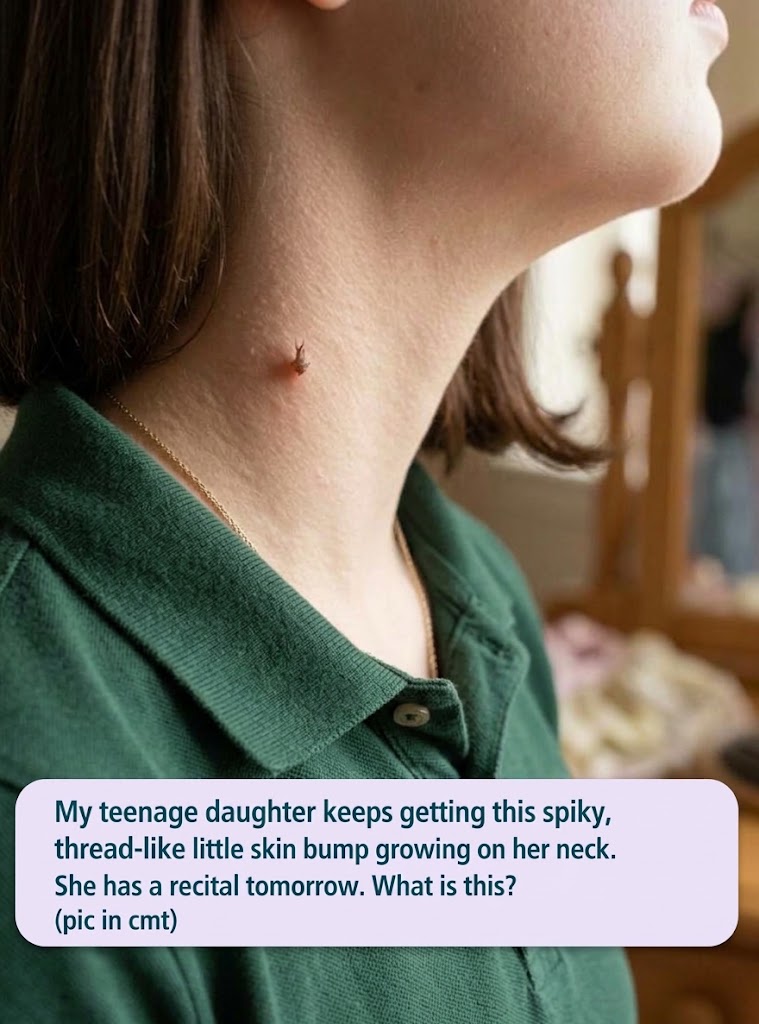
A small, unusual bump on the neck can quickly become a source of concern, particularly when it appears just days before an important family gathering or school performance. Unlike an ordinary pimple, the growth may look like a tiny thread or a narrow projection extending from the skin. Parents sometimes notice these changes while helping their teenagers prepare for an event, raising questions about whether the bump is harmless or requires medical attention. It may feel soft, appear slightly raised, or catch against clothing and jewelry. Although many small skin growths have common, non-serious explanations, their appearance alone cannot reveal exactly what they are. Understanding the possible causes is important, especially before attempting any treatment at home.
The situation becomes more confusing because several different skin conditions can produce remarkably similar bumps. Some develop in areas where clothing regularly rubs against the skin, while others may have an entirely different origin. A growth might remain unchanged for weeks or gradually become more noticeable. While the temptation to remove it quickly can be strong, especially before a special occasion, choosing the wrong treatment could irritate delicate skin. Dermatologists emphasize that identifying the growth should come before deciding how to handle it. And one particular type of skin condition explains why some of these bumps develop such an unusual, finger-like appearance.
One possible explanation is a filiform wart, a narrow, elongated skin growth associated with certain types of human papillomavirus (HPV). These warts frequently appear around the face and neck and may resemble tiny threads extending outward from the skin. HPV can enter through small breaks in the skin and may spread through direct contact or contaminated objects. However, not every thread-like bump is a wart. Another possibility is a skin tag, a generally harmless, soft growth commonly found where skin experiences friction. Unlike filiform warts, skin tags are not caused by HPV. Because other skin conditions can also look similar, a healthcare professional may need to examine the growth before confirming its identity. Cutting, twisting, pulling, or applying over-the-counter wart-removal acids can lead to bleeding, irritation, infection, or scarring, particularly on sensitive neck skin. Instead, gently clean the area with mild soap and water, avoid accessories that catch on the bump, and leave the growth undisturbed until it can be properly assessed.
Fortunately, many small neck growths do not require urgent removal, especially when they remain stable and cause no discomfort. However, a doctor or dermatologist should evaluate bumps that persist, repeatedly return, grow larger, or develop unusual changes. Increasing pain, unexplained bleeding, spreading redness, swelling, or drainage also warrant prompt medical advice. For teenagers preparing for a recital or other special event, reassurance can be just as important as proper skin care. Parents can explain that unfamiliar skin changes are common and that a professional examination can clarify whether treatment is necessary. There is usually no reason to make an upcoming performance depend on immediately removing a harmless-looking bump. The most important detail is that a thread-like growth cannot be reliably identified by appearance alone. Whether it turns out to be a filiform wart, a skin tag, or another condition, avoiding home removal and seeking an appropriate medical assessment is the safest approach.