
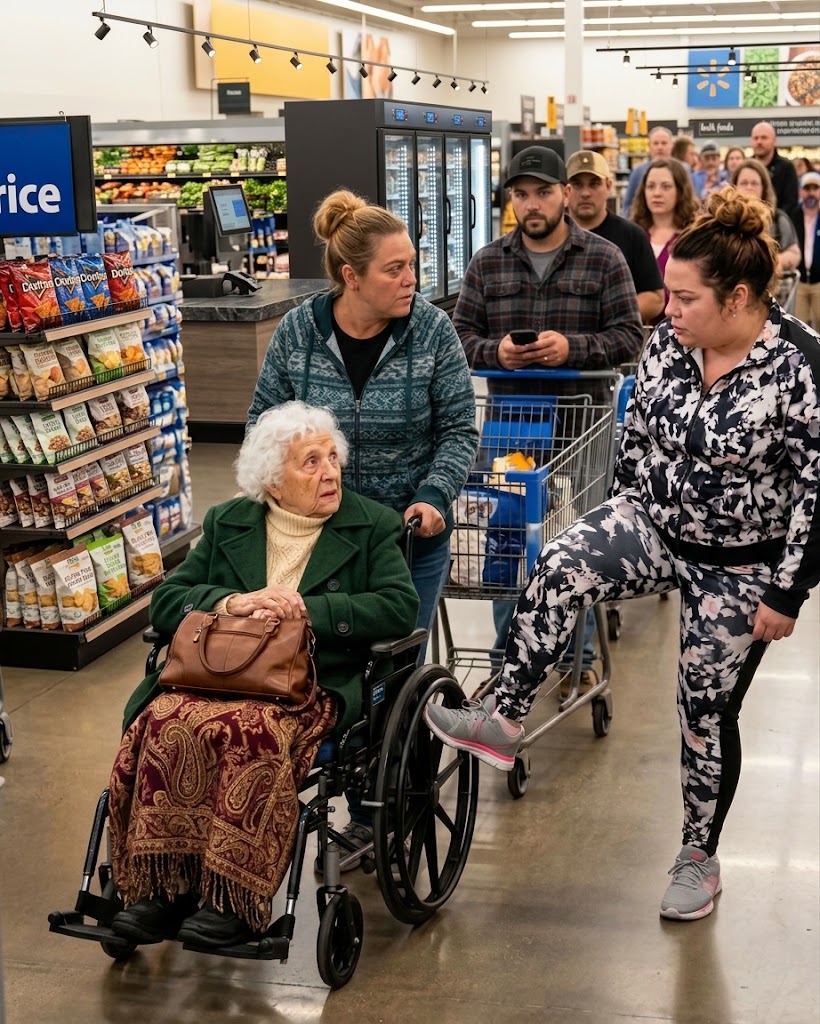
The sharp kick against my mother’s wheelchair sent its front wheels jolting, and for one terrifying second, I thought my 80-year-old mother might fall. A stranger had followed us through the department store, muttering that Mom was pretending to be disabled just to receive special treatment at the checkout. When I stepped between them and warned her not to touch my mother again, she folded her arms and demanded that Mom prove she could not walk. My mother had been unable to walk for six years, ever since a car accident changed her life, but that day she had come for one simple reason: to choose a birthday present for my daughter, Mia, who was turning 12. While the security guard tried to calm the confrontation, Mom quietly reached into her cardigan and pulled out a worn brown leather case containing her medical information. A faded concert program slipped from behind an identification card, and the moment I spotted Mia’s name circled in purple, I realized it was from the school concert she had missed six years earlier.
I picked up the paper and noticed several handwritten lines on the back, but before I could read them, the woman suddenly turned pale and pointed toward a man near the store entrance. Security noticed what appeared to be a concealed weapon beneath his shirt, and moments later, employees began locking the doors as customers scrambled for cover. I tried pushing Mom toward what I thought was the nearest exit, but she stopped me, insisting that we follow an employee guiding shoppers through a safer passage. Once police secured the area and confirmed the man had been arrested, I finally unfolded the concert program. Mom had written that she never got to hear Mia sing that day, but later, during her hospital recovery, my daughter had visited and performed the entire song beside her bed. Then I confessed something I had carried for six years: I had pressured Mom to attend the concert despite her exhaustion, and I blamed myself for the accident that followed.
Mom listened before gently explaining that although the crash had changed her life, I had not caused the other driver to run the red light. She admitted missing her garden and the freedom of walking, but she also treasured the life she still had. The concert program reminded her that losing something did not mean losing everything. She also told me that grabbing her wheelchair without asking, as I had done during the emergency, sometimes made her feel powerless. Her words helped me understand that protecting someone should not mean taking away their choices. Outside the store, she decided she still wanted to buy Mia a birthday present, and I asked whether she wanted me to push her chair. “Not yet,” she replied, turning toward a music shop across the street.
As we moved together toward the crossing, I walked beside Mom instead of deciding where she should go. The frightening encounter had begun with a stranger judging her disability, but it ended with me recognizing how much I had misunderstood my own mother. For six years, I had remembered the accident, the hospital, and everything she could no longer do, while overlooking the joy she had found afterward. Mia’s little concert program had preserved a moment of love that fear nearly erased from my memory. At the traffic light, Mom moved forward when it was safe, and I stayed at her side. For the first time in years, I remembered not the crash, but the sound of my daughter singing beside her grandmother’s hospital bed.