
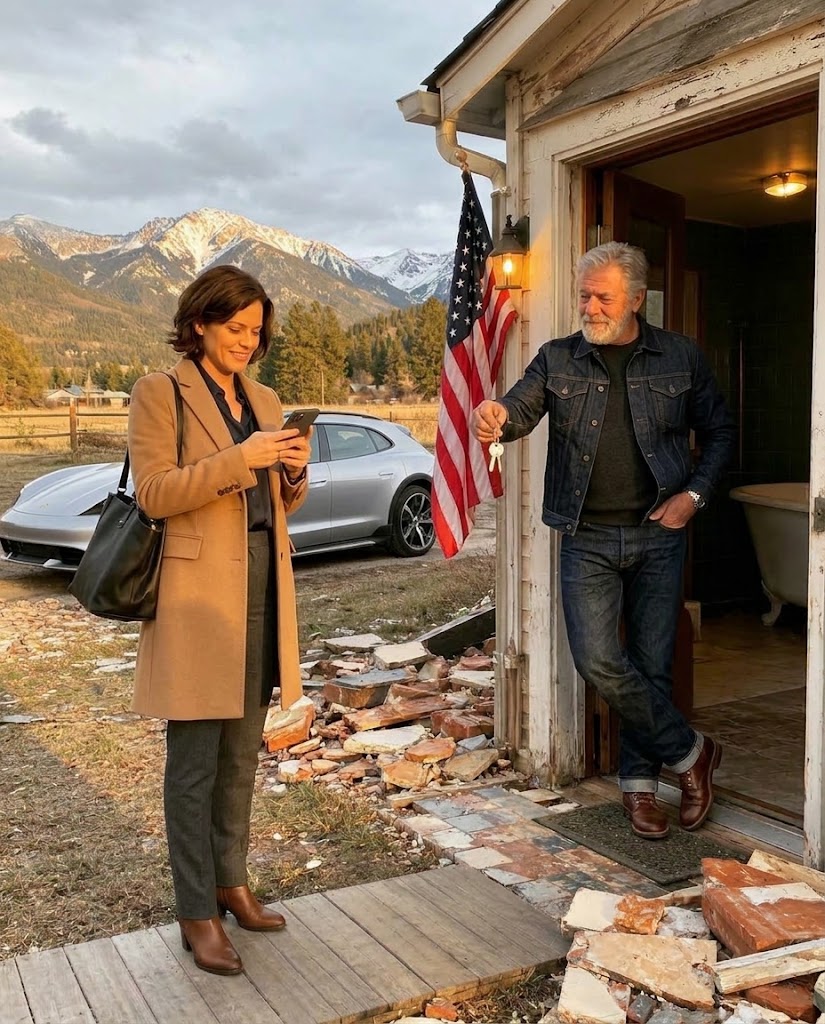
“I’ve decided this place should be Haley’s new home,” my father announced as I stepped out of my car after a four-hour drive into the mountains. The scent of pine hung in the cool air, but my attention was fixed on the construction debris scattered across the porch of the cabin I’d bought with my own money three years earlier. Inside, a fine layer of white dust coated the walnut floors, and the bathroom’s natural stone tiles had been replaced with glossy marble and a bathtub standing on gold claw feet. My quiet bedroom, once painted in warm earth tones, now wore pink damask wallpaper and a Hollywood-style vanity that looked suspiciously like my younger sister’s taste. Dad explained that he’d used the emergency key I’d given Mom and hired contractors because he wanted to surprise Haley with a fresh start. When I asked why nobody had consulted the woman whose name was on the deed, he looked genuinely offended. I found the construction company’s number on a permit, identified myself as the property owner, and instructed its representative to suspend all work pending verification of the contract and authorization. Dad called me selfish, but as I drove away, I realized he’d unknowingly forced me to confront a secret I’d been keeping for eight years: the houses my family considered their own actually belonged to me.
My name is Emma Parker, and at thirty-eight, I’d spent much of my adult life becoming financially independent from a family that had always regarded my success as something everyone should share. At twenty-six, I started a consulting business with two clients and a secondhand laptop. Over time, it grew into Clearwater Holdings, an investment and property-management company whose financial position I kept largely private. My father, Daniel Parker, knew I was successful, but he had little understanding of what I’d built. Neither did my mother, my brother Lucas, or my younger sister Haley. I preferred it that way because I’d grown up watching Dad turn nearly every family conversation about money into a calculation of who could provide what. Eight years earlier, his aggressive real estate investments had collapsed under debt. Several heavily leveraged properties were approaching foreclosure, including our family home in the New York suburbs, Lucas’s house in Connecticut, and Haley’s Manhattan condominium. Mom called me in tears, frightened that everyone would lose their homes. I couldn’t bear to watch that happen, but I also knew that handing Dad a large sum of money wouldn’t address the decisions that had created the crisis. I consulted Jordan Reed, the attorney who had worked with me since my company’s early days. Together, we developed a plan for Clearwater Holdings to acquire the affected properties through properly documented transactions, settle the outstanding secured debts, and lease the homes back to their occupants at modest rates. Jordan served as the company’s registered agent, and the ownership records identified Clearwater rather than me personally. My family understood that an investor group had purchased the properties and agreed to favorable rental terms. What they didn’t know was that I controlled the company behind those purchases. I also sent Dad a fixed monthly contribution toward family living expenses, approximately equal to what the household paid in rent. In practice, I was quietly subsidizing their housing while Clearwater absorbed property maintenance, insurance, and other ownership costs. I told myself the arrangement would give everyone time to rebuild their savings and establish healthier financial habits. Eight years passed. My family continued living in the same houses, paying far below market rates, and rarely questioning how fortunate the arrangement had been. The more comfortable they became, the less they seemed to recognize that someone else was carrying the financial burden. I didn’t ask for gratitude, and I certainly didn’t want the family home to become a monument to my generosity. But their expectations continued expanding. Lucas wanted help with renovations, Haley complained that her condominium was too small, and Dad frequently spoke as though the family’s properties could be reassigned according to whoever needed them most. Three years earlier, I had purchased a mountain cabin separately from Clearwater. Its quiet rooms, pine floors, and windows overlooking the aspens offered a refuge from the demands of my work and family. I furnished it slowly, choosing every detail because it pleased me rather than anyone else. The only key I’d shared was meant for genuine emergencies. When Dad used that key to redesign the place for Haley without consulting me, I finally understood how far the family’s assumptions had spread. They didn’t merely believe I should help when someone needed something. They had come to believe that anything I possessed was available for them to decide how to use.
Three days after discovering the unauthorized renovations, I sat across from Jordan in my New York office with a stack of property records between us. We reviewed the deeds, lease agreements, payment histories, and my family’s rights as tenants, along with the contractor’s authorization and the changes already made to the cabin. Jordan explained that ownership gave Clearwater legal rights, but it did not mean I could simply remove people from their homes without observing the lease terms, applicable notice periods, and eviction procedures. I asked him to prepare the lawful notices and options for ending the subsidized arrangements, including adequate time for each household to find other accommodation. I also arranged for the cabin’s original finishes to be restored after the contractors documented the alterations and clarified who had authorized and paid for the work. When the notices arrived, my mother called in distress, asking whether the investor group was selling the homes. I told her I was involved and asked everyone to meet at the family house on Sunday afternoon. Dad greeted me from beside the fireplace, arms folded, while Lucas paced near the window and Haley sat with her husband looking furious. I placed copies of three deeds on the coffee table. Each identified Clearwater Holdings as the owner. Then I explained that the company belonged to me and had held title to their homes for eight years. Lucas stared at the papers before asking whether I had been the mysterious investor all along. I said yes. Dad demanded to know why I’d kept it secret. I told him that when his investments failed, I had wanted to protect the family without creating another cycle of reckless borrowing and unconditional rescue. I explained how the acquisitions had settled the immediate debt crisis and how my contributions had offset much of their rental expenses. Haley accused me of deceiving everyone and using my financial position to control them. I acknowledged that concealing my role had created its own problems, but reminded her that none of them had been forced to sign the original agreements and that they’d enjoyed years of substantial housing assistance. Dad insisted that the family home belonged to the Parkers because it had always been theirs. I pointed to the deed and told him that sentimental attachment didn’t cancel a completed property sale. He then reminded me that he’d paid for my education and taught me about business, as though that entitled him to control the results of my work. I said I appreciated what he’d done for me as a child, but it didn’t authorize him to assign my private cabin to someone else. Haley asked where she was supposed to live if the arrangement ended. I told her we would follow the applicable notice and tenancy requirements, and that I was willing to discuss reasonable transition arrangements, but the open-ended subsidy was over. Lucas called the entire plan a scheme to keep everyone dependent. His accusation hurt because there was a part of it I had to consider. I’d intended to create security, but by hiding my role and quietly paying the bills, I had also allowed the family to avoid confronting how much support they needed. Dad, however, had taken that security for granted and treated my cabin as though it were another resource he could distribute. I left the meeting knowing our relationships might never fully recover. Forty-eight hours later, Haley posted a photograph of Mom crying, accompanied by a social-media account of a wealthy sister forcing her family from their homes. Strangers accused me of cruelty without knowing about the eight years of subsidized housing. Jordan advised me to be careful about disclosing private financial records, and we prepared a factual response that explained the ownership structure and the history of the assistance without publishing sensitive tenant information. I stated that Clearwater had purchased the homes when the family faced foreclosure, that the occupants had benefited from below-market arrangements, and that the decision to end those arrangements followed Dad’s unauthorized use of my private property. I also made clear that the transition would proceed through lawful notice and housing procedures, not sudden lockouts. Public reaction gradually shifted as people learned more of the circumstances, but I took little satisfaction in it. The dispute was no longer about who could win an argument online. It was about whether our family could build relationships that existed independently of the money I provided.
The following months were difficult for everyone. My parents moved into a smaller apartment on the outskirts of town after their tenancy ended through the agreed legal process. Lucas found housing he could afford on his actual income, though the adjustment required him to reconsider expenses he’d previously treated as manageable. Haley and her husband relocated from Manhattan to a quieter suburban neighborhood, where their children adapted more easily than the adults. I knew the moves were painful, particularly for Mom and Dad, who had lived for years in a home filled with family history. There were mornings when I wondered whether I’d taken the right approach. I hadn’t created my family’s original financial problems, but I had chosen the structure that protected them from the full cost of those problems, and I couldn’t pretend my secrecy had been harmless. For eight years, I’d allowed everyone to believe an anonymous investor was giving them extraordinarily favorable terms. Perhaps if I’d spoken openly about the help sooner, we could have established a realistic timeline for financial independence before resentment became unavoidable. Yet I also remembered Dad standing on my cabin porch, explaining that he’d decided to give my home to Haley. I couldn’t return to the arrangement that had made such a decision seem reasonable to him. With Jordan’s help, I closed out the old leases, reconciled accounts, addressed the outstanding property obligations, and reviewed Clearwater’s holdings for their long-term financial viability. Some properties could be retained as rentals under conventional agreements; others could be sold or repositioned according to the company’s investment strategy. I kept those decisions separate from my emotions about the family dispute. Haley’s social-media campaign eventually faded, although the damage to our relationships remained. Lucas struggled after the publicity affected his work situation, then found another position several months later. I was sorry he had experienced that, even though I wasn’t prepared to resume financing his household. Mom didn’t contact me for four months. In the fifth month, she called and asked whether we could have lunch near my office. We met at a quiet restaurant, and for two hours she told me about the apartment, the neighbors, and the routine she and Dad were building. She didn’t deliver a dramatic apology. Instead, she asked about my company—what I actually did, how many people worked with me, and what had made me want to start it. For years, conversations about my work had quickly turned toward what I could afford to contribute to someone else’s plans. That afternoon, she seemed interested in the work itself. Three weeks later, Dad called. He talked about his new neighborhood for a while before admitting that he’d never understood what I’d done when his investments failed. He had thought the investor group was an unexpected stroke of good fortune. Now he knew that I’d organized the purchases, accepted the financial risk, and maintained the arrangement for years. He stopped short of saying he was sorry for the cabin, and I didn’t pretend that his acknowledgment settled everything. Still, I could hear a difference in his voice. For the first time, he spoke to me not as the daughter who was supposed to solve a problem but as the person who had already solved more than he realized. A month later, I returned alone to the mountain cabin. The unauthorized marble, gold fixtures, and pink wallpaper had been removed, and the rooms had been restored to the finishes I’d originally selected. The natural stone bathroom caught the morning light, the wooden vanity smelled faintly of cedar, and my leather armchair was back beside the bedroom window. The restoration had been expensive and inconvenient, but walking through the rooms felt like recovering something I’d been afraid to lose. I made coffee slowly and sat looking toward the aspens, whose new spring leaves were just beginning to appear. I thought about the family homes, the years of hidden assistance, and the uncomfortable conversations we’d finally begun having. The arrangement I’d created had been financially effective for a time, but it had also allowed difficult truths to remain unspoken. Ending it had forced all of us to reconsider what we expected from one another.
I don’t know whether my family will ever return to the easy closeness I once hoped we had. Mom calls occasionally now, sometimes just to ask how my week has been. Dad is learning to speak about money without assuming someone else will provide it. Lucas and Haley remain more distant, and I try not to interpret every quiet month as a permanent ending. I still love them, even though I no longer manage their housing or cushion their financial decisions. Looking back, I can see that buying the properties eight years earlier was both generous and imperfect. I wanted to protect people I loved, but I also wanted to avoid the painful conversations that might have changed how we related to one another. A company could acquire deeds, service debts, and administer leases; it couldn’t make my father respect a boundary or make my siblings see me as anything other than the successful one. Those were matters we would have to address ourselves. At the cabin, I no longer keep an emergency key with my parents. I arranged appropriate property access and security through people whose responsibilities are clearly defined, and I make the decisions about repairs and renovations. One Thursday morning, I opened the windows, carried my coffee to the armchair, and watched pale sunlight move across the floorboards. No one was asking for money, proposing changes, or telling me how another relative might benefit from the space. I opened a book and read until the coffee went cold. The family relationships were still unfinished, but the house around me was quiet, familiar, and mine.