
“I sold it.”
My son said it leaning against my kitchen counter with his arms folded, the way you’d mention you’d thrown out an old lawn chair.
“You sold what?”
“The RV, Dad.”
I looked out of the kitchen window. The driveway was empty. Three days earlier my motor home had been sitting there washed, fuelled and ready for the first real trip of my retirement.
Now there was a clean rectangle of concrete.
“I was leaving Monday.”
Jason shrugged. “You can buy another one someday.”
“With what?”
He looked away. His wife, Britney, stepped forward — still wearing her big sunglasses inside my house.
“I’ve wanted cosmetic surgery for years. The RV was just sitting there.”
“It was my property.”
“We needed twenty thousand dollars,” Jason said.
“No,” I said. “You wanted twenty thousand dollars.”
Neither of them answered.
My name is Frank Dawson. I’m sixty-eight, a retired Navy Chief Petty Officer out of Norfolk, Virginia. For thirty-two years the Navy decided where I slept, where I sailed and how many Christmas mornings I missed.
When my wife Emily died of breast cancer, I worked five more years, because retiring meant going home to a silent house.
When I finally did leave, I made one promise. I would see America. Not from a ship. Not through an airport window. I’d drive it.
Route 66. Yellowstone. The Grand Canyon. The Pacific Coast Highway. The Blue Ridge Parkway. Every place Emily and I had circled in travel magazines for thirty years and said one day.
Retirement came. Emily didn’t.
For almost ten years I put every spare dollar into an account called RV Fund. Same pickup. Meals at home. No vacations.
Then I bought a twenty-year-old Class C. Faded paint. A generator that needed two tries on a cold morning. It smelled of cedar and coffee and road dust.
I thought it was perfect.
Six months I spent on it. Tyres, brakes, solar panels, a decent mattress. Emily’s quilt went on the bed. Her old coffee maker fit in the cabinet above the sink. Our wedding photo went over the little table.
Some evenings I’d sit behind the wheel for an hour and go nowhere. Just imagining Emily in the passenger seat telling me I was driving too fast.
Then I trusted my son.
I went to my Navy reunion in Richmond for three days and gave Jason my spare key. “Keep an eye on the place.” “No problem, Dad.”
When I came back on Sunday, the RV was gone. Nothing else had been touched. The TV was there. The tools were there. Emily’s photos were on the walls.
Only my dream was missing.
“You weren’t using it,” Jason said.
“I was gone three days.”
“Life goes on, Dad.”
Britney said they were late, and they left.
I sat in the garage until dark with the notebook of every receipt and every part, and Emily’s photo on the workbench.
“I finally bought it,” I told her. “And now it’s gone.”
The insurance company said that because Jason had a key and had found the title, it might not be simple theft. The police said I might need a lawyer.
At 8:17 that night my phone rang. Tidewater RV Exchange.
“Mr. Dawson, my name’s Daniel, I’m the sales manager. We have your motor home.”
“I didn’t authorise any sale.”
A pause. “I’m starting to understand that. Sir — during our inspection we found something hidden inside. Under the dining booth. There’s a compartment behind a panel.”
I had rebuilt half that RV with my own hands. There was no compartment.
“What’s in it?”
“I’d rather not say on the phone. One of the items has your name on it. It’s an envelope.”
“Who wrote it?”
“I don’t know, sir. But I think you might. You need to come here now.”
I don’t remember the drive. When I got there the showroom lights were dimmed. Daniel took me through a side door into the service bay.
There she was under the fluorescent lights. Faded blue. Emily’s ceramic hummingbird still hanging by the driver’s window.
I put my hand on the door. “I thought I’d lost you.”
An older mechanic came over. “You restore this yourself? You did good work. We nearly missed it.”
He lifted the dining booth cushion. Underneath was a wooden panel that blended perfectly into the floor. Two screws. Behind it, a narrow steel box.
“I’ve never seen that before in my life.”
“There was a key beside it but the lock had jammed. We opened it.”
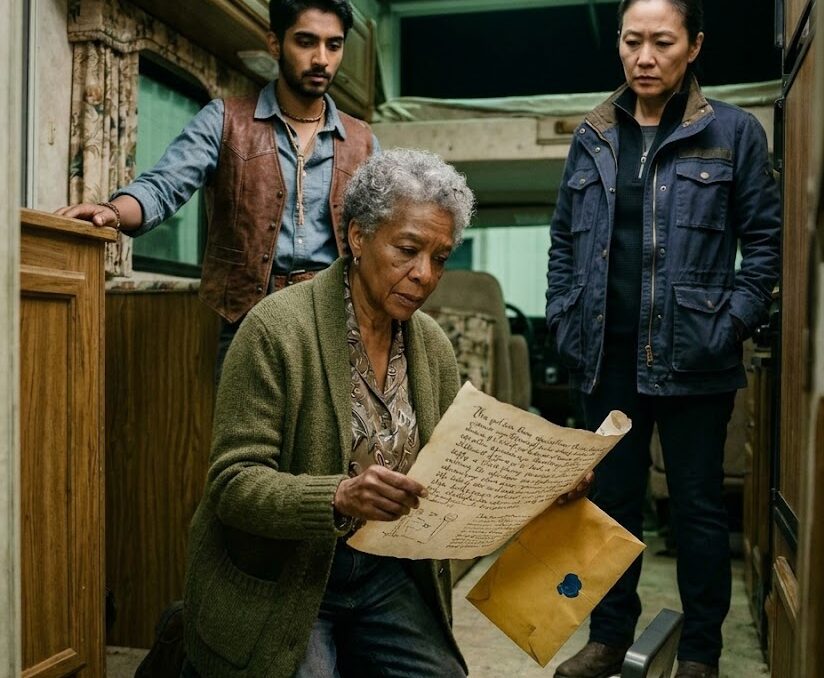
Daniel lifted the lid. Black-and-white photographs. An old Navy challenge coin. A leather journal. A faded road atlas. And a thick envelope sealed with blue wax.
I knew the handwriting before I touched it.
Emily’s.
Frank.
And underneath: For our trip, when you’re finally ready.
My hands were shaking. Daniel put his hand on my arm.
“Before you open that, there’s something else.”
He opened a folder on the bench. The sale papers Jason had brought in.
“The sale hasn’t gone through. There’s a problem with the title. The registered owner is Frank Dawson.”
“That’s me.”
“We know. But your son signed your name.”
I looked at the signature. It was a decent copy. He’d practised.
“We wired him twenty thousand this morning,” Daniel said quietly. “We’d already got a buyer lined up — a retired couple from Chesapeake, they put a deposit down this afternoon. When our title clerk ran it, the signature didn’t match the one on file at the DMV. A forged title is a felony in Virginia, Mr. Dawson. We’re required to report it. Our lawyer’s coming, the buyer’s coming to get her deposit back, and the police are on the way to take your statement.”
“And if I say I signed it?”
He looked at me for a long moment. “Then you’d be lying to the police. And the RV goes to Chesapeake.”
I sat down in the dining booth with Emily’s envelope in my lap.
And I opened it before anybody arrived. I needed her first.
Frank,
If you’re reading this, you finally did it. I knew you would. I also knew you’d wait far too long.
Then she told me how that box got there.
During her last round of chemo, the woman in the next chair was a lady called Ruth Kessler. Ruth’s husband, Walt, sat with her every week, and every week he talked about the old blue Class C in his driveway that they’d never use again.
Emily asked him to hold it. For me. For however long it took.
Don’t give it to him, she wrote that she’d told Walt. He won’t take it. Sell it to him cheap, and let him think he found it himself. Watch the base newsletter. When you see his retirement notice, put an ad on the same board.
Walt did it. Five years after she died. I remembered thinking the price was too good, and Walt saying he just wanted it to go to a Navy man.
Emily had climbed into that RV, sick as she was, and Walt had built the compartment under the booth because she wanted it to be the one place I’d sit every single day.
The photographs were from our honeymoon. The coin was from my first ship — I thought I’d lost it in 1989. The atlas had every place we’d circled marked in her pen. The journal had a page for each one. What she wanted me to eat there. What she wanted me to look at. Where she wanted me to stop and talk to her.
The last line of the letter said:
And be patient with Jason. He’s going to make a big mistake one day. Let him pay for it. Then let him back in.
The police arrived twenty minutes later. I told them the truth. I didn’t sign it.
Jason was charged the next week. Britney’s surgery hadn’t happened yet — the deposit came back. The rest Jason had to find himself. Every dollar went back to the dealership and to the couple from Chesapeake.
When the prosecutor asked me what I wanted, I said restitution and probation. Not prison. Emily asked me to let him pay for it. She didn’t ask me to bury him.
He came to the house the morning I finally left. Not with Britney. On his own.
He didn’t say much. He said sorry three times and looked at the ground.
I tore a page out of his mother’s journal — the Blue Ridge Parkway, the last one on the list — and gave it to him.
“I’ll be there in about four months,” I said. “If you want to come, come. Your mother has an opinion about where we eat.”
Then I got in, and I drove away, a little too fast.
He was there, by the way. In the parking lot at Mabry Mill, four months later, on his own.
He said I was driving too fast too.