
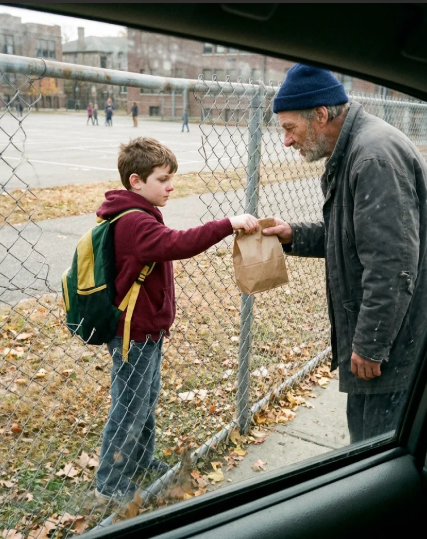
The school nurse called on a Wednesday. “Mrs. Lowell, this isn’t an emergency. But Eli has come to my office hungry every afternoon for almost a month. He says his stomach hurts. I asked what he had for lunch, and he said nothing.”
I pack my son’s lunch every morning. A turkey sandwich, an apple, crackers, a juice box. I watch him put it in his backpack.
That night, I sat on the edge of his bed. “Buddy, where’s your lunch going?”
Eli is eight. He has never been good at lying. His ears turn red.
“I give it to Mr. Ray. The man behind the fence. He looks hungry, Mom.” He picked at his blanket. “And he knows your name.”
The Man Behind the Fence
Every parent knows the cold that goes through you in a moment like that.
I called the principal at seven the next morning. She was alarmed too. They’d seen a man on the sidewalk outside the playground fence a few times, she said, but he’d never come onto school property, never spoken to staff. A counselor had already been planning to call me.
I didn’t wait for a meeting. At 7:50 a.m., I parked across the street from Lincoln Elementary and watched.
Eli walked straight to the far corner of the chain-link fence. A thin man in a worn brown coat was standing on the sidewalk on the other side. Gray beard. Sixty-something. Eli pushed the paper bag through a gap in the fence. The man didn’t grab it. He took it slowly, then put his fingers flat against the fence where Eli’s hand had been, just for a second.
Then the bell rang, Eli ran inside, and the man just stood there watching the door close.
“I’m Not Here to Hurt Him”
I was out of the car before I knew it. “Hey! Who are you? Why are you taking food from my son?”
He didn’t run. He didn’t argue. He held the lunch bag out to me with both hands, unopened.
“I never eat it,” he said quietly. “I tried to tell him to stop. He wouldn’t listen. He’s stubborn.” Something almost like a smile. “Like you were.”
“How do you know anything about me?”
“I’m not here to hurt him, Megan. I’ll go. I promise you’ll never see me again. I just needed to see him once. And then once turned into a month.” His voice broke. “You have your mother’s laugh. I heard it once at the pickup line. I had to sit down on the curb.”
My mother told me my father died in a car accident when I was three. There were no photos of him in our house. She didn’t like talking about it, so I stopped asking around the age of ten.
The man reached into his coat pocket. He pulled out something small and yellowed and pressed flat in a plastic sleeve.
It was a tiny hospital bracelet. The kind they put on newborns. The faded ink said: GIRL — LOWELL — 03/14/1990.
My birthday.
Ray
“I cut that off your ankle myself,” he said. “The nurse let me. I was the first person who ever held you.”
His name is Ray Lowell. He is my father. He did not die in a car accident in 1993.
We sat in my car for two hours. He told me everything, and he didn’t make himself sound better than he was.
He drank. Badly. The night my mother left, he’d driven drunk with me in the back seat and put the car in a ditch. Nobody was hurt, but my mother packed one suitcase, took me, and moved two states away. She told him if he ever came near me, she’d tell me he was dead. Then she just told me he was dead.
“She was right to leave,” he said. “I’d have done the same.”
He got sober in 2004. He’s been sober twenty-two years. He works nights as a hospital janitor and rents a room above a hardware store. For years he thought about finding me and decided he didn’t have the right. Then, last month, a former neighbor of my mother’s shared a photo on Facebook. Eli’s first day of third grade, holding a sign, standing in front of Lincoln Elementary.
“I just wanted to see if he was real,” Ray said. “I told myself one time. I never meant for him to notice me. He walked right up to the fence the second day and asked if I was hungry. I said no. He didn’t believe me.”
“How does he know you know my name?”
Ray looked ashamed. “He told me his mom’s name was Megan. And I said, ‘I know.’ I shouldn’t have. It just came out.”
The Box in My Mother’s Closet
That weekend, I drove to my mother’s house. I didn’t yell. I just put the hospital bracelet on her kitchen table.
She stared at it for a long time. Then she went to her closet and came back with a shoe box. Inside were twenty-two birthday cards, every one addressed to me, every one postmarked March. Each had a sobriety chip taped inside. One year. Two years. Ten years. Twenty.
“I was so scared,” my mother whispered. “Every year I thought, if I open the door even a crack, he’ll come back the way he was. And then every year it was too late to tell you the truth.”
I’m still working on forgiving her. But I understand her more than I thought I would.
Two Lunches
We went slowly. A family counselor. Supervised visits. Coffee first, then a park, then dinner. Ray never once pushed. He never once asked for anything.
The first time he came to our house, Eli opened the door, looked up at him, and said, “I knew you were nice.”
Ray gave him his twenty-year sobriety chip. Eli keeps it in a little box next to his bed and tells everyone it’s a “grandpa medal.”
These days, Eli packs his own lunch. And every Sunday, he packs a second one for Grandpa Ray, who eats it at our kitchen table instead of on the other side of a fence.