
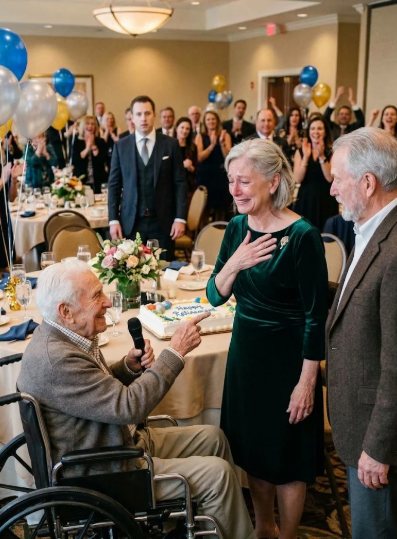
After thirty-five years at Harmon Valve & Pump, my husband Bill was finally retiring. The company rented the ballroom at the Marriott, ordered a sheet cake with a picture of a wrench on it, and invited two hundred people.
I wore my good blue dress and sat at the front table, proud of him. Bill had started on the factory floor at twenty-three and retired as head of plant operations. He’d earned every bit of that night.
The CEO, Trent Harmon, gave the speech. He was forty-four, the founder’s grandson, with a tan in February and a watch that cost more than our first house.
“The lucky housewife”
Trent’s speech was fine for three minutes. Bill’s loyalty. Bill’s work ethic. The night Bill slept at the plant during the 2011 flood.
Then he pointed at me.
“And of course we have to thank Joan,” he said, grinning. “The luckiest housewife in Ohio. Thirty-five years of Bill’s paychecks and never had to work a day in her life! Joan, what are you going to do now that he’s home all day? Learn to cook?”
The room laughed. Not everyone. But enough.
Bill’s jaw went tight. He started to stand up. I put my hand on his knee and shook my head.
I’d been called worse. And it was Bill’s night, not mine.
What Trent didn’t know — what almost nobody in that room knew — was that before I married Bill, before our three kids, I had worked at Harmon Valve & Pump. Not on the line. In the back office with a drafting table, a pencil, and the man who founded the company.
I had never told Bill’s coworkers. It didn’t seem important anymore.
The wheelchair
Trent was still chuckling at his own joke when a nurse wheeled an old man in from the side door.
Arthur Harmon. Ninety-four. The founder. He hadn’t come to a company event in six years.
The room went quiet. Trent hurried over, surprised. “Grandpa! We didn’t think you were well enough to—”
Arthur held out a trembling hand for the microphone. Trent gave it to him.
The old man didn’t look at Bill. He didn’t look at his grandson. He looked straight across the ballroom at me.
“Joan Kowalski,” he said, using my maiden name. “I’ve waited forty-five years to do this properly.”
Bill turned and stared at me. “Joan… what is he talking about?”
What did the founder know about me — and why did his grandson go pale?
The HV-7
“In 1979,” Arthur said, his voice thin but steady, “this company was four months from bankruptcy. We had one product and it was failing. I had eleven employees and a second mortgage.”
He pointed a shaking finger at me.
“And I had a twenty-two-year-old draftswoman from Toledo who stayed after work every night for six weeks redesigning our pressure valve on her own time. She brought me the drawings on a Friday. By Monday I knew she’d saved us.”
The HV-7 relief valve. Every person in that room knew the name. It was still the company’s best-selling product. Its silhouette was on the company logo on the cake.
“The patent has my name on it,” Arthur said. “Not hers. In 1980, the bank told me investors wouldn’t trust a valve designed by a young woman. I let them talk me into it. Joan never complained. She left the next year to marry a young man from the factory floor named Bill and raise their children. I’ve carried that for forty-five years.”
You could have heard a pin drop on that ballroom carpet.
“Never worked a day”
Arthur turned his wheelchair slightly, toward his grandson.
“Trent, you just told two hundred people this woman never worked a day in her life. Every paycheck in this room — including yours — exists because of the work she did before you were born.”
Trent’s tan had gone gray. He mumbled something about a joke.
“It wasn’t funny the first time,” Arthur said. “And it’s not funny now.”
Then he made two announcements. The company’s new engineering center, breaking ground that spring, would be named the Joan Kowalski Design Center. And he had already filed paperwork with his attorneys to formally recognize me as co-inventor of the HV-7 in the company’s history and in every product brochure from that day on.
The whole ballroom stood up. The men from the factory floor — Bill’s men — were the loudest.
Bill
In the car afterward, Bill didn’t say anything for a long time.
“You told me you did ‘some office work’ before we met,” he finally said.
“I did.”
“Joan. I installed that valve ten thousand times. I trained every new hire on it. I’ve been explaining your drawing to people for thirty-five years.” He started laughing and crying at the same time. “Why didn’t you ever tell me?”
I thought about it. “Because I was proud of what you built. I didn’t want you to ever think you were standing on something of mine.”
He took my hand across the console and didn’t let go until we got home.
Six months later
Trent sent a handwritten apology two weeks after the party. To his credit, it sounded like he meant it. He invited me to the groundbreaking, and he gave the shovel to me.
Arthur passed away that autumn, peacefully, at ninety-five. The last time I visited him, he asked me to bring my old drafting pencil. I still had it in a kitchen drawer. He held it for a long time and said, “Best employee I ever had.”
Now Bill and I drive past the Joan Kowalski Design Center every Sunday on the way to breakfast. He always slows down. And every single time, he says the same thing: “Lucky housewife, my foot.”