
This is a fictional story.
Every year on his birthday, my father gives gifts to his grandchildren instead of receiving them. He calls it “Grandpa’s tradition.” He says it’s because he already has everything he needs.
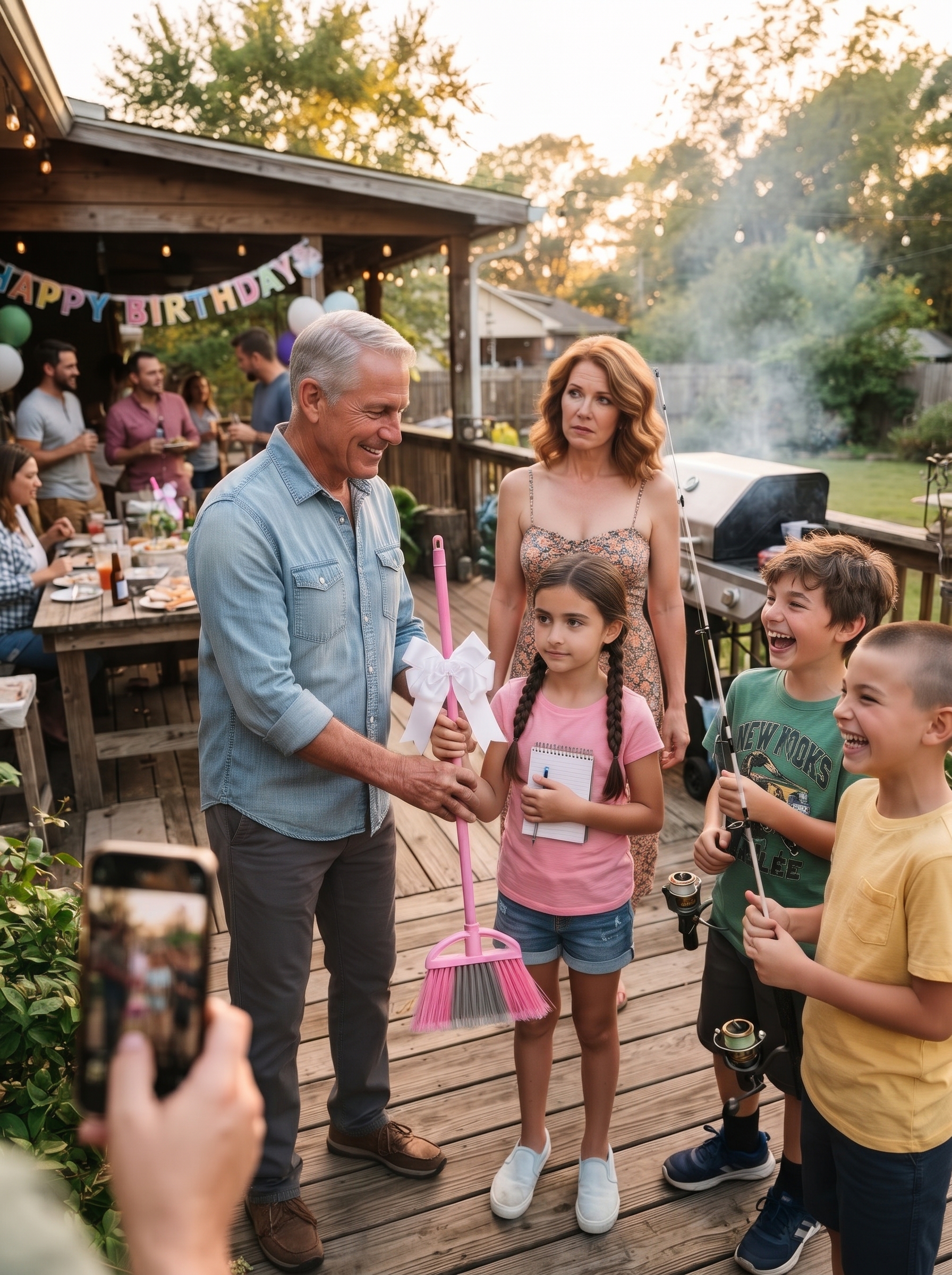
This year, he turned seventy-two. He lined up all four grandkids on the back porch, in front of the whole family, and handed out the gifts one by one.
Three boys. Three brand-new fishing rods. $180 each. I know because the price tags were still on.
Then he got to my daughter.
Mia
My name is Carrie. I’m forty, a single mom, and a nurse at our county hospital. My daughter, Mia, is eleven.
Mia loves fishing more than anything in the world. She watches fishing videos the way other kids watch cartoons. She can tie four different knots with her eyes closed. She keeps a notebook of every fish she’s ever caught off the public dock, with the weight, the bait, and the weather that day.
And for five years, she has begged my father, Roy, to take her out on his boat.
He’s taken all three of her boy cousins. Every summer. Every fall. Weekend after weekend. Mia was always “too young,” or the boat was “too full,” or “maybe next time, sweetheart.”
Next time never came.
The Broom
Mia stood at the end of the line, bouncing on her toes, watching her cousins unwrap their rods. I could see her hoping.
My father reached behind the porch swing and pulled out something long, wrapped in pink paper with a big white bow.
Mia’s face lit up. For one second, she thought it was a rod.
She tore off the paper.
It was a broom. A pink plastic broom with a matching dustpan.
My father grinned and said it loud enough for everyone to hear: “Every girl needs one of these. Fishing’s for boys, sweetheart. This is more your speed.”
My brother laughed so hard he spilled his beer. My sister-in-law filmed it on her phone. One of the boy cousins said, “Mia, go sweep the boat!” and the others cracked up.
I stood up so fast my chair fell over.
But before I could say a word, Mia did something that stopped me cold.
“Thank You, Grandpa”
She didn’t cry. She didn’t argue. She looked up at her grandfather and said, very quietly, “Thank you, Grandpa.”
Then she took the broom, walked to the far end of the porch, and swept up the wrapping paper. Every scrap. She put it in the trash bag, leaned the broom against the railing, and sat down on the steps by herself.
The laughter faded. Nobody quite knew what to do.
I sat down next to her. She was holding her fishing notebook against her chest.
“Mom,” she whispered, “can we go home?”
On the drive, she stared out the window. Then she said something that I’ll never forget.
“The Willow Lake Youth Derby is in three weeks. Grandpa’s a judge. He hands out the trophy every year.”
She turned to me. “I want to enter.”
“Baby, you don’t even have a real rod.”
She looked out the window again, toward the little blue house next door to ours. “I know someone who does.”
Who was the neighbor Mia went to for help — and what happened when Grandpa Roy had to read the winner’s name out loud?
Miss Opal
Our neighbor, Opal Harlan, is seventy-eight years old. She wears overalls, drives a 1989 pickup, and grows tomatoes the size of softballs.
What I didn’t know, until that evening, was that in 1974, Opal Harlan was the first woman ever to win the state bass championship. She’d competed against men for nineteen years. She had a shed full of trophies she’d never mentioned to anyone on our street.
Mia knew. She’d seen the old newspaper clipping taped inside Opal’s shed door when she was helping carry tomatoes.
That night, Mia knocked on Opal’s door holding her notebook. I stood behind her on the porch. Mia told her about the broom.
Opal listened without a word. Then she spat to the side, went into her shed, and came back with a battered spinning rod that had clearly caught a lot of fish.
“Fishing’s for boys, huh?” she said. “Be here at 5:30 tomorrow. Bring a jacket.”
Three Weeks
For three weeks, Mia and Opal were on the water every single morning before school. Opal taught her how to read the wind, where bass hide when the water cools, and how to wait. Mostly how to wait.
“The fish don’t care who you are,” Opal told her. “They only care if you’re patient.”
Mia filled half a new notebook. She came home every morning smelling like lake water, smiling in a way I hadn’t seen in a long time.
We didn’t tell my father anything.
Derby Day
The Willow Lake Youth Derby had sixty-three kids that year. All three of my nephews were there with their shiny new rods and my father’s tackle boxes. My father was at the judges’ table in his lucky hat, shaking hands like the mayor.
When he saw Mia walk up to the registration table, holding a battered old rod, with a seventy-eight-year-old woman in overalls beside her, his smile froze.
“Mia? What are you doing here?”
“Fishing, Grandpa,” she said politely, and walked right past him to the dock.
For four hours, she barely spoke. She worked the shady side of the cove where Opal had taught her to look, while the boys crowded the main dock and tangled each other’s lines.
At 11:40, her rod bent almost in half.
It took her six minutes to bring it in. Opal stood behind her the whole time, not touching the rod once, just saying, “Easy. Easy. Let him run. Now.”
When the fish came out of the water, the whole dock gasped.
The Weigh-In
At the weigh-in station, the scale read 6 pounds, 4 ounces.
The biggest fish of the derby by more than two pounds. The biggest fish caught in the Willow Lake Youth Derby in eleven years.
My nephews’ best catch was a pound and a half.
And by tradition, the head judge reads the winner’s name and hands over the trophy.
My father stood at the microphone for a long moment, looking at the card in his hand. The crowd waited. Then he cleared his throat.
“First place,” he said, and his voice cracked. “Mia Lawson. Age eleven.”
Sixty-three families cheered. Mia walked up, took the trophy, and shook his hand like a professional. “Thank you, Grandpa,” she said. The same words she’d used on the porch.
Then the announcer added, “And Mia was coached by our very own Opal Harlan, 1974 state bass champion!”
The crowd roared. My father turned white. He had grown up fishing in this county. He knew exactly who Opal Harlan was.
What Grandpa Did Next
That evening, my father knocked on my door. He was holding his own tackle box. The old green one with his initials scratched into the lid, the one his own father gave him in 1962. The one none of the grandsons had ever been allowed to touch.
He knelt down on the doormat in front of Mia.
“I was wrong,” he said. “About you. About fishing. About a lot of things. I’m sorry I gave you that broom, Mia. This is yours now. If you’ll still let me take you out on the boat.”
Mia thought about it for a long, serious moment.
“Okay,” she said. “But Miss Opal comes too. And she drives.”
They go out every other Saturday now. All three of them. My father says Opal is the only person who has ever made him feel like a beginner.
The trophy sits on Mia’s dresser. And the pink broom? It’s leaning in the corner of Opal’s shed, right under the 1974 newspaper clipping. Opal says it’s the best fishing story she’s ever been part of.
This story is a work of fiction. Names, characters, and events are products of the author’s imagination. Any resemblance to real people or events is purely coincidental.