
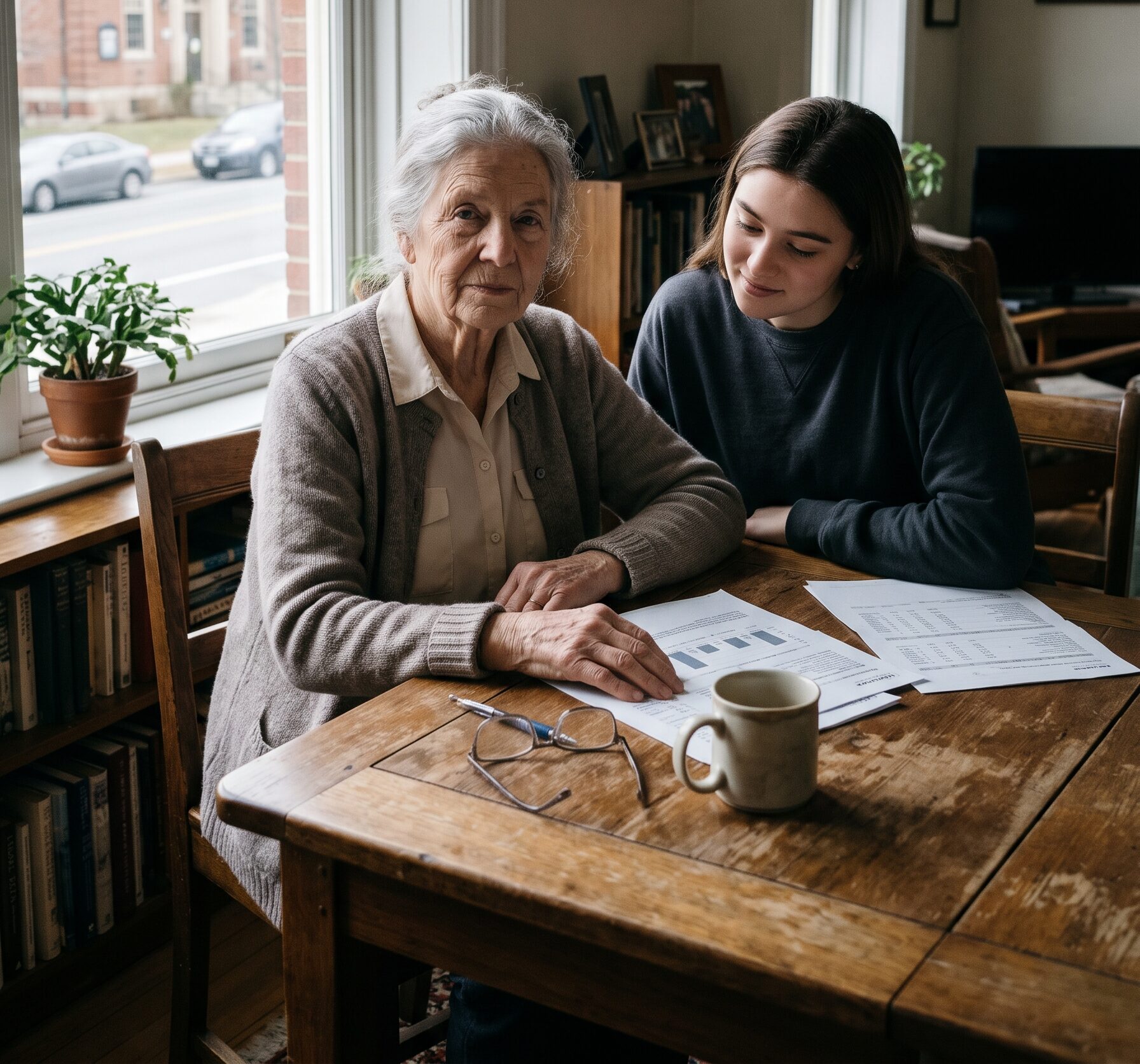
The call came through on a Tuesday afternoon while Grandma was sitting peacefully at my kitchen table, buttering toast and listening to the radio. On the other end of the line, my sister Andrea was laughing—a bright, careless sound that didn’t match the words she spoke next.
“Hey, just letting you know we dropped Grandma off on your porch,” Andrea said between chuckles, airport announcements echoing faintly behind her. “Figured you’d want a surprise before my flight takes off.”
I froze, my eyes darting to Grandma. She looked up from her toast, her brow furrowing slightly as she set her knife down. “Andrea’s at the airport?” Grandma asked quietly. “She told me she was just running to the bank for a minute.”
My stomach dropped. “Andrea,” I said, keeping my voice steady. “Grandma is sitting right next to me. What are you talking about?”
There was a brief pause, followed by a dismissive wave of her hand that I could practically hear in her tone. “Oh, don’t be dramatic. It was a joke. Anyway, boarding’s starting—talk later.” The line went dead.
Grandma didn’t raise her voice or get flustered. She simply folded her hands on the table, looked out the window at the quiet street, and said, “I think I’d like to call Arthur.”
Arthur was Grandma’s estate attorney, a sharp, patient man who had handled her affairs for years. The next morning, I drove Grandma to his office. While she sat calmly in his conference room, Arthur pulled up recent records and inquiries connected to her accounts. What he uncovered made my blood run cold.
Over the past several months, Andrea had contacted the firm and financial institutions asking detailed questions about Grandma’s family trust, potential property transfers, and the steps required to list Grandma’s house for sale to fund an assisted living facility. None of it had been authorized. None of it had even been discussed with Grandma.
“They were treating me like a line item on a spreadsheet,” Grandma said softly, though her eyes were sharp. “Like my house was already empty and my voice was already gone.”
She didn’t waste a single day in anger. By the end of the week, Grandma had signed new documents with Arthur’s guidance. She formally revoked Andrea’s financial power of attorney, appointed an independent professional fiduciary to oversee major financial safeguards, updated her advance medical directives, and reinforced legal protections ensuring no one could sell or move her out of her home without her explicit consent.
A few days later, we held a quiet family meeting in Grandma’s living room. Andrea arrived defensive, expecting a lecture about a harmless airport joke. Instead, Grandma placed a neat stack of printed records on the coffee table and asked plainly about several unapproved account withdrawals and the inquiries regarding her home.
“I’ve spent my whole life working hard so I could make my own decisions,” Grandma told her, her voice steady and firm. “Helping someone never justifies taking away their choices. Care without consent isn’t care—it’s control.”
Andrea’s face flushed. For a moment, she tried to argue that she was only “planning ahead” and “thinking about what’s practical.” Grandma didn’t debate her. She simply stood by her boundaries, making it clear that respect and transparency were the only terms moving forward.
Over the next several months, the frost between them slowly began to thaw. Without secret plans or back-channel decisions, the air felt lighter. Andrea stopped treating Grandma like someone fragile who needed managing and started listening to her like an adult who still knew her own mind. And once Grandma felt completely free of pressure, she made a choice entirely on her own: she decided to sell her large family home in her own time and move into a sunlit, manageable apartment just three blocks from her favorite public library.
She spent her remaining years there surrounded by books, morning coffee, and visits from both of us—living on her own terms, sharp and independent, until she passed away peacefully at eighty-eight.
When her estate was settled, her generosity reached far beyond what any of us had expected. She left thoughtful support for both of her granddaughters, established a nursing scholarship for students entering patient care, and endowed a fund for the public library she loved so dearly. Attached to her final wishes was a short note written in her familiar, steady handwriting: Aging never requires surrendering one’s voice. Hold onto yours—and always respect someone else’s.