
This is a fictional story.
My father is ninety-three years old. When he was nineteen, he fought at the Chosin Reservoir in Korea, in thirty-below cold, with frostbite on both feet.
He doesn’t talk about it. Not ever. But when my daughter got engaged to a Marine, something in him woke up.
The Dress Blues
My name is Patty. I’m fifty-eight. My daughter, Emma, married Sergeant Josh Kendrick in June, at a beautiful vineyard outside Richmond, Virginia.
For a month before the wedding, my dad, Harold, practiced walking without his cane in the hallway of his assisted living facility. Up and down. Every morning. The nurses timed him.
“I’m not going to stand at my granddaughter’s wedding next to a Marine sergeant leaning on a stick,” he told me.
On the morning of the wedding, he put on his Marine Corps dress blues. He’d had them taken in. The ribbons were straight. The shoes shone like black glass. He stood in my kitchen, ninety-three years old, and saluted me. I cried before we even left the house.
Vivian
The groom’s mother, Vivian, had paid for most of the wedding, and she made sure everyone knew it. She’d chosen the venue, the flowers, the menu, and the color scheme: “champagne and blush.” She’d sent a dress-code email to every guest. Twice.
When she saw my father during cocktail hour, her smile froze.
“Oh,” she said. “He’s… in uniform.”
“He’s a Korean War veteran,” I said. “He was a Marine.”
“It’s just a lot of navy blue for the photos,” she said, and walked away.
The Announcement
After dinner, just before the first dance, the DJ tapped the microphone.
“Quick announcement from the groom’s family,” he said, reading off a note card. He looked uncomfortable. “Could the gentleman in the… costume please change into something more appropriate for the photos? This is a wedding, not a parade.”
A few people laughed. Vivian’s friends at her table laughed loudest.
Josh and Emma were in the other room with the photographer. They didn’t hear it.
My father didn’t say a word. He picked up his white cover from the table, tucked it under his arm, nodded politely toward Vivian’s table, and walked out to the parking lot. Without his cane. Straight as a flagpole.
The Parking Lot
I found him sitting in the passenger seat of my car, staring straight ahead at the vineyard.
“It’s her day, Patty,” he said quietly. “Emma’s day. I don’t want to cause trouble. Just take me home.”
I was about to march back into that reception hall and cause plenty of trouble myself.
Then the doors of the hall flew open.
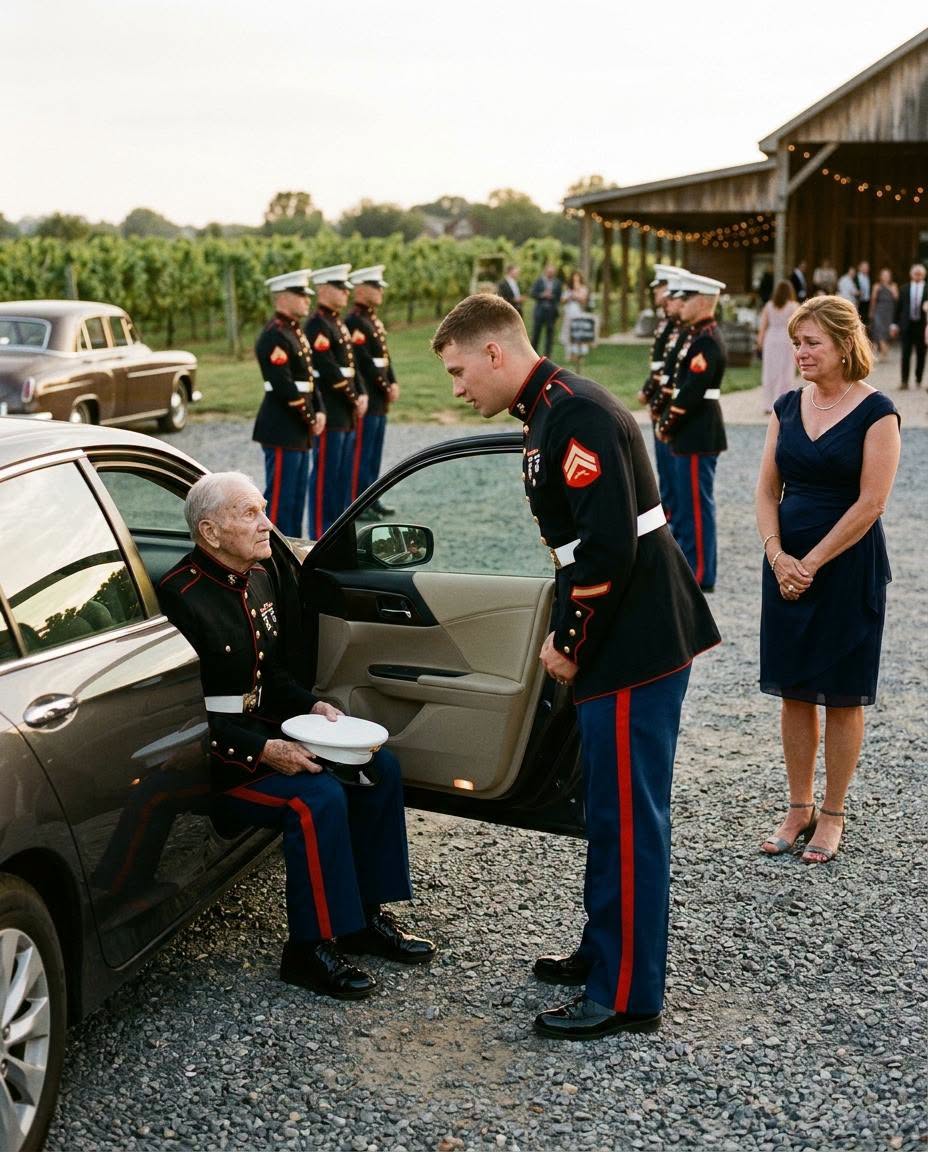
And twelve Marines in dress blues came marching across the gravel parking lot toward my car. At the front of them was the groom.
What did Josh and his Marines do, and what did Harold discover about Vivian’s family that night?
“Sir”
One of the groomsmen had heard the announcement and gone straight to Josh. Josh had left his own photo shoot mid-pose.
The twelve Marines stopped in two straight lines next to my car. Josh opened the passenger door himself.
“Sir,” he said to my father. “On behalf of my unit, I apologize for what you just heard. It doesn’t represent me, and it doesn’t represent this family. My wife would like her grandfather back inside. And so would I.”
My father looked at him for a long moment. “Son, it’s your mother’s party. I don’t want to make it worse.”
“With respect, sir,” Josh said, “it’s my wedding. And you’re the only Marine here who’s earned the right to wear those blues longer than any of us have been alive.”
The Walk Back
They walked him back in.
Twelve Marines in two lines, and my ninety-three-year-old father in the middle, no cane, his cover on his head. When they came through those doors, the DJ, without being asked, turned off the music.
Josh stopped in the middle of the dance floor. “Ladies and gentlemen,” he said, “this is Private First Class Harold Bennett, United States Marine Corps, First Marine Division. He fought at the Chosin Reservoir in 1950. Marines, attention.”
Twelve heels clicked. Twelve salutes.
My father returned the salute. His hand was shaking, but his back was straight.
The whole room stood up. Even Vivian’s table, eventually.
The Photograph
That should have been the end of it. But something else happened that night that none of us could have planned.
By the entrance, Vivian had set up a “memory table” with framed photos of family members who’d passed away. Later in the evening, my father walked past it on his way to the restroom. And he stopped.
He stood in front of one small black-and-white photo for so long that I went over to check on him. It was a young Marine in a winter parka, grinning, with a cigarette behind his ear.
“That’s Eddie Walsh,” my father said. His voice cracked. “From Boston. We shared a foxhole at Chosin.”
The label underneath said: “Edward Walsh, 1931–2009. Beloved father of Vivian.”
Three Miles
Vivian came over, confused, and asked what was going on.
My father told her. Quietly, the way he’d never told me.
On December 6, 1950, during the breakout from the reservoir, Eddie Walsh was hit in the leg and couldn’t walk. It was thirty-five below zero. The column couldn’t stop. So nineteen-year-old Harold Bennett put Eddie on his back and carried him three miles through the snow to the aid station.
They lost touch after the war. My father never knew if Eddie made it home.
Vivian put her hand over her mouth. “My father used to tell that story,” she whispered. “About a skinny kid from Pennsylvania who carried him through the snow. He said he never got to thank him. He looked for him for years.”
She looked at my father in his dress blues. The “costume.”
“If you hadn’t carried him,” she said, “I wouldn’t be here. My son wouldn’t be here.”
The Last Dance
Vivian cried in my father’s arms for a long time. Then she walked to the DJ booth, took the microphone, and apologized to the entire room. In front of all her friends.
Later that night, Emma asked her grandpa for a dance. Then Vivian asked for one too.
The photographer got a picture of the whole wedding party at the end of the night. Every single person in it. Right in the center, in navy blue, ninety-three years old, standing without a cane: my father.
Vivian had it framed for him. It sits on his dresser at the assisted living facility, right next to a black-and-white photo of a grinning young Marine with a cigarette behind his ear.
“Eddie finally made it to a wedding,” my father says.
This story is a work of fiction. Names, characters, and events are products of the author’s imagination. Any resemblance to real people or events is purely coincidental.