
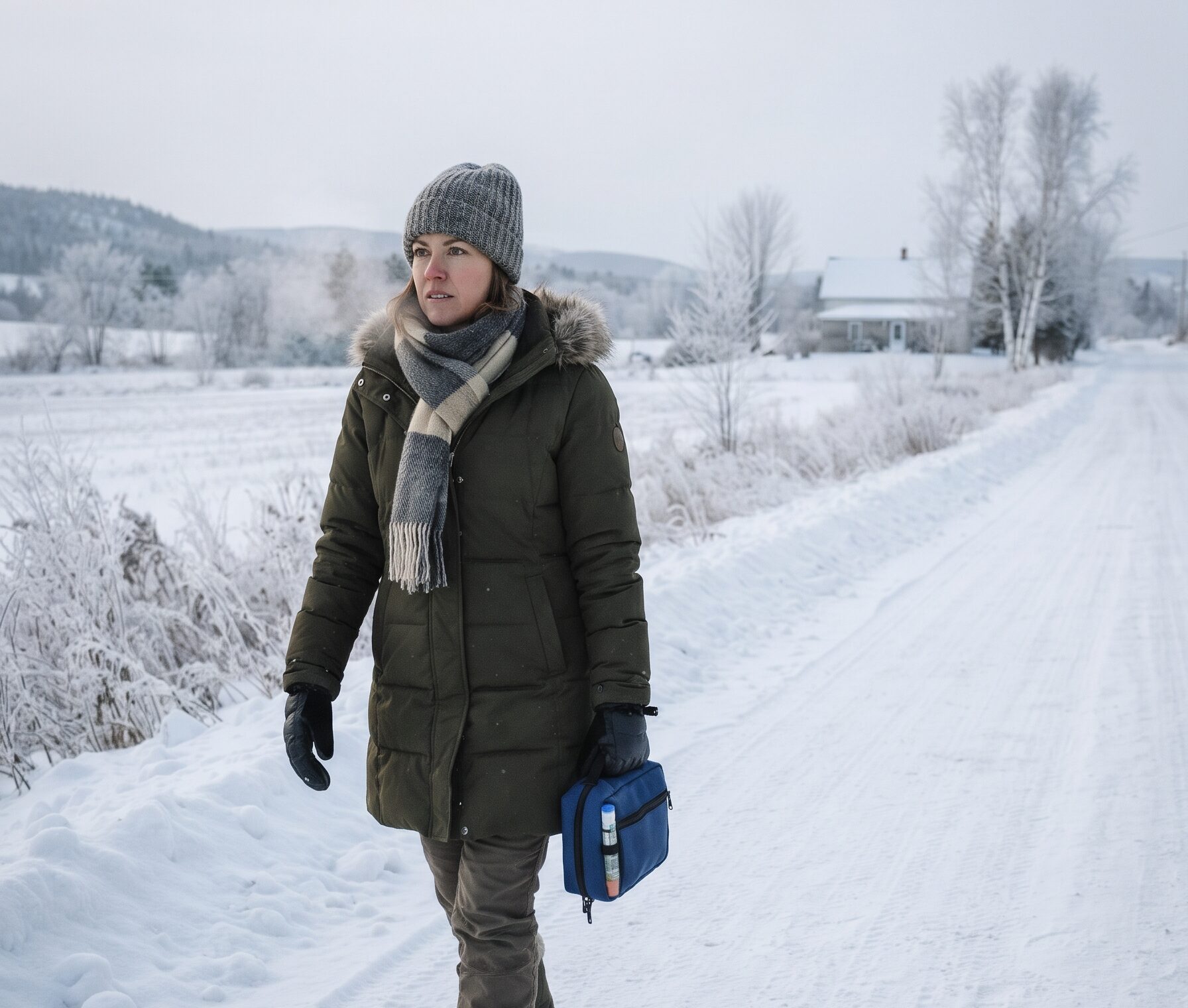
The school nurse, Pauline Fitch, called at ten in the morning while I was staring out my kitchen window at my car, which had slid sideways down our icy hill the night before. My nine-year-old son, Caleb, who has type 1 diabetes, had checked his blood sugar at 9:45 and needed his mealtime insulin before lunch at 12:10. His daily pen wasn’t in his backpack, and the backup pen kept in the nurse’s office was past its 28-day window since being opened.
I knew right where his pen was: sitting in its blue zip pouch on the kitchen counter of my sister-in-law, Heidi, three miles down the county road and one mile outside of town. Caleb had stayed overnight with her because of the early ice storm, and he had forgotten to pack the pouch after his breakfast dose. Since my insurance wouldn’t cover an early refill without paying $340 out of pocket and the local pharmacist couldn’t leave his store unattended, I called Heidi, who owned a four-wheel-drive truck.
“I’m not taking my truck out on that ice twice for a boy who should have remembered,” Heidi said, and hung up. My husband, Nils, was a fuel-truck driver stuck 130 miles away behind closed highway gates, and our nearest neighbor was away for the winter. With no other option, I put on Nils’s oversized chore boots, bundled up, and set out on foot along the frozen grass ditch beside the glass-slick road.
During the three-mile walk to Heidi’s house, I thought about the quiet tension between us—from the family inheritance split after she cared for their mother, to Thanksgiving dinner when I offered to pay her $60 a week to watch Caleb after school, which she took as an insult. Near the township line, I slipped on an icy culvert and bruised my hip badly, but I picked myself up and kept going.
At 11:20, I knocked on Heidi’s door. She cracked it open just enough to hand me the blue pouch, saying, “There. Now you don’t owe me anything,” before shutting it again. Her red truck sat clean and plugged in on the driveway. I tucked the insulin pouch inside my coat against my chest so it wouldn’t freeze and walked the final windy mile into town, reaching the elementary school at 11:40. Caleb received his dose at 11:46 and ate lunch with his class right on schedule.
While warming my feet by her office heater, Nurse Pauline called Heidi directly. In a calm, matter-of-fact tone, she explained what happens when a child with type 1 diabetes goes without insulin, noted that Heidi was listed first on Caleb’s emergency card, and offered to train her on his care that Thursday—or recommend removing her from the card. Heidi admitted no one had ever actually shown her how his care worked.
When school dismissed early at 1:30 due to the storm, Heidi pulled up in her truck with the hazard lights flashing to drive us back to her house since our hill was impassable. On the slow drive, she admitted that earlier that morning, when taking Caleb to school, her truck had slid straight through the county road stop sign in front of an oncoming propane truck, leaving her terrified to face that intersection again—and too proud to admit she was scared.
That evening, we finally talked honestly. Heidi realized Caleb’s condition wasn’t the same as her late mother’s, and I admitted that out of fear, I had treated her like a coat check rather than trusting her enough to teach her. On Thursday, Heidi attended the nurse’s training session, took careful notes, and signed Caleb’s updated care plan. By Monday, she had quietly bought a brand-new $340 backup pen for the school out of her own pocket, refusing my checkbook and telling me we were square. We still banter, and neither of us forgets easily, but now she checks his numbers, writes them down, and makes sure his pouch is tucked safely in the front pocket of his bag.