
This is a fictional story.
Three Tickets
I turned fifteen on December 31, 2007.
That morning, in our kitchen in Clarksville, Tennessee, I found three first-class plane tickets to Los Angeles lying on the counter next to my birthday cake.
Douglas Ashford. Cynthia Ashford. Trevor Ashford.
I read them twice. My name wasn’t there.
“Mom, where’s my ticket?”
She kept slicing the cake. She didn’t even look up. “Audrey, you’re too old for family vacations. Your brother is still young enough to enjoy them.”
It was the third New Year in a row. Every year, Trevor got a trip. Every year, I got a promise that next year would be different.
“But it’s my birthday,” I said. “Can’t we at least celebrate together?”
Dad walked in carrying two leather suitcases. “Travel costs money, Audrey. You’re old enough to understand that the world doesn’t revolve around you.”
Trevor came in a minute later wearing a brand-new $400 leather jacket, talking about the rooftop pool at their hotel. Then he saw the tickets.
“Wait. Audrey’s not coming?”
“Your sister is staying with Aunt Lorraine,” Dad said. “It’s all arranged.”
I pushed my plate away. “Have a great trip.”
Seventeen Dollars
At 5:30 the next morning, I watched their SUV pull away from the house. Nobody said goodbye.
I waited for Aunt Lorraine. She never came. Nobody called.
By 7:30, I was sitting on my bedroom floor counting the money I’d earned pulling weeds and raking leaves for our neighbors. Seventeen dollars.
That was everything I had in the world.
I packed a backpack, put on two sweaters, and wheeled my old bike out of the garage. I didn’t really know where I was going. I just knew I couldn’t sit in that empty house for a week pretending I didn’t exist.
I rode for hours. It was freezing. By early afternoon my fingers had gone numb on the handlebars, and I stopped at a little roadside diner just outside Fort Campbell.
Dorothy
The woman behind the counter took one look at me and came straight around it.
“Honey, you look half frozen. Sit down.”
Her name was Dorothy Harper. She owned the diner. She brought me hot chocolate and a plate of pancakes and wouldn’t take a single one of my seventeen dollars.
When I finally told her why I was there, she didn’t say anything for a long time. Then she picked up the phone behind the register and said, “What’s your aunt’s number?”
Aunt Lorraine answered on the second ring.
She had no idea my parents had left town. Nobody had asked her to watch me. There were no “arrangements.”
She drove forty minutes through the snow to get me. I’ll never forget the look on her face when she walked into that diner.
A Different Life
I stayed with Aunt Lorraine that week. Then I just… kept staying.
My parents came back from Los Angeles tanned and cheerful. When Lorraine told them I’d be living with her, they didn’t argue. Mom said it was “probably for the best, since Audrey’s so difficult.” They didn’t come looking for me. Not that winter. Not ever.
Dorothy’s diner became my second home. I worked weekends there through high school. The soldiers and their families who came in for breakfast took me under their wing. A retired sergeant helped me with algebra. A colonel’s wife helped me with my college essays.
When I graduated, I enlisted in the U.S. Army.
Eighteen years later, I was Major Audrey Ashford.
The Gala
I hadn’t heard from my parents in years when the calls started.
Trevor now ran a real estate development company. He was planning a big project near Fort Campbell and trying to attract wealthy investors. My parents suddenly wanted to “reconnect.”
I didn’t answer.
Then a friend sent me a photo from the Montgomery County Winter Veterans Gala, held the first Saturday in January. On a glossy display board for Trevor’s company was my official Army photo, my name and my rank. Under it, it said: “Proudly advised by Major Audrey Ashford.”
I had never agreed to that. I had never even seen his business plan.
The gala organizers called me directly. I told them the truth. They announced publicly that I had no connection to Trevor’s company.
Then an investor asked Trevor a simple question: had every property owner on his project map actually signed a purchase agreement?
Trevor hesitated.
And a small, white-haired woman in the third row stood up and said, “I never agreed to sell my diner to anyone.”
It was Dorothy.
Two other local business owners stood up after her and said the same thing. Several investors closed their folders. One firm said it was putting its funding on hold until ownership was verified.
The Meeting
Two days later, my parents begged me to meet them in the lounge of a hotel downtown. Trevor came too.
“Please, Audrey,” Mom said. “We could lose everything.”
“All you have to do is tell the investors it was a misunderstanding,” Dad said. “Say you’re advising your brother privately. That’s all.”
“I won’t lie for you,” I said.
Mom’s eyes filled with tears. “Doesn’t family mean anything to you?”
I opened my leather portfolio.
“Dad, before we talk about Trevor’s problems, there’s something you need to see.”
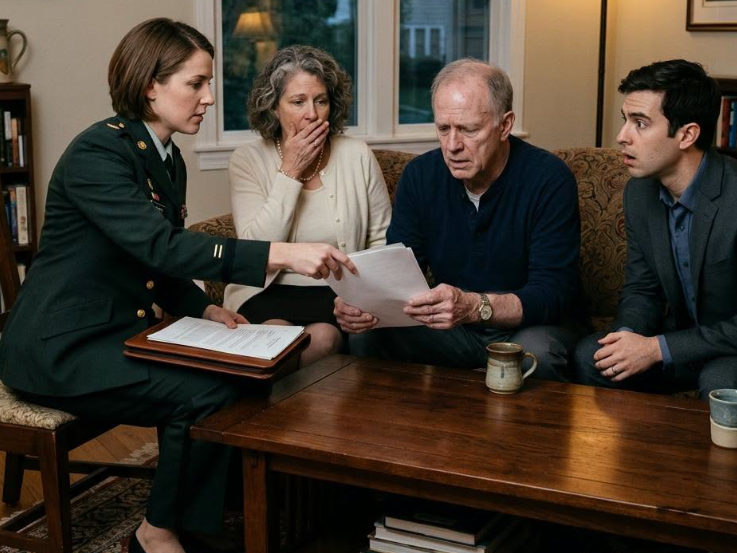
I slid a single document across the table. It carried the seal of the county court. My father read the first paragraph, and the color drained out of his face. His hands began to shake so badly the page rattled. Trevor leaned over to read it, then turned to our father and whispered, “Dad… that land was hers?”…
Grandpa Walter
My grandfather, Walter Ashford, died when I was fourteen.
He was the only person in my family who ever seemed to notice me. He taught me to fish. He came to every school play. He used to say I had “the Ashford backbone, and none of the Ashford nonsense.”
What I didn’t know until I was thirty-two was that he had left me a trust fund of $400,000 and a valuable piece of commercial land on the edge of Clarksville. Both were meant for me alone, to be released when I turned twenty-five.
Six weeks after my parents came back from Los Angeles, my father moved both of them out of my name.
The paperwork included a signature that was supposedly mine. I was fifteen years old. I was living with Aunt Lorraine. I had never seen those papers in my life.
How I Found Out
When Trevor’s company started using my name, my attorneys did some digging. They pulled property records, old bank statements and my grandfather’s estate files.
They found the transfers. They hired a handwriting expert, who confirmed the signature wasn’t mine.
By the time I walked into that hotel lounge, my lawyers had already filed civil proceedings. The bank had the documentation. Legal restrictions had already been placed on every disputed asset.
And those assets turned out to be connected to almost everything my parents owned. Their big house. Their investment accounts. The properties tied to Trevor’s company.
Grandpa’s land was the very land Dad had used to help fund Trevor’s business. He’d told Trevor it was his own.
The Silence
Dad didn’t say anything. There was nothing he could say. The records spoke for themselves.
Trevor stared at him. “You told me Grandpa left that land to you.”
Mom lowered her head and started to cry.
“I’m not here to humiliate anyone,” I said. “I’m not here for revenge. I just want the truth acknowledged, and I want what Grandpa meant to leave me. That’s all.”
The Settlement
My legal team spent six weeks going through every record. Then my parents’ lawyer called.
They agreed to a civil settlement. They had to return the transferred assets and repay every dollar taken from my grandfather’s estate.
To do that, they sold their luxury house and most of their expensive cars. By March, they had moved into a two-bedroom apartment outside Clarksville.
Trevor’s development company stopped operating and left him with serious debt. The diner project was dead.
Trevor
A few weeks later, Trevor called me. For the first time in his life, he didn’t ask for anything.
“I’m sorry, Audrey. I used your name because it made me look better. I never asked why you weren’t on those trips. I just went. I was a kid, but I’m not a kid anymore.”
He took a job managing a logistics warehouse. He’s never asked me for money or favors since.
Mom
In April, Mom asked if we could have coffee. Just the two of us.
She looked older than I remembered. Smaller.
“I used to tell everyone you were difficult,” she said quietly. “It was easier than admitting what we did to you. I’m so sorry.”
“I appreciate that,” I said. “But this is going to take time, Mom. A lot of time.”
“I know,” she said. “I’ll wait.”
Dad hasn’t called. Maybe one day he will.
Dorothy’s Diner
That spring, Dorothy finally decided to retire at seventy-nine. I offered to help her financially. She refused.
“I’ve got everything I need, honey. I always did.”
Her longtime kitchen manager, Joanne Mitchell, bought the business. Dorothy kept the building and rents it to her for far less than she could get.
In May, the whole town came out to celebrate Joanne as the new owner. Soldiers, families, the retired sergeant who taught me algebra.
At the end of the night, Dorothy pressed an old photograph into my hand. It was her, at fifteen, standing in front of the same diner in a waitress apron.
“Somebody took me in once, too,” she said. “Now you know why I picked up that phone.”
The Scholarship
I used part of my inheritance to create the Walter Ashford and Lorraine Ashford Scholarship. It supports military kids and teenagers growing up in difficult family situations.
The rest, I invested, the way Grandpa would have wanted.
Every New Year’s Eve, on my birthday, I go to the diner. Joanne makes me pancakes. And I leave seventeen dollars in the tip jar.
Every single time.
This story is a work of fiction. Names, characters and events are products of the author’s imagination. Any resemblance to real persons or events is purely coincidental.