
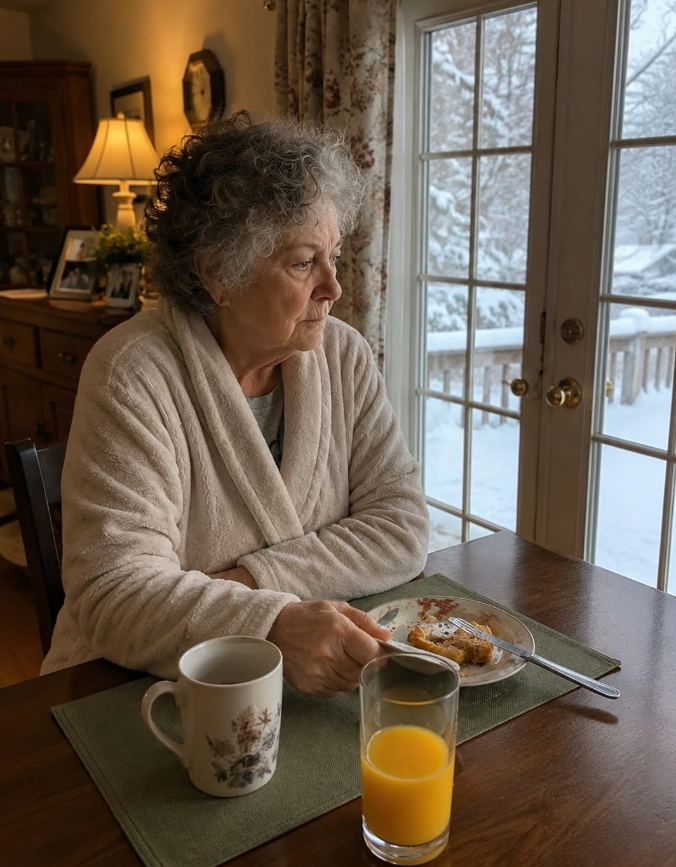
The courier knocked at 9:40 on a Monday morning, and the name on the package was written in my husband’s hand — the looped J, the heavy crossbar on the T — except my husband had been dead for three years. The delivery record showed the shipment had been scheduled in advance, by Frank himself, with one condition: deliver it the first business day after “the sale announcement.” I stood in my doorway in my housecoat, seventy-one years old, holding a box my dead husband had aimed at this exact week like an arrow fired across three years. Inside was a brass key, a map to a storage facility on Route 9, and a note in that same steady handwriting: “Peggy. If you’re reading this, Walt finally did it. Don’t sign ANYTHING he sends you. Go to unit 114 before Friday. Bring Carl. Not the kids.” On my kitchen counter, four days old, sat a stack of buyout papers from Walt — my husband’s business partner of twenty-six years — offering me $85,000 for Frank’s half of the machine shop, with a cover letter asking for my signature by Friday. Just a formality, his assistant kept saying on the phone. Just a formality.
Frank and Walt built Hollis & Danner Machine Works from a rented garage bay in 1987, and for twenty-six years the division was simple: Frank ran the floor and the men, Walt ran the books and the customers. Frank trusted him the way you trust a man you’ve eaten ten thousand lunches with. But the last spring of his life, after the first bad echocardiogram, my husband got quiet in a new way. He started staying late “doing inventory.” He photocopied things at the library instead of at the shop. Once I found him at the kitchen table at 2 a.m. with a yellow legal pad, and when I asked, he kissed my head and said, “Just making sure the math is honest, Peg.” I thought it was a dying man squaring his accounts. It was a dying man who had discovered that his partner had spent six years quietly moving the company’s best contracts into a second corporation — one with only Walt’s name on it — so that when the day came to value Frank’s half, the “official” company would be an empty shell worth almost nothing. Frank was too sick to fight a war in court. So he did what machinists do: he built something precise, and he set it to trigger.
Unit 114 smelled like cardboard and machine oil, and when the roll door rattled up, Carl — Frank’s oldest friend, thirty years a fraud examiner — took one look and had to sit down on a milk crate. Frank had left us an arsenal, labeled in his block handwriting like parts bins: six years of the real customer invoices next to the doctored ones; bank records for the shadow corporation, “Danner Precision LLC,” that Walt had registered without ever telling his partner; photographs of the same machines listed as “sold for scrap” in one company’s books and producing parts in the other’s; and on top, a letter to me, four pages, that I will not share except for one line — “I didn’t tell you because I wanted our last year to be about us, not about him.” There was also a sealed envelope marked “For the attorney — Frank’s affidavit, notarized,” dated eleven weeks before he died. Carl went through the boxes with his glasses on his forehead, whispering numbers, and then he said the sentence that started the war: “Peggy, this isn’t a buyout dispute. The sale closes Friday. Walt needs your signature to deliver clean title to the buyers — which means until Friday, YOU are the one person on earth with the power to stop a $2.4 million closing.” That afternoon, Walt’s assistant called a third time, honey-voiced, offering to “send a car” so I could sign. I told her I had a hair appointment. Then Carl and I drove to see an attorney with four boxes in the trunk, and when she opened Frank’s affidavit and read the first page, she reached for her phone and said, “Cancel my Thursday.”
The attorney, Dana Whitcomb, filed at 8:52 Thursday morning: an emergency motion to enjoin the sale, a claim for breach of fiduciary duty, and a fraud complaint attaching Frank’s notarized affidavit, the parallel invoices, and the shadow corporation’s bank records. By noon, the buyer’s legal team had seen the filing — no regional company buys a lawsuit — and by 2:15, the closing was postponed indefinitely, which is lawyer language for dead. Walt called me himself that evening, the first time in three years, using the voice he used at the funeral, saying there had been “accounting complexities” I wouldn’t understand and that Frank “would have wanted this settled as family.” I let him finish. Then I told him Frank had, in fact, settled it as family — he’d left the family everything it needed in unit 114 — and I hung up and let Dana do the rest. The forensic review valued the true combined business, both corporations, at $2.4 million exactly as the buyers had; the court-supervised settlement awarded Frank’s estate its genuine half, $1.18 million, plus recovery of six years of diverted contract profits, and the fraud referral cost Walt the sale entirely. He signed everything before it reached trial. His attorney told Dana his client “wished to avoid further distress to the widow.” The widow was doing just fine.
The kids know everything now — Frank’s note said “not the kids” only because he didn’t want them charging at Walt half-cocked before the evidence was in a lawyer’s hands, and my son laughed through tears when I explained that, because it was so exactly his father. The money is in a trust Dana built, the shop’s men kept their jobs under the court-appointed manager, and Walt gives his eulogies to an empty room these days, because everyone in a town this size reads the county business journal. But here is what I actually want to tell you, the part I think about every night when I put Frank’s note back in the drawer beside my bed: my husband spent the last spring of his life sick, tired, and afraid — and he spent it building a shield for a fight he knew he wouldn’t live to see. Love isn’t only flowers and anniversaries. Sometimes love is a brass key, a storage unit, and a package that waits three years in the dark to knock on your door the exact week you need it. He promised me he’d take care of me. He kept it from the grave.