
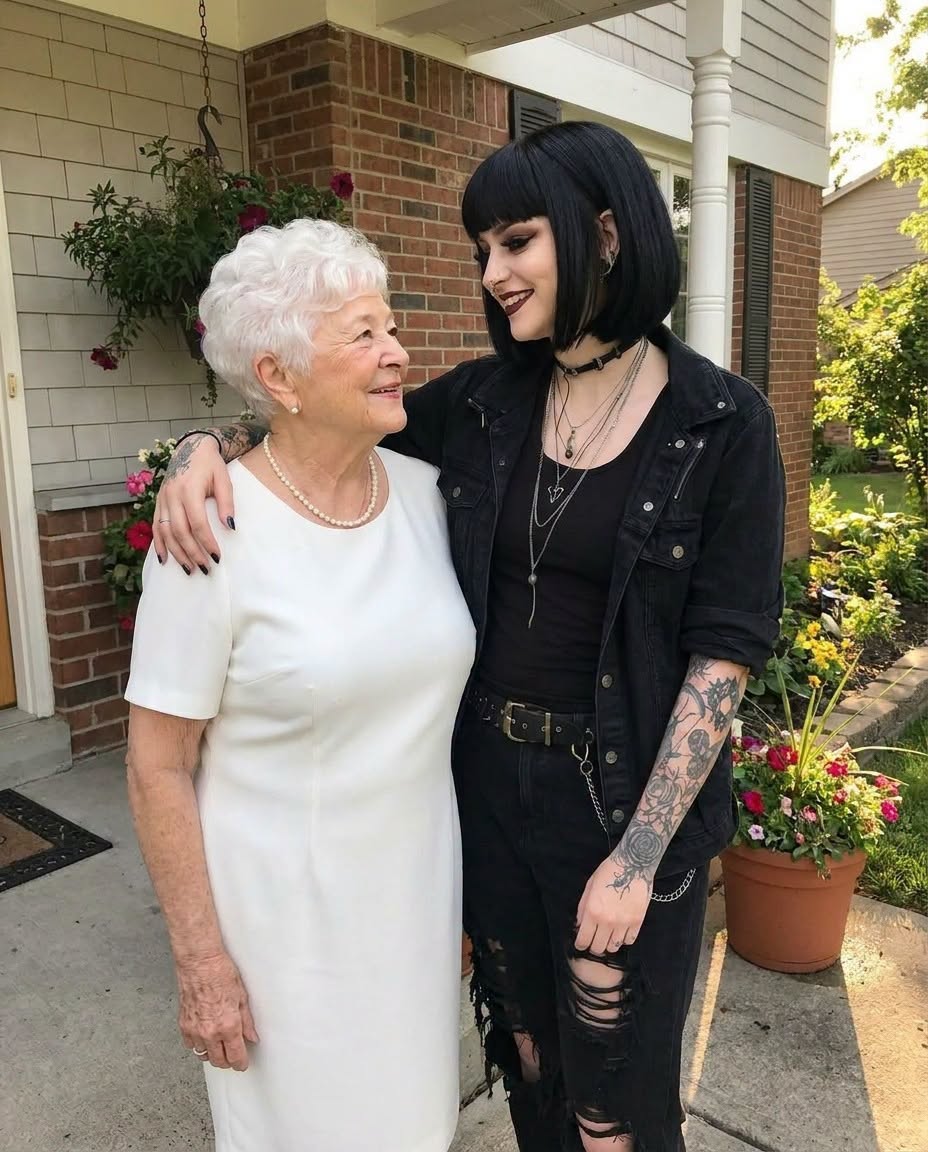
Raven waited until almost everyone had left my mother’s funeral before walking toward me with her fist tightly closed. She had spent months sitting at Mom’s kitchen table every Saturday in black clothes and silver jewelry, somehow belonging in a place where I had always assumed I belonged more. Without a word, she opened her hand and revealed a tiny brass key. “Your mother told me to give this to you only after she was gone,” she said. When I asked what it opened, Raven told me I would understand once I found it. I demanded to know why my own mother, Doris, had trusted a twenty-something tattoo artist with something she had hidden from her daughter. Raven looked at me through swollen eyes and said quietly, “Because I knew a part of her you didn’t.”
The first time I met Raven, I had found her drinking tea from Mom’s best china while sitting in my late father’s chair. Doris was seventy-three, stubbornly independent, and normally spent Saturdays with me, so I took Raven’s sudden presence personally long before I admitted the real reason: I was jealous. Their friendship had begun at a bookstore café after Mom criticized the novel Raven was reading, but before long their weekly visits became private, often involving a small wooden box full of old cards that Mom hurried to hide whenever I arrived. One afternoon, after accidentally leaving my phone behind, I returned and overheard Raven challenging Mom about her estranged sister, Elaine. Doris and Elaine had not spoken in eleven years following a bitter argument during my grandmother’s illness, yet Mom spent every Saturday urging Raven to reconcile with her own estranged mother. “Sometimes you can be right,” Mom told her, “or you can still have your family.” Raven immediately asked why Doris could not follow her own advice. I stood outside the kitchen listening, knowing I could have forced the subject into the open—and chose silence instead.
Two months later, Mom suffered a fatal stroke. After the funeral, I finally used Raven’s key and found a locked wooden box hidden behind blankets in Mom’s bedroom closet. Inside were dozens of letters, Christmas cards, and birthday messages addressed to Elaine, one for nearly every year they had been apart, none of them mailed. When Elaine came to see them, she shocked me by admitting she had a similar box at home filled with letters she had written to Doris and never sent because she feared they would be returned unopened. Then she reminded me of a phone call five years earlier, when she had asked whether Mom ever mentioned her. I had told her, “Not really.” The truth was that Doris mentioned Elaine constantly—remembering birthdays, recalling childhood stories, pointing out things her sister would have liked—but I had been exhausted from feeling caught between them and gave the answer that ended the conversation fastest. Elaine realized I had allowed her to believe her sister no longer cared, and she walked out before I could defend myself. Only afterward did I discover one final sealed envelope beneath the lining of Mom’s box, addressed to Elaine in Doris’s handwriting.
I did not open it. Instead, I asked Raven to explain why Mom had confided in her, and her answer stripped away the last of my resentment. Doris had been embarrassed. I had spent years telling her to call Elaine, and after repeatedly refusing me, she found it easier to admit her fear to a younger woman who had not watched her spend a decade pretending she no longer cared. Raven had not replaced me; she had simply become the person in front of whom Mom felt least ashamed of changing her mind. The next morning I drove to Elaine’s house, handed her the unopened letter, and apologized without qualification for the lie I had told years earlier. Three weeks later she returned to Mom’s kitchen and told me what the letter said: Doris regretted wasting years waiting until she knew exactly what to say and had finally realized that waiting itself had become the problem. She missed her sister. Elaine admitted that one of her own unsent letters said nearly the same thing. Their reconciliation had come too late for them, but the truth had finally arrived.
Not long afterward, Raven texted me to say she had finally called her own mother and they were meeting for dinner. Elaine and I sat at Doris’s kitchen table with the box between us, neither of us pretending we knew exactly what our relationship would become. I told her I would like to see her again if she wanted that, without trying to arrange the outcome or manage the pace. She asked me to call the following week. Looking back, I understand now how wrong I had been about Raven: I thought a stranger had taken my place in Mom’s life, when in fact she had simply been trusted with a corner of my mother I had never been allowed to see. Loving someone for decades does not mean possessing every private fear, regret, or unfinished sentence inside them. The brass key did not open a secret about Raven at all. It opened the consequences of everything our family had left unsaid—and gave those of us still living one last chance not to repeat it.

