
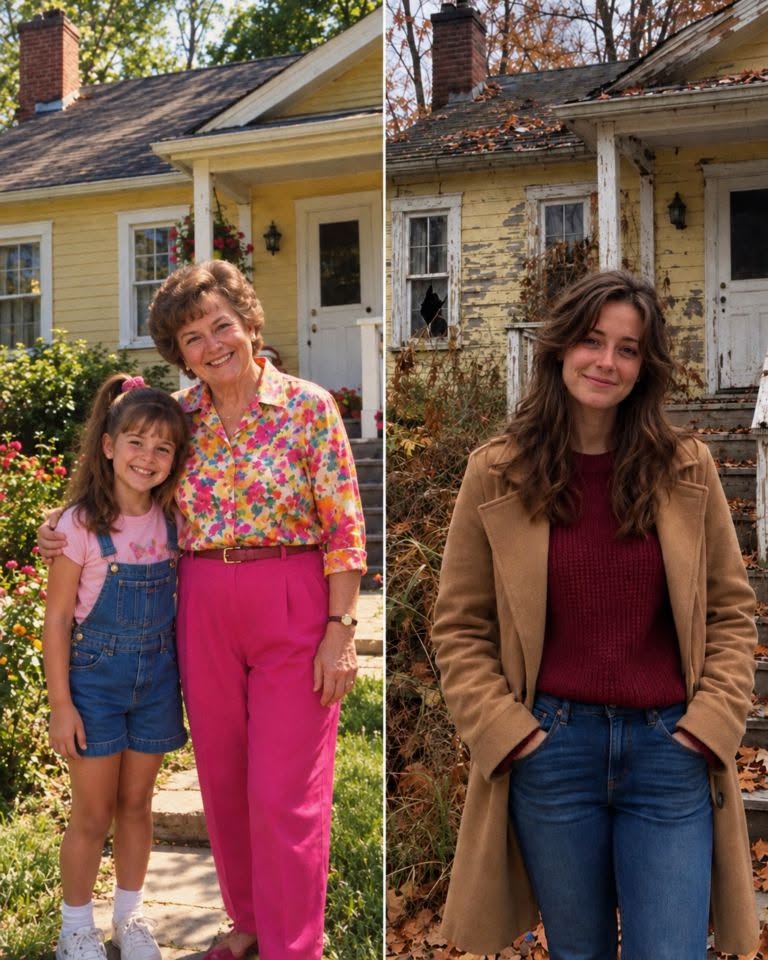
I used the money my grandmother left me to buy back her beloved old house.
My husband called it the most foolish financial decision I’d ever made and refused to help with the repairs. But three days later, he called me from the property, sounding completely shaken.
“Layla, you need to come here immediately. We found something.”
When I arrived, part of the storage room wall had been opened, and a stranger stood beside my husband, holding a folder.
Declan looked at the man and said, “Go ahead. Tell my wife what this could be worth.”
I had no idea why they were inside my house, what they had discovered, or how much my husband had been doing without my knowledge.
And the truth was about to change far more than our finances.
Three days earlier, I’d been sitting across from Declan at breakfast when I shared what I thought would be wonderful news.
“I bought Grandma Rose’s old house,” I announced.
He lowered his coffee cup and stared at me.
“You’re joking.”
“No. The sale closed yesterday.”
Instead of congratulating me, he laughed.
“Congratulations, Layla. You’ve officially discovered the most ridiculous way to spend an inheritance.”
I felt my excitement disappear.
“You haven’t even asked how much I paid.”
“I don’t need to. I’ve seen that place. The paint is peeling, half the windows need replacing, and the yard looks abandoned.”
“I know it needs work.”
“Work? It needs a miracle.”
That was Declan.
We’d been married for eleven years, and over time, I’d noticed that he applied completely different financial standards to himself and to me.
If he wanted something, it was an investment.
If I wanted something, it was an unnecessary expense.
He could spend thousands restoring his Mustang without hesitation, but when I bought a replacement coffee maker, he questioned every dollar.
Last Christmas, he’d complained about the price of our new kitchen appliance.
Two days later, he ordered another expensive set of tools for his garage.
“Don’t you already own several toolboxes?” I’d asked.
“Not these particular tools.”
Apparently, replacing something was only reasonable when he was the person making the purchase.
Even grocery shopping could turn into a debate.
“Why are you buying the expensive cereal?” he’d ask.
“Because Owen likes it.”
“He’ll be fine with the cheaper brand.”
But when his Mustang needed premium parts, he insisted that quality was worth paying for.
I’d spent years accepting those contradictions because they seemed too small to argue about individually.
Now, however, he was criticizing something that meant more to me than almost anything else.
Grandma Rose’s house wasn’t just an aging property.
It was where I’d spent the happiest summers of my childhood.
Grandma had taught me how to make apple pie in its tiny kitchen. We’d read books together during thunderstorms and spent warm evenings on the porch watching fireflies.
When I was upset, she always knew how to make me feel safe.
After she passed away, the house went to her son, my uncle Frank.
He sold it a month after the funeral.
I was only nineteen then, with barely enough money to support myself.
There was nothing I could do to stop the sale.
I cried for weeks.
The new owners lived there for years, until they finally listed the property the previous spring.
When I saw the listing, I couldn’t stop looking at the photographs.
The house needed significant repairs, but I recognized every room.
Grandma had also left me a modest financial inheritance.
Instead of spending it immediately, I’d invested the money carefully over the years.
Eventually, it had grown enough for me to purchase the home she’d loved.
I’d spoken with contractors, reviewed repair estimates, and worked out a realistic renovation budget.
I wasn’t making an impulsive purchase.
I had a plan.
But Declan refused to hear any of it.
“The roof alone will cost a fortune,” he complained.
“I already have estimates from two contractors.”
“And the kitchen looks like it hasn’t been updated since the seventies.”
“I know. I’ll renovate it gradually.”
“With what money?”
“My own savings. I’m not asking you to contribute.”
He shook his head.
“This is the worst decision you’ve ever made.”
Then he grabbed his car keys.
“Don’t expect me to rescue you when you realize what you’ve done.”
Before he could leave, I tried one more time.
“Declan, would you at least listen to why I wanted the house?”
He shrugged.
“Because you miss your grandmother.”
“That’s part of it.”
“What else?”
“I want Owen to experience the place where I grew up. We could spend weekends there, fix the garden, and enjoy time together.”
“And I want you to sell that old wreck before it empties your bank account.”
He walked out before I could respond.
For the next two days, the criticism continued.
Whenever I mentioned replacing the porch boards, Declan demanded to know whether I’d checked the cost of lumber.
When I discussed painting the kitchen, he reminded me that the roof needed attention first.
“I know the roof is a priority,” I told him.
“Then why are you thinking about the kitchen?”
“Because I’m allowed to plan more than one improvement at a time.”
Nothing satisfied him.
The worst moment came during dinner.
Our ten-year-old son, Owen, looked up from his plate.
“Mom, can I have my own room at Grandma Rose’s house?”
“Of course, sweetheart.”
“Could we put shelves on the walls for my comic books? Like the ones at the comic store?”
I smiled.
“We’ll see what fits.”
Declan gave a sarcastic laugh.
“Assuming your mother doesn’t spend every dollar fixing that place.”
I looked at him sharply.
“Declan, please don’t say things like that in front of Owen.”
Our son stopped eating.
“It’s not a bad house, Dad. Mom said Grandma Rose loved it.”
Declan shrugged.
“Loving something doesn’t automatically make it worth the money.”
Owen thought for a moment.
“Would you sell your Mustang if someone said it wasn’t worth fixing?”
Declan looked surprised.
“That’s different, buddy.”
“Why?”
“Because I know what I’m doing with the car.”
I placed my fork on the table.
“And I know what I’m doing with the house.”
The conversation ended there, but Owen barely touched the rest of his dinner.
That hurt more than Declan’s criticism.
I could tolerate him questioning my choices.
What I couldn’t accept was watching our son become embarrassed about something that had made him so happy.
On the third morning, I’d had enough.
“I’m going to start cleaning the property this weekend,” I told Declan. “You’re welcome to help, but I’m doing it either way.”
He barely looked up.
“Fine. Don’t expect me to get involved.”
“I wasn’t planning to.”
That afternoon, while I was at work, my phone rang.
Declan’s name appeared on the screen.
When I answered, his voice sounded unusually serious.
“Layla, I’m at your grandmother’s house.”
I frowned.
“What are you doing there?”
There was a pause.
“I found something.”
“What do you mean?”
“Something unexpected. I don’t even know how to explain it.”
My first thought was that he’d discovered water damage or some major structural issue.
“Is the house okay?”
“Just get here. Please.”
He ended the call.
I drove to the property with my stomach in knots.
Declan was waiting at the front door.
He looked pale and unusually quiet.
“What’s happened?” I asked.
“Come inside.”
He led me through the living room and into a small storage room near the back of the house.
There, I discovered that a section of plywood covering an old built-in closet had been removed.
Dust and scraps of wood covered the floor.
A stranger stood nearby with a folder tucked under his arm.
Between them sat a small metal chest.
I stopped in the doorway.
“Would somebody please explain what’s happening?”
Declan gestured toward the stranger.
“This is Robert.”
The man offered his hand.
“Robert Miller. I’m a real estate appraiser. Your husband asked me to evaluate the property.”
I didn’t take his hand.
Instead, I turned toward Declan.
“You brought an appraiser into my house?”
He folded his arms.
“I wanted to find out what it’s actually worth.”
“Why? I already purchased it.”
“Exactly. I wanted to know whether we could recover the money you spent.”
A terrible realization washed over me.
“You were planning to sell it?”
“I didn’t say that! I just wanted you to understand the numbers.”
Robert looked uncomfortable.
“He did ask me about the property’s current market value and potential resale price.”
Declan shot him an annoyed glance.
I took a deep breath.
“Fine. Now explain why part of my wall has been opened.”
Robert pointed toward the exposed storage area.
“There was plywood covering an old closet. Your husband removed it so I could inspect the wall. Behind it were some shelves containing old jars and tools.”
“And the chest?”
“We found it on the bottom shelf.”
The box was about the size of a shoebox, with scratched metal sides and a rusty lock.
I stared at it.
“Did you open it?”
Declan shook his head.
“We tried, but it’s locked. I even bent a screwdriver.”
“That’s why you called me?”
“I thought your grandmother might have told you where the key was.”
“She never mentioned anything like this.”
Robert cleared his throat.
“I should also mention that I believed your husband had permission to inspect and access the property.”
“He didn’t,” I answered.
The appraiser looked genuinely embarrassed.
“I’m sorry, Mrs. Layla. I wasn’t aware of the circumstances.”
Declan pointed at the chest.
“Robert has a tool in his truck. We could probably open it in a few minutes.”
“No,” I said firmly.
“Layla—”
“No. We don’t know what’s inside or even who placed it there. Other people owned this house for years.”
Robert nodded.
“That’s a reasonable concern. Finding something on a property doesn’t necessarily establish ownership of its contents.”
I turned toward him.
“Thank you for coming, Robert, but I don’t need an appraisal. I’m not putting the house on the market.”
He hesitated.
“Would you like me to send the report?”
“No. And I’d appreciate it if you kept anything you saw here confidential.”
He gathered his folder and left.
The moment the front door closed, Declan threw his hands up.
“You just made me look ridiculous in front of that man!”
“You invited him into my property without telling me.”
“I was trying to protect our finances!”
“By arranging an appraisal behind my back?”
He stared at me.
“You used your inheritance to buy a house that needs serious repairs!”
“My inheritance, Declan.”
“We’ve been married eleven years. Since when is everything separate?”
“Since you decided that the money I saved wasn’t worth discussing with me before making plans for it.”
He shook his head.
“I’m simply being practical.”
I laughed in disbelief.
“Practical? You bought a boat.”
“That’s different.”
“You’ve used it twice.”
“I like owning it.”
“And the Mustang?”
“I’m restoring it.”
“For six years. Every spare weekend, every expensive part, every repair. And I’ve never told you to sell it.”
“That’s my hobby.”
“And this house is something I care about.”
He looked away.
I continued.
“Did I ever hire someone to estimate how much money we could get for your Mustang without asking you?”
“No.”
“Did I ever invite a buyer to look at your boat while you were at work?”
“Of course not.”
“Then why did you think doing something similar with my grandmother’s house was acceptable?”
He had no answer.
I pointed toward the storage room.
“You don’t even know how much money I set aside for renovations, do you?”
He shrugged.
“Not exactly.”
“Or what the contractors quoted for the roof?”
“How would I know?”
“Because I tried to explain it at breakfast, and you wouldn’t listen.”
Declan sighed.
“Layla, I can’t remember every conversation.”
“You remember the ones that matter to you.”
His eyes shifted toward the metal chest.
“Well, maybe there’s something inside that could help pay for the repairs.”
“I never expected to find anything. I bought this place because I loved it.”
“And that’s the problem! You make decisions based on feelings.”
I looked at him steadily.
“If you’re so concerned about Owen’s future, why did you make him feel ashamed of something he was excited about?”
Declan’s expression softened slightly.
“I didn’t mean to upset him.”
“But you did.”
He began pacing.
“I’m tired of being treated like the bad guy just because I’m thinking about our finances.”
“You haven’t even apologized.”
He stopped beside the chest.
“If I hadn’t come here, we wouldn’t have found this thing at all!”
He nudged the metal box with his shoe.
It slid several inches across the dusty floor.
A faint metallic sound followed.
Something small had fallen from underneath.
I bent down.
Attached to the bottom of the chest with brittle yellowed tape was a tiny brass key.
For a moment, we both stared at it.
“Well,” I said quietly, “at least we found the key.”
Declan leaned closer.
“Try it.”
I carefully peeled away the tape and inserted the key into the lock.
It resisted at first.
I turned it gently a second time.
Click.
The lock opened.
I lifted the lid.
Inside were several flat packages, each wrapped in protective paper.
Declan peered over my shoulder.
“What is it? Jewelry?”
I picked up the first package and slowly unfolded the wrapping.
Inside was an old comic book.
Superman appeared on the cover.
Declan stared.
“You’ve got to be kidding.”
I unwrapped another.
Then another.
Every package contained a vintage comic book, carefully preserved.
Declan dropped into a nearby chair.
“All that secrecy for comic books?”
I examined the first one more closely.
The cover showed Superman lifting a car above his head.
Across the top were the words *Action Comics*.
Near the corner, I noticed the issue number.
**No. 1.**
The date was 1938.
I didn’t know much about rare comics, but something about the book seemed familiar.
Owen was obsessed with comic book history.
He spent hours watching videos about famous collectors and valuable first editions.
“Declan,” I said slowly, “I think this might be important.”
He laughed.
“You think those old comics are worth anything?”
“Someone took the trouble to wrap them carefully and hide them in a locked chest.”
“People collect all kinds of strange things. Just sell them online.”
I took out my phone.
“I’m calling Owen.”
Declan rolled his eyes.
“Wonderful. Our ten-year-old is going to appraise them.”
I started a video call.
Owen answered almost immediately.
“Hi, Mom!”
“Sweetheart, I found some old comic books. Could you look at one for me?”
I held the cover toward the camera.
Owen leaned closer.
“Mom, can you move it nearer?”
I adjusted the phone.
His eyes widened.
“Wait. Is that Action Comics Number One?”
I checked the cover.
“Yes. Why?”
“From 1938?”
“That’s what it says.”
For a moment, he seemed unable to speak.
Then he practically shouted.
“Mom! That’s Superman’s first appearance! If it’s real, it could be worth millions!”
Declan stopped smiling.
“Millions?” he repeated.
Owen was practically bouncing with excitement.
“Don’t bend the pages! Don’t touch it too much! You need a professional comic book expert!”
I carefully placed the comic on a clean surface.
Declan reached toward it.
“Let me see.”
I moved it away.
“You were just calling it worthless.”
“I didn’t know what it was!”
“Neither did I. That’s why we should be careful.”
Owen continued explaining how rare early Superman comics had achieved enormous prices at auction.
His excitement was contagious.
But as I looked at Declan, I noticed something troubling.
He was suddenly fascinated by the house he’d spent three days insulting.
He began searching online for auction results.
“Layla, look at this! Some of these have sold for unbelievable amounts.”
I glanced at the screen.
The numbers were extraordinary.
But I also knew we had no proof our copy was authentic.
“We need to have it examined before jumping to conclusions.”
Declan barely seemed to hear me.
“We should find a buyer immediately.”
“No. First we verify what we found.”
The following morning, I contacted a specialist who dealt with rare comic books.
The expert advised me not to attempt cleaning, repairing, or handling the books unnecessarily.
I arranged for proper storage and professional examination.
I also contacted an attorney.
Because other people had owned the house after Grandma Rose’s death, I wanted to understand any potential legal questions surrounding the discovery before making decisions.
Declan found the entire process frustrating.
“What if someone offers us cash right now?” he asked.
“Then they can wait until we know exactly what we have.”
He spent hours reading articles about valuable comic collections and imagining what he might buy.
I spent those same hours worrying about whether the books were authentic and how to protect them.
Three weeks later, we finally received the results.
The specialist confirmed that the most remarkable book was a genuine, well-preserved copy of *Action Comics No. 1*, published in 1938.
Because it contained Superman’s first appearance, it was among the most sought-after comic books in the world.
Depending on its precise condition and the results of a professional sale, the expert believed it could potentially bring several million dollars.
I sat quietly after hearing the news.
Then I called Owen.
“Sweetheart, remember the Superman comic we found?”
“Of course!”
“The expert says you were right. It’s genuine.”
He gasped.
“Really?”
“Yes.”
“How much is it worth?”
“Possibly millions of dollars.”
Owen let out such an excited yell that I had to hold the phone away from my ear.
Declan, meanwhile, was already browsing luxury vehicles online.
I reminded him that we hadn’t sold anything.
He grinned.
“But we will!”
His excitement should have made me happy.
Instead, I felt strangely disappointed.
For days, he’d mocked my decision to buy the house.
Now that something valuable had been discovered inside, he suddenly thought purchasing it was brilliant.
I told him I was considering auctioning the rarest comic once the legal and authentication questions were settled.
The remaining books, I explained, would become part of Owen’s collection.
“Even if they’re valuable?” Declan asked.
“Yes.”
“Why wouldn’t you sell everything?”
“Because Owen loves them. Some things are worth keeping.”
He shook his head.
I didn’t argue.
A few evenings later, Declan sat across from me at the kitchen table.
“Layla, I’ve been thinking,” he began.
I waited.
“I owe you an apology. I called your grandmother’s house a terrible investment, and I dismissed the comic books without understanding what they were.”
I studied his face.
He appeared sincere.
But one question had been bothering me ever since we discovered the chest.
“Would you still be apologizing if those comics were worthless?”
He hesitated.
“Layla, why does that matter? We could be rich.”
“Because you only seem to respect my decision now that there’s money involved.”
He looked uncomfortable.
“That’s not entirely fair.”
“Was it fair to bring an appraiser into my house without asking?”
He looked down.
“No.”
“Was it fair to criticize me in front of Owen?”
“No.”
I took a breath.
“I didn’t buy Grandma’s house because I expected to discover something valuable. I bought it because I wanted to preserve a place that meant something to me.”
Declan remained quiet.
“I supported you when you wanted to restore your Mustang. I never asked you to justify every purchase, and I never treated your interests as foolish.”
His shoulders dropped.
“I know.”
“I needed that same respect from you.”
For the first time, he didn’t try to defend himself.
“I’m sorry, Layla,” he said. “I really am.”
I nodded.
“Thank you. But I need some time.”
The following afternoon, Owen and I sat on Grandma Rose’s old porch.
The boards creaked beneath our feet, and the paint still needed replacing.
Sunlight filtered through the trees.
Owen was sketching plans for his future comic book room.
After a while, he looked up.
“Mom, we’re still keeping the house, right?”
“Of course we are.”
“Even if we sell the Superman comic?”
“Yes, sweetheart.”
He smiled.
“Good. I really like it here.”
I looked at the old windows, the weathered porch railing, and the garden that Grandma had once cared for so lovingly.
I’d already planned the repairs.
The roof would come first.
Then the kitchen.
Finally, the porch where my grandmother and I had spent so many afternoons.
If everything went well, the sale of the rare comic could make those renovations much easier.
But the money hadn’t changed why the house mattered to me.
Declan has apologized several more times since then.
I believe he may finally understand why his behavior hurt me.
Still, I haven’t decided whether I’m ready to forgive him completely.
Sometimes I wonder what would have happened if we’d opened that chest and found nothing but ordinary papers.
Would he still have apologized?
Would he have learned to respect my decisions?
Or would he have continued making jokes about my grandmother’s house?
I don’t know.
What I do know is that Owen and I are going to restore the property, preserve the family memories, and build new ones of our own.
The discovery behind that wall may eventually change our financial future.
But it also revealed something about my marriage that no amount of money could fix overnight.
Because Grandma Rose’s house was worth saving long before anyone discovered a valuable comic book hidden inside its walls.