
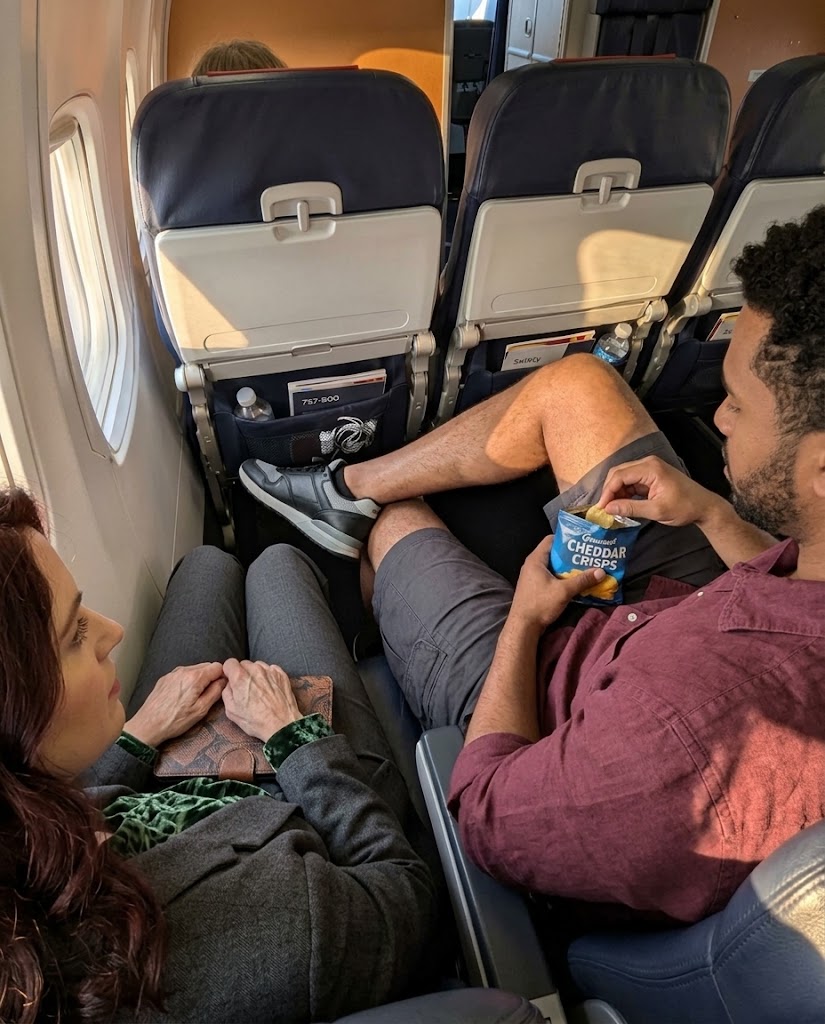
“What the hell did you do?” Josh stopped in the aisle and stared at the empty window seat where I had been sitting less than ten minutes earlier. Several passengers looked up, including Henry, the older gentleman who had spent most of the flight reading beside us. I was now two rows back in an empty aisle seat, my aching hip finally straight and both feet planted in the space I had actually paid for. For nearly four hours, Josh had spread his knees into my seat, taken over the armrest, pushed one loafer into my legroom, and treated every polite request to move as though I were creating the problem. “You’re tiny,” he had told me the first time I objected. “You don’t need all that space.” At sixty-one, five-foot-two, recently widowed, and traveling alone to meet my first granddaughter, I had spent most of the flight doing what I had done for much of my life—making myself smaller because confrontation felt worse than discomfort. Then Josh went to the restroom, and I finally stopped.
The flight had begun pleasantly enough. Josh introduced himself, Henry congratulated me when I mentioned baby Rose, and I settled beside the window with photographs my daughter Marianne had sent that morning. It was my first long trip without Steven, my husband of thirty-four years, and traveling alone still made ordinary things feel slightly off balance. Twenty minutes after takeoff, Josh’s knee pressed against mine. When I shifted, he followed. When I asked him to move, he laughed. Soon his jacket was draped over the divider, his elbow blocked my tray table, and his foot occupied the space beneath the seat in front of me. A flight attendant even stopped once and asked whether everything was all right. I smiled and said yes because Josh was watching me and because I hated scenes. The moment she walked away, his knee came back. By the fourth hour my hip hurt, I had read the same page four times, and I realized I was protecting the comfort of a stranger who had shown no interest in protecting mine.
When Josh finally went to the restroom, I asked the attendant whether another seat was available and explained what had been happening. She apologized and moved me two rows back. Henry quietly confirmed that he had heard me ask Josh several times to stay on his side. When Josh returned and demanded to know what I had done, the attendant told him to lower his voice and sit down. He immediately tried to use my earlier silence against me. “You asked her before,” he said. “She said everything was fine.” For one second, I nearly let him have that version because passengers were watching and I could feel my hands starting to shake. Then I told the truth: I had said I was fine because I wanted to avoid an argument, but I had not been fine. I had repeatedly asked him to move. Henry backed me up. The attendant confirmed that I could remain in my new seat and advised me that I could make a customer-service report after landing if I wished. What unsettled Josh most was not that I had moved. It was that I had stopped agreeing to pretend nothing had happened.
Half an hour later, he came back to my row with an apology that was really a request. He said he was sorry “if” he had made me uncomfortable, then immediately asked whether I intended to file a complaint because he traveled frequently for work and did not want anything attached to his name. He never asked whether my hip still hurt. He wanted reassurance that his behavior would have no consequence. I told him I had not decided. After landing, instead of hurrying straight to baggage claim, I went to the airline’s customer-service desk and submitted a written account of what had happened, including the attendant’s intervention and the seat change. I did not ask for compensation or demand punishment. I simply wanted the incident documented accurately. For years I had treated smoothing things over as a kind of virtue, even when doing so required me to edit my own experience. Filing that complaint was less dramatic than shouting at Josh in the aisle, but it mattered more. For once, I wrote down what happened without shrinking it to make somebody else comfortable.
Then Marianne called to tell me Rose was awake. By the time I reached arrivals, my daughter was waiting with my granddaughter bundled in her carrier. Marianne took one look at me and asked what had happened, so I told her a man had decided his ticket included half my seat. “I managed to move,” I said. “And I reported him.” She smiled and told me she was glad I had stood up for myself. Then she placed Rose in my arms, and everything else disappeared for a while. My granddaughter was smaller than I imagined, with round cheeks and one tiny hand that closed around my finger. Steven should have been there; he had once promised to teach our future grandchildren to make lemon cakes, even before they had teeth. Marianne sat beside me on a bench and rested her head against my shoulder while Rose slept against my chest. I had spent hours on the plane being told, in one way or another, that I did not need the space I had been given. Now the two people I had crossed the country to see were making room for me without being asked. When Marianne said we had all afternoon, I held Rose a little closer and stayed where I was. For once, nobody expected me to give up my place.

