
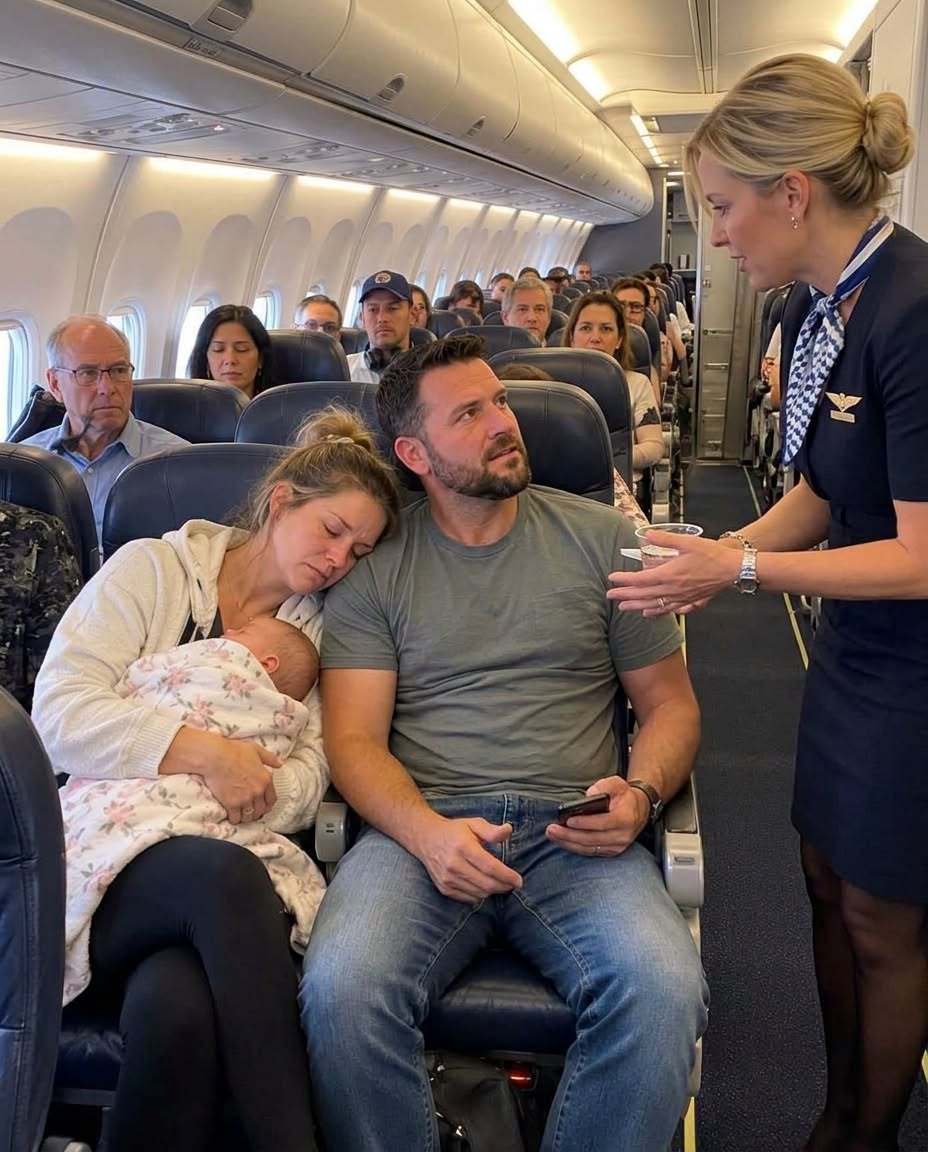
The wheels hit the Chicago runway hard enough to wake Lily in my arms, and before the seat-belt sign went dark, the stranger beside me leaned close and said, “Someone at arrivals is asking airport security where to find you.” His name was Noah Whitman, though I had learned that only after boarding, when a flight attendant addressed him with the kind of careful respect reserved for men whose names appear on buildings. Earlier, somewhere over Missouri, he had quietly asked whether I would pretend to be asleep against his shoulder because photographers were watching him and he wanted one hour without another photograph of grief becoming a headline. Now his face was no longer tired; it was alert. A security woman named Mara met us at the aircraft door and told me a man downstairs was claiming there was a custody emergency involving my daughter. My almost-ex-husband Ryan had changed the locks on our apartment, frozen the account I used for groceries, and gone nearly three weeks without asking to see Lily, yet somehow he knew our flight number. When Mara added that somebody had already removed my gray suitcase from baggage claim—the suitcase containing Lily’s birth certificate, my divorce filings, emergency cash, and photographs documenting the night Ryan grabbed my wrist too hard—I stopped believing any of this was coincidence.
Ryan had always been good at controlling the story. By the time Noah’s people moved Lily and me through a restricted airport corridor, Ryan had filed an emergency petition in Texas portraying me as unstable, paranoid, and likely to disappear with our child. Attached was a statement from a doctor I had never met and an affidavit from Ryan’s new girlfriend, Heather, a woman who barely knew me but apparently knew enough to swear I was dangerous. Aunt Claire, the only person I had told about Chicago, called to say a man claiming to be Ryan’s lawyer had appeared at her apartment and warned her against helping me. Noah arranged a secure hotel suite and an attorney, Vivian Hart, who quickly pointed out the flaws in Ryan’s filing: there was no existing custody order forbidding travel, the medical statement appeared suspect, and the theft of my documents could become evidence of a coordinated effort to interfere with my legal rights. Then airport surveillance changed everything. The man searching for me was not Ryan’s attorney. Noah recognized him as Graham Vale, a former Whitman Group insider accused of stealing from the company. When Noah mentioned another old Whitman associate named Margaret Sloane, I felt the room shift beneath me. Sloane had been my mother’s family name, and suddenly I remembered the tiny brass key my mother had pressed into my hand before she died—a key Ryan had quietly removed from my ring years later.
By nightfall, the pieces had become frighteningly clear. Surveillance showed Ryan meeting with Vale weeks before I fled, and a hidden phone discovered inside Lily’s diaper bag rang with Ryan’s voice telling me he wanted the brass key and his daughter because Lily was “insurance.” He spoke about a Chicago vault, a founding family trust, and a woman named Margaret who had hidden assets from the Whitman empire decades earlier. An investigator named Elias Mercer arrived with my recovered suitcase and a cache of old documents, revealing that Margaret Sloane had been my grandmother and had instructed him years earlier to watch over me from a distance. Then Vale—whose real role was as the architect of the entire scheme—appeared with Ryan and tried to force me to sign away any interest in what the documents called the Aurora Trust. Ryan finally admitted he had married me because he had been told I might someday control a fortune. What he had not known was that Noah and Mercer had expected Vale to come. Federal agents were waiting outside the suite, and Mercer had been recording everything. The final evidence was biological: preserved records tied my mother’s line to Noah’s father, Thomas Whitman. Noah and I were not strangers thrown together by chance. We were half-siblings.
The legal unraveling that followed was less cinematic and far more consequential. Ryan’s communications with Vale, the fraudulent custody allegations, the financial coercion, and the attempt to use Lily as leverage destroyed his credibility in family court and triggered separate criminal scrutiny. Vale’s efforts to manipulate the Aurora Trust became part of a broader federal investigation into fraud, theft, and corporate misconduct. I did not become an executive or march into Whitman Group demanding a throne. Instead, with independent counsel and fiduciary advisers, I established what assets legally belonged to me, what belonged to Lily’s bloodline interest, and what required court or trustee approval before anyone could touch it. Noah respected that distance. He never treated me as a missing asset his family had finally recovered. He treated me as a frightened woman who happened to be his sister, and that distinction mattered more than the money. When reporters gathered outside Whitman Tower the next morning, I finally told my own story: I had arrived in Chicago with a baby, two suitcases, and nowhere safe to sleep. I had not come searching for a fortune. I had come searching for safety and discovered that the stranger who had offered me his shoulder on an airplane belonged to the family history someone else had spent decades trying to erase.
Six months later, I redirected much of what came to me through the Aurora Trust into the Margaret House Foundation, providing emergency housing and legal support to mothers facing financial abuse, custody intimidation, and homes where access to money had become a weapon. Mercer eventually brought me a cassette recorded years earlier by Margaret. Her voice crackled through an old player and told me that if I was hearing the tape, then the truth had probably arrived “like thunder.” Then came her final surprise: my seat beside Noah had not been accidental. Years earlier, she had instructed Mercer that if Ryan ever turned dangerous and I fled with a child, he was to get me onto the safest flight possible—and, if he could, place me near Noah. I looked at Mercer, then at the brother I had met only because he once needed a stranger to pretend she belonged beside him. For thirty-one years I had believed my life was a chain of people leaving: the father I never knew, the mother I lost too young, the husband who betrayed me. Instead, beneath all that absence was a path someone had quietly built toward home. Noah reached for my hand and said, “Come home.” I looked down at Lily, who had fallen asleep against his shoulder exactly as I once had, and smiled. “I already did.”

