
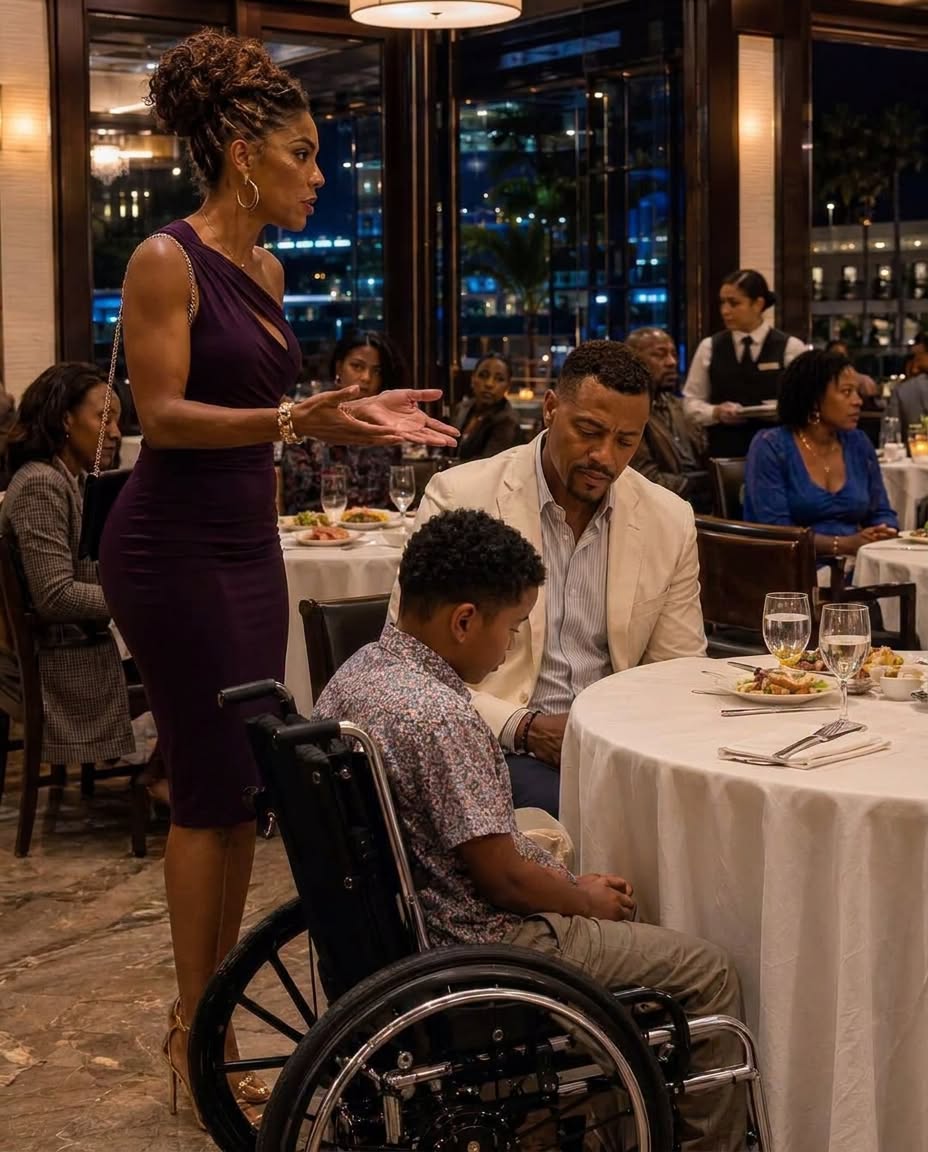
“Move him somewhere else,” the woman said, pointing at my nine-year-old son’s wheelchair. “It’s ruining everyone’s meal.” The dining room fell silent, and Liam lowered his eyes to the plate where his chocolate-cake joke had stopped halfway through. My husband Ben pushed back his chair, but I caught his wrist because I wanted every person nearby to hear what came next. Liam had brushed an empty chair with one wheel, apologized immediately, and been told by the server that he was not blocking the aisle. Still, the woman stood beside our table as if his presence required justification. When Liam whispered that we could eat upstairs, I knelt beside him and asked whether he had done anything wrong. Then I stood and told him we were staying exactly where we were.
Five years earlier, a car accident had changed how Liam moved through the world and how our family entered every public space. Vacations now required checking ramps, elevators, bathrooms, table spacing, and backup routes, while Ben still fought the instinct to grab the wheelchair whenever fear overtook trust. That evening had begun differently: Liam raced toward the elevator, teased his father about charging taxi fare, and rolled into the restaurant eager for dessert. Manager Jeff removed a chair without making a spectacle and asked whether the space worked for him. For ten minutes, we were simply a family eating dinner rather than people measuring whether a room had been designed to include us. The stranger at the next table changed that when she turned a harmless bump into a complaint about where Liam was allowed to exist.
When Jeff arrived, the woman—Cindy—claimed that Liam had nearly struck her and that I had threatened her. The server corrected the story, confirming that his wheel touched an empty chair, he apologized at once, and the aisle met accessibility requirements. I asked the diners whether Liam had prevented anyone from moving or eating, and one by one they answered no. Then Cindy’s adult son arrived with his fiancée to celebrate their engagement and learned what his mother had said. A rehabilitation professional who helped injured patients regain mobility, he asked whether she had truly told a child that his wheelchair spoiled the room. Cindy tried to call it a misunderstanding, but Liam quietly said, “I apologized,” and the simplicity of those words left her nowhere to hide.
Cindy eventually faced Liam and admitted that her statement had been cruel, though Jeff still asked her to leave the restaurant. As he explained, an apology acknowledged the harm but did not erase the consequence. Her son declined to follow her and admitted that he had ignored smaller comments for years because confronting them was uncomfortable. No one applauded, which mattered to me; Liam’s humiliation was not entertainment or a public performance. The fiancée offered him a slice of chocolate cake, and his concern about the frosting slowly returned the room to something ordinary. The hotel documented the incident, reaffirmed its accessibility policies, and made clear that compliance involved more than aisle measurements—it required protecting a guest’s equal right to remain where every other guest was welcome.
The next morning, Liam entered the dining room first and personally confirmed that the space around our breakfast table was sufficient. Cindy’s son and his fiancée asked his permission before joining us, and over pancakes he told them that he had always known he belonged there—he had only forgotten for a moment. That sentence stayed with me because prejudice often works by making someone doubt a truth they already understand about themselves. As we left, Ben reached toward the wheelchair handles, then stopped and allowed Liam to move on his own. The night before, a stranger had tried to decide where my son was permitted to exist. By breakfast, Liam had reclaimed that decision without needing anyone to speak over him.