
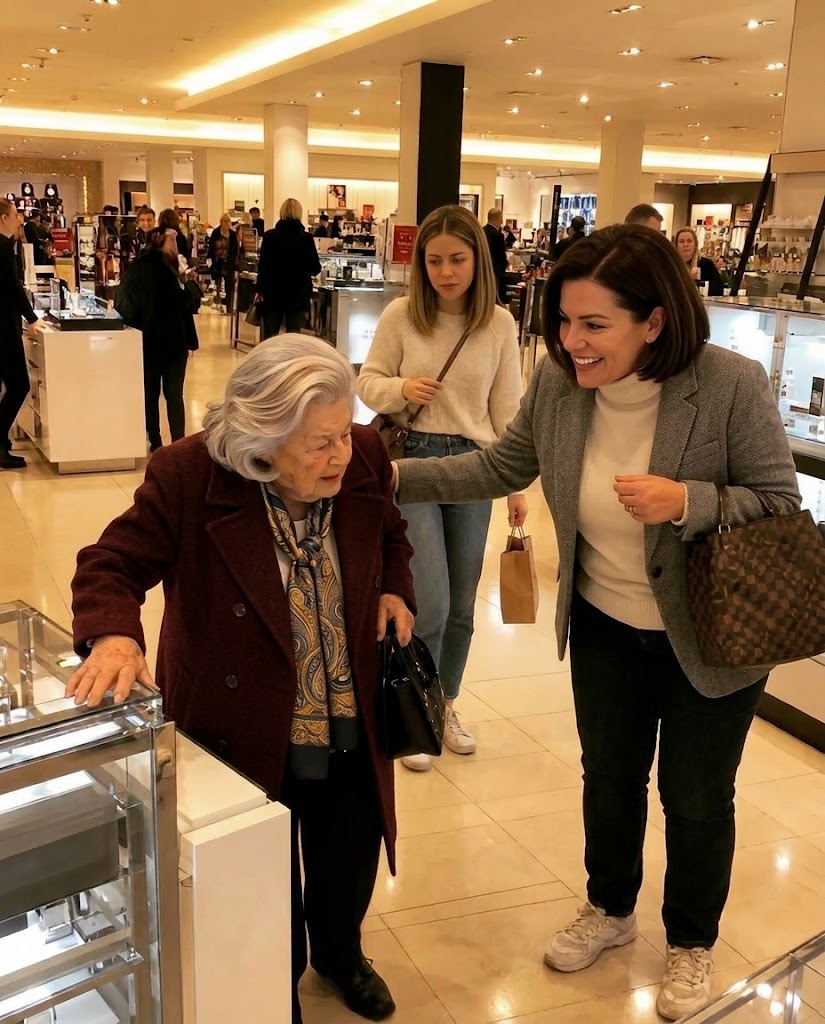
“That coat belongs in a museum,” the woman behind us said, laughing loudly enough for my eighty-six-year-old grandmother to hear. Grandma merely smiled at me and continued placing her Christmas purchases on the department-store counter, the same dark green wool coat buttoned around her that she had worn for as long as I could remember. Then one of its heavy brass buttons came loose, bounced across the polished floor, and stopped beside a security guard’s shoe. He bent to pick it up, started to hand it back, and suddenly froze. On the reverse was a tiny stamped crown above the number 17. “Where did you get this?” he asked. Grandma looked puzzled and said the button had always been on the coat; when she added that she had owned it since she was nineteen, the guard’s expression changed completely. “Ma’am,” he said, reaching for his radio, “please don’t leave.”
Minutes later the store manager arrived carrying an old archival box labeled 1959 FIRE — COAT NO. 17. Inside were photographs, newspaper clippings, and a letter documenting a Christmas-season fire that had torn through the same downtown store sixty-seven years earlier. Grandma went pale before the manager even finished explaining. At nineteen, she had been shopping there when smoke rolled across the ceiling and panic broke out. On her way toward the exit she found a seven-year-old boy pinned beside his injured mother beneath a fallen display. The mother could not stand and begged Grandma to take her son. Grandma grabbed the nearest heavy coat from a rack, wrapped the coughing child in it, and carried him through the smoke until a firefighter pulled them outside. She promised the mother she would return, but part of the ceiling collapsed behind her and firefighters refused to let her go back inside. The boy was taken away by ambulance before Grandma learned his name. She sat on the curb with the green coat across her knees, soot on her hands, convinced the mother had died where she left her.
The manager told us the boy had survived and spent decades trying to identify the young woman who carried him out. His name was Thomas. He remembered almost nothing about her face because the smoke had burned his eyes, but while she held him, one brass button had twisted beside his cheek. He remembered staring at the little crown and the number 17, afraid that if he closed his eyes he might never open them again. Old store catalogues eventually identified the coat, but nobody knew who had taken it from the building that day. Thomas left photographs with the store in case his rescuer was ever found: graduation, marriage, children, grandchildren—a life Grandma had never known continued because she had carried one frightened boy toward daylight. Four days later, they met in a quiet room upstairs. Thomas entered with white hair and a walking stick, touched the button, and whispered, “Seventeen.” Grandma immediately apologized for failing to save his mother. Thomas answered by turning toward the doorway.
An elderly woman was wheeled into the room beneath a blue blanket. “Mom,” Thomas said, kneeling beside her, “we found her.” Grandma gripped my arm so hard it hurt. The woman had survived the fire after all. The fallen display had partly shielded her when the ceiling came down, and firefighters reached her through a service entrance; she spent months in the hospital with a badly injured leg. Grandma knelt beside her and sobbed that she had broken her promise to come back. The woman took her hand and told her the opposite was true. She remembered hearing the ceiling cracking and fearing Grandma would put Thomas down and attempt another rescue. “I needed you to keep going,” she said. “You took my boy out.” Because of that decision, she had watched him return to school, marry, become a father, and eventually a grandfather. Thomas showed Grandma a photograph of his youngest granddaughter, also seven years old—the same age he had been in the fire. “You gave me the chance to know her,” he said. Sixty-seven years of guilt did not disappear in one afternoon, but for the first time Grandma finally knew the ending of the story she had been carrying alone.
That evening, I helped her hang the green coat in the hallway. Its cuffs were frayed, the wool had softened with age, and the missing button had been carefully sewn back into place by the same security guard who first recognized it. For years I had offered to buy Grandma something newer, warmer, and less worn, and she had always answered, “This one still keeps me warm.” I used to think she meant only that an old coat still did its practical job. Now I understood that it had carried a terrified child through fire, held the memory of a mother Grandma believed she had abandoned, and survived sixty-seven winters until all three lives crossed again. Before I put it away, Grandma stopped me and fastened the top brass button herself. She ran her thumb over the little crown and the number 17, then smiled through fresh tears. “This one still keeps me warm,” she said again. This time, I knew she was not talking about the wool.

