
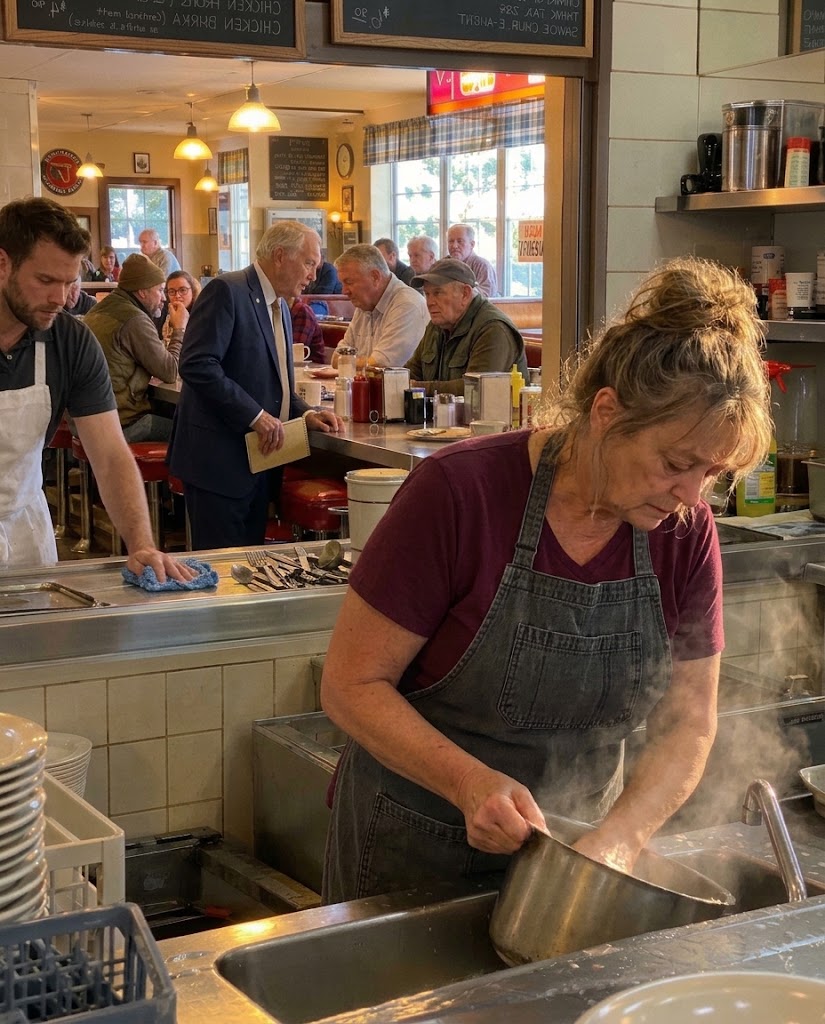
The steam from the industrial dishwasher fogged my glasses as I tried to close my swollen fingers around another greasy plate. Through the narrow serving window, I could hear the familiar clatter of coffee cups and the little brass bell above the entrance to Gus’s Diner, where I had worked for thirty-eight years. Only that morning, I had been pouring coffee for customers whose orders I knew better than my own grocery list; now I stood alone in a windowless room that smelled of bleach, old grease, and scalding water. My new boss, Chad Whitmore, had explained the change with a polished smile, announcing that the restaurant needed younger faces and fresh energy to attract a different crowd. At sixty-two, with arthritis stiffening my knuckles and aching knees that protested after every shift, I apparently no longer belonged in the dining room. He called the reassignment a favor, claiming that washing dishes for the same hourly wage would be easier than serving tables. I had wanted to take off my apron, leave through the back door, and never return, but instead I tied on the heavy rubber apron and began scrubbing. What Chad didn’t understand was that Gus’s had never been merely a place where people bought breakfast, and by the following morning, nearly everyone who mattered to that diner would make certain he understood.
My name is Beverly Ann Novak, though everybody in Millbrook calls me Bev, and I started working at Gus’s Diner in 1988 when I was twenty-four years old. I had just left my first husband with my four-year-old daughter, Carrie, forty-one dollars, and a Pontiac that wouldn’t shift into reverse. Gus Petros, the big, bald owner who had inherited the restaurant his father opened in 1971, hired me without experience after discovering that Carrie was waiting in my car. He brought her inside, made her a pancake shaped like Mickey Mouse, and told me she could sit at the counter each morning until the school bus arrived. That small kindness allowed me to earn a living when I had almost nothing, and I never forgot it. Over the decades, Gus’s became the center of a town where farmers arrived before sunrise, retired couples lingered over coffee, and children learned that their birthdays would be remembered. I knew Dale Lindgren wanted his eggs over medium and occasionally sneaked two strips of bacon beneath his hash browns despite his wife’s objections. I knew the Miller boys, whose mother died in a highway accident, came every birthday to share pancakes with candles and free chocolate milk because she had started that tradition. I knew Walter Haugen had ordered the same pancakes for thirty-one years but still liked looking over the menu before deciding. I knew Pastor Jim wrote his sermons on napkins in the corner booth, and that Marlene and Bonnie, two sisters who ran a flower shop, had spent more than twenty years communicating through me after a family argument neither would explain. Most of all, I knew Ed Kessler, a seventy-four-year-old retired farmer who arrived at 6:15 every morning, sat on stool three, and ordered black coffee and plain wheat toast. He always counted out exactly one dollar and eighty-five cents, stacking his coins neatly before leaving, and he never allowed anyone but me to fill his cup. Gus understood these relationships because he had spent his life building them. When he died unexpectedly in January at eighty-one, his children sold the business to Chad, a thirty-year-old entrepreneur from Des Moines who arrived with a laptop, a sleeveless vest, and plans to turn the old diner into a fashionable breakfast destination. He replaced the weathered sign with one reading “Rise & Grind,” removed the paper menus in favor of QR codes, raised prices, charged for coffee refills, and introduced dishes that confused customers who simply wanted eggs, pancakes, and biscuits with gravy. He hired a young culinary-school graduate named Tanner and a nineteen-year-old waitress named Madison, neither of whom deserved blame for the changes. Madison was eager to learn, but she didn’t know the regular customers or their habits. Within weeks, business was already suffering, yet Chad decided the solution was to move me out of sight. I said nothing when he sent me to the dish pit, partly because I needed my job and partly because I remembered a promise Gus had made fifteen years earlier: as long as his diner existed, there would always be a place for Bev out front.
The morning after my reassignment, I arrived at 5:15 and began washing dishes while Madison prepared for another difficult shift. She looked exhausted and asked whether I hated her for taking my position. I assured her that she hadn’t taken anything; she’d needed a job, and Chad had offered one. At six o’clock, the bell above the entrance began ringing, and it scarcely stopped for twenty minutes. Through the serving window, I watched Dale and his wife Joanne arrive together, followed by the Miller boys and their father, Walter Haugen with his cane, Pastor Jim, the flower-shop sisters, farmers still wearing muddy boots, local shopkeepers, teachers, and families whose children I had served for decades. The diner seated forty-eight people, but by 6:20, at least seventy had crowded inside, filling every stool, booth, and available space along the walls. Madison approached Dale’s table and cheerfully asked what he wanted for breakfast. “Whatever Bev’s making,” he replied. Joanne requested the same thing. At the next table, the Miller boys repeated the answer, followed by Walter, the farmers, Pastor Jim, and nearly everyone else. Madison eventually returned to the kitchen carrying page after page of orders bearing those identical words. I had called nobody and organized nothing; I had spent the previous evening soaking my aching hands, eating canned soup, and wondering whether I could bear another day in the back room. Chad emerged from his office, saw the packed restaurant, and attempted to explain that I no longer worked out front. Dale simply told him they would wait until I was making something. Then the bell rang again, and Ed Kessler entered wearing a dark gray suit, polished shoes, and a tie I had never seen him wear in twenty-eight years. He walked past his usual stool carrying a manila folder and stopped directly in front of Chad. “I’d like a word about your lease,” he announced. Chad looked confused until Ed identified himself as the owner of Kessler Holdings, the company that controlled the diner building. In 2011, when Gus had faced foreclosure after serious medical expenses and mounting debt, Ed had quietly purchased the property, settled the bank’s claim, and leased it back to him at an affordable rate. I remembered Gus telling me that an anonymous benefactor had saved the restaurant, but I had never suspected Ed. Now he opened the folder and read a provision from the commercial lease: Beverly Ann Novak was to remain employed as head waitress at her existing rate of pay for as long as she wished, and any reassignment without her written consent constituted a lease default. The provision, signed by Gus and Ed and carried forward through the lease assignment Chad had accepted, gave the landlord grounds to pursue termination after thirty days’ written notice. Chad’s face lost its color as he realized that his attempt to remove an older employee could jeopardize the business in which he had invested his savings and borrowed money. Ed explained that he had consulted an attorney about the clause and was prepared to enforce the contract. Then he turned toward the dish-pit window, where I stood with aching hands and water dripping from my fingers. For the first time since Gus’s funeral, I understood that the promise he had made beside the grill had not died with him. But Ed’s decision to protect me was about more than a lease, and the reason reached back to a cold November morning in 1998 when a grieving farmer had walked into the diner intending to drink one final cup of coffee.
Ed’s wife, Lorraine, had died of ovarian cancer that October, leaving him alone after thirty years of marriage. For weeks, he withdrew from the community, neglected his farm, and sank into despair so deep that he later admitted he had been considering ending his life. One morning, he stopped at Gus’s, sat on stool three, and barely responded when I offered coffee. I brought him two slices of plain wheat toast, although he hadn’t ordered any, and when he finished eating, I told him I would see him the following morning. Years later, Ed confessed that those ordinary words had given him a reason to return the next day, and the day after that, until life gradually became bearable again. Coffee and toast had cost one dollar and eighty-five cents in 1998, and although prices rose, Ed continued paying the original amount because he never bothered checking the menu. Rather than correct him, I quietly covered the difference from my tips, sometimes only a few cents and eventually more than two dollars each morning. Standing in the crowded diner, Ed revealed that Gus had noticed my habit years earlier and told him about it. Ed had allowed the arrangement to continue because he understood it was my private way of showing concern. Then he handed me an envelope containing $11,200, which he described as repayment with interest for the breakfasts I had helped cover over the years. I could barely speak. Chad, meanwhile, admitted that revenue had fallen by nearly thirty percent since he took over and that he had been trying desperately to attract customers while ignoring the people who already depended on the place. Ed pointed out the mistakes: charging farmers for refills, removing menus older customers could actually use, changing familiar recipes, and pushing a longtime waitress into a hot back room because of her age. The lease provision gave us leverage, and I knew that moving me out of the dining room specifically because I was older also raised serious concerns about age discrimination under employment law. But instead of asking Ed to terminate the lease immediately, I told Chad that I would not consent to the reassignment and that I wanted him to understand what he was trying to manage. I explained how the Miller boys came for their mother’s memory, how Mr. Haugen valued the familiar ritual of choosing his pancakes, and how some lonely customers needed to know someone would notice if they stopped appearing. I didn’t reveal Ed’s private struggles, but I told Chad that not everyone walked through those doors simply because they were hungry. For thirty-eight years, I had helped make the diner a place where people were remembered. Chad finally admitted that he didn’t know how to run that kind of establishment and asked whether I would teach him. I agreed on one condition: he would spend an entire shift washing dishes in the room where he had sent me, listening through the serving window to the customers and staff. He accepted the rubber apron, and Madison showed him how to operate the dishwasher while I returned to the kitchen to prepare breakfast for seventy people. Tanner followed my directions for Gus’s biscuits and gravy, and I made pancakes, eggs, and cinnamon rolls the way our regulars remembered them. The room filled with conversation again, and even the flower-shop sisters managed to exchange a few words directly for the first time in years. At three o’clock, after spending the day in the dish pit, Chad went to sit with a worried farmer who had barely touched his breakfast. He listened without offering advice, just as Gus once had, and a week later an anonymous envelope appeared in that man’s mailbox. I never asked what it contained. Soon afterward, Chad restored the old Gus’s Diner sign, brought back paper menus and free coffee refills, returned the Farmer’s Breakfast to a reasonable price, and asked Tanner to keep the gravy simple. Some newer dishes remained, including avocado toast, because younger customers genuinely enjoyed them, but the restaurant stopped pretending that its history was something to erase. Madison stayed, learned the regulars’ names and preferences, and began considering a future in social work. Chad started arriving before dawn to turn on the grill, pour coffee, and greet customers himself. Business improved as longtime patrons returned, and he eventually repaid the loan his father had given him. I kept Ed’s envelope unopened, planning to use the money someday to help the Miller boys with college expenses, because their family had already endured more than enough loss.
On the thirty-ninth anniversary of my first day at Gus’s Diner, I arrived to find the grill hot, the coffee ready, and a chocolate cake sitting on the counter with thirty-nine candles. Chad had written “BEV — 39 YEARS — THE HEART OF THIS PLACE” across the frosting in uneven blue letters, and he admitted with some embarrassment that Tanner had baked the cake while he handled the decorating. The bell above the door began ringing, and familiar faces filled the room: Dale and Joanne, the Miller boys, Walter with his cane, the farmers in their work boots, Pastor Jim, and Marlene and Bonnie, who were now speaking to each other without needing me to translate. Ed took his place on stool three, wearing his old barn coat and John Deere cap instead of the suit he’d worn the morning he confronted Chad. Everybody sang an enthusiastic, thoroughly off-key birthday song even though it wasn’t my birthday, and I blew out the candles while trying not to cry. Then Chad came around the counter and held out his hand. “As long as there’s a Gus’s, there’s a Bev,” he told me, repeating the words Gus had spoken in 2011. Ed had shared the story with him, and Chad wanted to make the same promise now that he understood what it meant. His hand was different from the soft one I remembered when he first bought the diner. There were small burns and calluses from working the grill, carrying heavy trays, and wrestling with the dishwasher’s stubborn hose. I shook it, grateful that he had learned not just how to run a restaurant but how to take responsibility for the people who made it worth visiting. Yet that morning brought another change, one that mattered to me even more than the cake or the applause. When Ed sat down, I handed the coffee pot to Madison and told him she would be serving him. For twenty-eight years, he had refused to let anyone else fill his cup, but I reminded him that I was sixty-three now and that someday my knees or hands might prevent me from arriving at 6:15. I wanted him to know that someone else would remember his black coffee, his plain toast, and the words he needed to hear before leaving. Ed looked at Madison for a long moment, then slowly removed his hand from the top of his cup. She poured without spilling a drop, and after breakfast, she told him she would see him tomorrow. He answered, “Tomorrow,” in the same quiet voice I had heard for nearly three decades. Chad had even created a special entry in the register for Ed’s breakfast, fixing the price permanently at one dollar and eighty-five cents. It was a small thing, but by then he understood why it mattered. Sometimes I think about the morning he sent me to the dish pit and how close I came to leaving the diner behind. I stayed because Gus had once given a frightened young mother a job, because I had spent decades learning the lives of the people who came through our doors, and because I could not bear the thought of Ed arriving to find no familiar face waiting behind the counter. I know now that even the person who spends a lifetime noticing everyone else deserves to be noticed in return. The diner looks much as it did when Gus was alive, although the old sign has a new wooden plaque beneath it that reads “ASK FOR BEV.” I still pour coffee most mornings, but sometimes I hand the pot to Madison and watch her greet a customer by name. That is when I feel Gus closest: not in the building he left behind, or even in the promise he arranged to protect me, but in the small acts of kindness that have outlived him and are finding their way into younger hands. Ed still comes at 6:15, counts out his change, and leaves knowing someone expects to see him tomorrow. And when the bell rings over the door, I still look up, ready to welcome whoever has come in from the cold.

