
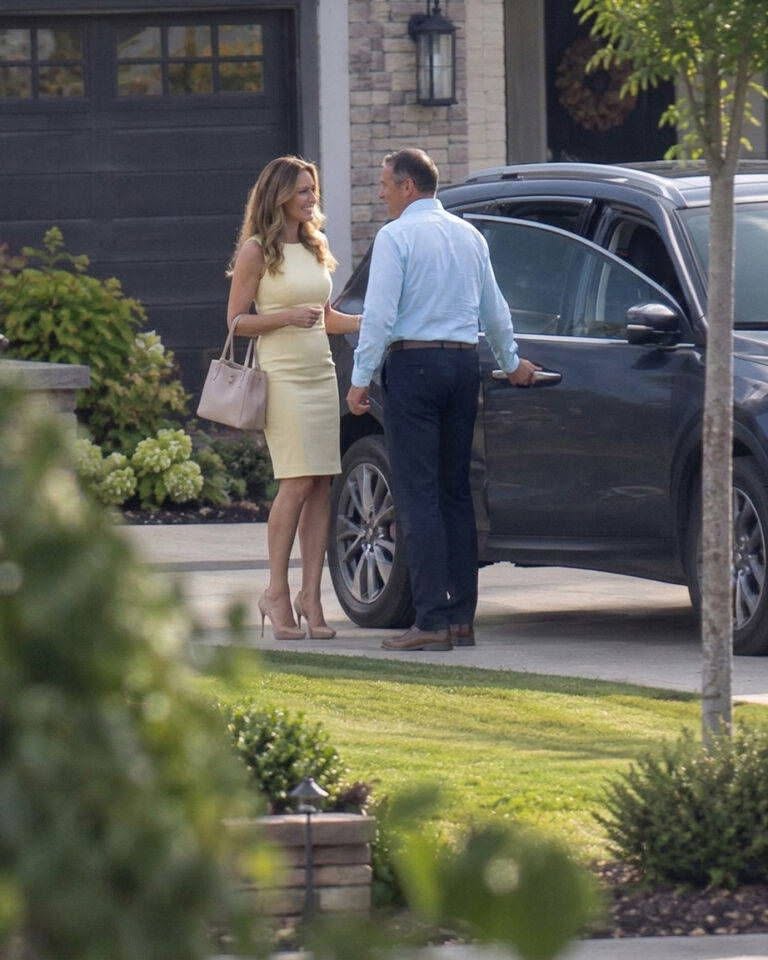
After I broke my leg, my husband insisted he “couldn’t be late for work” whenever I asked him to drive our girls to school. Funny, because he somehow had time to pick up his young, pretty coworker. He needed a lesson. So I left one small surprise in her seat, and that man will remember it for life.
“Is your mom coming tomorrow?”
Harold asked while I sat halfway up the stairs, one crutch wedged beneath my arm and Nicki’s coat across my lap.
I stared at him.
He was holding coffee.
I was trying to work a zipper one-handed while balancing a seven-year-old’s sleeve over the cast on my left leg.
“No. My mother is not driving an hour here, taking the girls to school, driving an hour home, then doing it again tomorrow.”
Harold checked his watch.
“What about Linda next door?”
“Linda has a job.”
“So do I.”
I stopped fighting with the zipper.
“Harold, they’re your children.”
“I know that.”
“Then take them.”
“The school is across town.”
“So leave earlier. Or work from home once in a while and take them then.”
He sipped his coffee.
“Scarlett, that’s not practical.”
Nicki looked between us.
“Mommy’s leg isn’t practical either, Dad.”
From the kitchen, Sasha shouted, “Nicki took my blue marker!”
“I did not!”
“You literally have it!”
Harold grabbed his briefcase.
“See? Mornings are chaos.”
Then he walked out.
***
Three weeks earlier, I’d slipped on wet tile outside a grocery store and broken my leg badly enough to require surgery and a cast. My doctor had forbidden me to drive.
Before that, I handled breakfast, lunches, shoes, permission slips, and school drop-off for nine-year-old Sasha and seven-year-old Nicki.
Harold never officially called any of it my responsibility. He simply became busy at exactly the right moments until it was.
My mother drove over twice, our neighbor helped three mornings, and I paid for a car service once while the other parent in our house refused to take them.
Every time I asked Harold, his answer was the same: he “couldn’t be late for work.”
If I pushed, he’d repeat it.
“Scarlett, I can’t be late for work.”
Then came my hospital appointment.
I took a taxi because Linda had already agreed to drive the girls.
The doctor examined my leg, said it was healing well, and warned me not to get overconfident.
I promised I wouldn’t.
Then I crutched through the hospital entrance and spotted Harold’s car.
For a second, I thought something had happened.
Maybe he’d come looking for me.
Then I realized his car wasn’t parked at the hospital.
It was across the street outside an apartment building.
A woman hurried out.
Adele.
I’d met her at Harold’s company Christmas party.
She was twenty-something, maybe thirty, pretty, with long dark hair and the kind of polished appearance most people couldn’t manage at eight in the morning.
Harold got out, walked around the car, and opened the passenger door for her.
She smiled.
Then he climbed behind the wheel, and they drove toward his office.
I stood on my crutches watching the taillights disappear.
Apparently, detours weren’t the problem.
The passenger was.
For ten miserable minutes, I let myself imagine the obvious.
Then I remembered Adele had spoken warmly about her boyfriend at the Christmas party.
That proved nothing.
Neither did Harold opening a car door for her.
But one thing was undeniable.
He had time.
***
That evening, I waited until the girls were upstairs.
“I saw you this morning.”
Harold was opening the refrigerator.
“At the hospital?”
“Near it.”
His hand froze on the milk.
“Adele got into your car,” I said.
He relaxed so visibly I almost laughed.
“Oh. That.”
“Yes. That.”
“Her car broke down.”
“And?”
“And I’m giving her a ride.”
I adjusted my crutches against the counter.
“You told me you can’t take Sasha and Nicki to school because it’ll make you late.”
“It will.”
“But picking Adele up won’t?”
“Her apartment is closer to the office.”
“It’s nowhere near our house.”
“It’s not that bad.”
I stared at him.
For eleven mornings, my mother had crossed half the city.
Our neighbor had rearranged meetings.
I’d balanced cereal bowls against my cast because standing at the counter hurt.
And Harold was explaining that his coworker’s neighborhood wasn’t that bad.
“You’d rather drive across town for Adele than take your daughters to school.”
“Don’t make this weird.”
“I’m not making anything.”
“Her car is in the shop,” he muttered. “Who else is supposed to give her a ride?”
I blinked.
“Apparently the same mysterious person taking your daughters.”
He rubbed his forehead.
“You have your mom. You have Linda.”
There it was.
You have your mom.
You have Linda.
Not “we.”
“Coworkers need help too,” he said.
I looked at him.
“Of course they do.”
Something in my tone made him frown.
“What does that mean?”
“Nothing.”
For once, I stopped arguing.
***
The next morning, Sasha was working at the kitchen table while Harold got ready.
The first draft of her school project covered half the surface.
At the top, written in purple marker, were the words:
PEOPLE WHO HELP MY FAMILY
Several drawings filled the page.
I recognized myself immediately by the red hair and enormous gray cast.
Under MOM, Sasha had written:
Takes us to school.
Makes lunch.
Knows where everything is.
Nicki had added another line beneath it:
EVEN WITH THE GIANT LEG.
I laughed.
“Thank you, I think.”
Nicki grinned.
Then I noticed the right side.
DAD.
Harold was drawn inside a blue car.
Beside him sat a stick figure with long black hair.
Sasha had written:
Takes Miss Adele to work because her car is broken.
Below it, in Nicki’s unmistakable block letters:
OUR SCHOOL IS TOO FAR.
Apparently, the girls had heard everything.
I studied the poster, then looked toward the hallway.
Harold was humming while tying his shoes.
I didn’t add anything.
Didn’t cross anything out.
Didn’t explain.
When the girls went upstairs to brush their teeth, I folded the poster twice with the drawings hidden inside and placed it on the passenger seat of Harold’s car.
An hour later, my phone rang.
I answered.
“Scarlett, what have you done?” Harold shouted. “Adele saw it!”
I moved the phone slightly away from my ear.
“Good morning to you too.”
I set down my coffee.
“Adele saw that thing,” he said.
“What thing?”
“You know exactly what thing!”
I smiled toward the kitchen window.
“Sasha’s first draft?”
“She opened it in the car!”
“Why?”
“Because she sat on it! It was folded with the blank side facing up,” he snapped. “I thought it was just scrap poster board.”
That was unfortunate.
For him.
“Then what happened?”
“What do you think happened?”
I waited.
His voice dropped.
“She read it.”
“And?”
There was a pause.
Then I heard a woman’s voice nearby.
“Tell her what you told me.”
Adele.
Harold muttered something I couldn’t make out.
“Harold.”
I sat straighter.
“What did he tell you?”
Another silence.
Then Adele answered.
“He told me he already drives the girls to school before he picks me up.”
I looked toward the stairs.
Sasha’s backpack sat beside Nicki’s, ready for yet another person to take them.
“He said what?”
Harold cut in.
“I didn’t say every day.”
Adele made a sound that needed no translation.
“You said, ‘I’m already out with the girls anyway.’”
I closed my eyes.
“Adele,” I said, “did you ask him to pick you up?”
“No. I told him I’d get a rideshare.”
Harold interrupted.
“This is ridiculous.”
Adele ignored him.
“He said it was no trouble because he was already doing school drop-off.”
Then I heard a car door open.
“Adele?”
“I’m getting out.”
“You don’t have to.”
The door slammed.
Harold came back on the line.
“Do you have any idea how embarrassing that was?”
I looked down at my cast, then at the two lunchboxes I’d packed before seven.
“Harold, I didn’t write it. Your daughters did.”
He exhaled.
“You put it in my car.”
“Yes.”
“You knew she’d see it.”
“I knew it was there. I didn’t realize your coworker provided complimentary document review with every ride.”
“Scarlett.”
“If the passenger seat was unavailable, I suppose that became a problem.”
He went quiet.
Then he said, “I have to go.”
“Don’t be late.”
He hung up.
I expected him to come home furious.
Instead, Adele called me that afternoon.
“I hope this isn’t inappropriate.”
I was on the couch with my leg elevated, a laundry basket beside me that I’d stopped pretending I could carry.
“Today passed inappropriate around 8:30.”
She laughed.
Then her voice turned serious.
“There’s something else.”
“What?”
“Harold talks about you at work.”
My fingers stopped sorting a sock.
“What does he say?”
“Nothing terrible.”
That sentence never improves anybody’s afternoon.
“He says you’re very particular.”
“About what?”
“Everything, I guess.”
I waited.
Adele continued.
“He says he tries to help at home, but you usually redo things, so you’ve both learned it’s easier if you handle the house and he handles other stuff.”
I stared at the laundry basket.
I remembered the time he’d packed a school bag with three toys, no homework, and a yogurt without a spoon. Another time, he’d wedged a wooden cutting board against the dishwasher’s spray arm.
Each time, I’d fixed the problem.
Eventually, I stopped asking because correcting the same things took longer than doing them myself.
Adele said, “He makes it sound like you don’t let him help.”
I picked up one of Nicki’s socks.
“No.”
“No?”
“I stopped asking.”
After we hung up, I opened the route app on my phone.
Home to school to Harold’s office.
Twelve extra minutes.
Then I entered Adele’s address.
Twenty-five.
I left both routes on the screen.
Harold came home just after six.
The girls were doing homework at the table when he set down his keys.
“We need to talk.”
“Great.”
I turned my phone toward him.
“Why was twenty-five minutes for Adele easier than twelve minutes for them?”
He looked at the screen.
Sasha leaned across her math worksheet.
“Twelve is smaller.”
Nicki looked too.
“Way smaller.”
Harold closed his eyes.
“Thank you both.”
“You’re welcome,” Nicki said.
I almost smiled.
Harold pulled out a chair.
“It’s not about the minutes.”
“Then?”
He looked at me.
“So what is it about?”
For once, he didn’t answer immediately.
Sasha erased something on her worksheet while Nicki counted on her fingers.
Finally, Harold said, “Adele appreciated it.”
I stared at him.
He rubbed his thumb along the edge of the table.
“Every morning she said thank you. She called me a lifesaver.”
“And your daughters?”
“They don’t…”
He stopped.
“They don’t what?”
He looked at Sasha.
Then Nicki.
“They don’t thank me for being their father.”
I sat back.
“No, Harold. They don’t.”
He looked almost relieved that I’d understood.
Then I finished.
“Because fatherhood isn’t customer service.”
His eyes dropped to the table.
I tapped my cast with one finger.
“I shouldn’t have had to break a bone for you to notice mornings existed.”
Nobody spoke for several seconds.
Then Harold quietly asked, “What do you want me to do?”
That question used to make me start assigning jobs.
This time, I didn’t.
“Tomorrow morning is yours.”
He looked up.
“What does that mean?”
“It means all of it.”
“Breakfast?”
“All of it.”
“Lunches?”
“All of it.”
“School bags?”
I picked up my coffee.
“You’re getting warmer.”
Sasha raised her hand.
Harold stared at her.
“What?”
“I need poster board tomorrow.”
His eyes automatically shifted toward me.
I took a sip.
“Don’t look at me.”
He turned back to Sasha.
“What kind?”
She smiled.
And for the first time since I broke my leg, Harold reached for his phone to make a note before anyone thanked him.
***
At 6:35 the next morning, he appeared beside my bed.
“Where are Nicki’s sneakers?”
I opened one eye.
“Ask Nicki.”
“She says she doesn’t know.”
“Then you’re both having an exciting morning.”
He left.
Ten minutes later, Sasha yelled that nobody had woken her up.
“You have an alarm!” Harold called.
Nicki shouted from downstairs, “We’re children!”
I pulled the blanket over my face.
Somehow, they left on time.
Barely.
That evening, Harold came home carrying groceries.
“My boss said I can start fifteen minutes later while your leg heals.”
I looked up.
“You asked?”
“Today.”
“And?”
“He said okay.”
Harold stood there holding a loaf of bread.
“I never asked before.”
“I know.”
He sat beside me.
“I didn’t realize how much you did.”
I shook my head.
“You didn’t have to know everything I did. You had to notice I was doing it.”
He nodded.
No flowers arrived.
That helped more than flowers would have.
A week later, Harold handled mornings without asking me for instructions.
One Friday, Sasha found her first draft buried beneath a stack of papers.
“I forgot about this!”
She unfolded it across the breakfast table.
Harold spotted his blue car and groaned.
“Please tell me that’s not being displayed.”
Sasha grabbed a marker.
“I have to fix it.”
Under DAD, she added:
Takes us to school.
Nicki leaned over her shoulder, took the marker, and added one more word.
NOW.
“Sasha!”
“What?” Nicki said. “It’s true.”
Harold looked at the poster.
Then at his daughters.
He held out his hand.
“It’s true.”
For a second, I thought he was going to change it.
Instead, he handed the marker back.
“Leave it.”
Sasha folded the poster.
Harold picked up both backpacks.
“Come on. We’re going to be late.”