
This is a fictional story.
6:18 P.M.
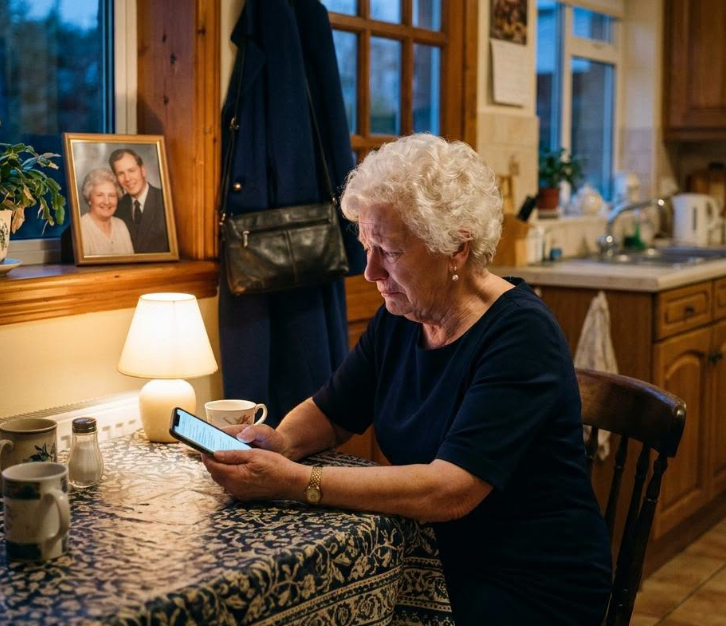
At exactly 6:18 in the evening, my phone buzzed on the kitchen table.
You weren’t invited. My wife doesn’t want you there.
It was from my son, Benjamin.
I was seventy-seven years old, sitting at my kitchen table in my best navy-blue dress, freshly pressed, and the pearl earrings my late husband, Thomas, gave me on our fiftieth anniversary. My purse was by the door. My coat was on the chair.
Benjamin had invited me himself, the Tuesday before. “Come at seven, Mom. You can finally see the new dining room.”
I’d been looking forward to it all week.
Always Something
Since Thomas passed four years ago, the house we bought thirty-nine years earlier has been very quiet. Benjamin called often. But our conversations almost always ended up in the same place.
The mortgage was short this month. The car insurance went up. June needed tuition for her private kindergarten. The landscaping business had a slow quarter.
There was always something. And somehow, I always fixed it.
Benjamin is our youngest. He’s forty-nine now, but some part of me still sees the little boy who sobbed at the gate of summer camp and begged us not to leave. Maybe I spent too many years rescuing him.
Genevieve
His wife, Genevieve, joined our family fourteen years ago. She’s elegant, organized and deeply concerned with how things look. She has a special talent for making you feel small while smiling at you.
At my granddaughter’s fifth birthday party, she introduced me to her friends as “Benjamin’s mother, who helps out with little things sometimes.”
I had cooked every dish at that party and paid for all of it, including the bounce house.
I smiled and said nothing.
When they bought their townhouse, I helped with the down payment. When the renovation went over budget, I helped again. Benjamin promised me their guest room would always be mine whenever I wanted it.
I believed him. Looking back, I’d confused being useful with being wanted.
The Folder
I picked up Thomas’s photo from the windowsill.
“You’d know what to do,” I whispered.
And then I remembered what he’d said to me, more than once, in his last year. “Eleanor, helping someone stand up on their own isn’t the same as carrying them forever.”
I went to my walnut desk, opened the bottom drawer and took out a thick folder labeled BENJAMIN.
Tuition. Mortgage contributions. Car insurance. Business expenses. A country club membership. Dozens of automatic transfers I’d set up over the years and forgotten.
On the last page was the yearly summary I’d prepared for my accountant.
$93,600. An average of seventy-eight hundred dollars every single month.
“Grandma, Are You Coming?”
At 6:47, my phone buzzed again. This time it was from my six-year-old granddaughter, June, on her mother’s old tablet.
Grandma are you coming??
My heart broke right there at the kitchen table.
Not tonight, sweetheart. I love you.
She sent back three pink hearts.
That’s when I finally cried.
Withdrawing Permission
When I’d dried my eyes, I called my bank’s after-hours line.
“I’d like to cancel every future payment connected to Benjamin Kelley and his household.”
The woman on the phone asked, carefully, “Ma’am, do you suspect fraud?”
“No,” I said. “I authorized every one of those payments. I’m simply withdrawing my permission.”
She set an appointment for me the next morning. At 7:03 p.m., I sent Benjamin one last text:
It’s time for you and your wife to take responsibility for your own expenses.
Then I turned off my phone.
174
The next morning, my banker of twenty years, Clara, went through everything with me. When she finished, she looked up over her glasses.
“Eleanor, there are a hundred and seventy-four recurring payments and scheduled transfers tied to your son’s family and his business. And one of them goes to a business account I don’t think you know about.”
“Cancel everything I’m legally allowed to stop,” I said.
I signed. I went home. I made tea in my favorite porcelain cup.
At 11:26, the first declined-payment alert must have hit Benjamin’s phone. Then another. Then mine started ringing. Benjamin. Genevieve. Benjamin again.
I didn’t answer.
Twenty minutes later, their white SUV pulled into my driveway. Genevieve stepped out first in a cream wool coat. Benjamin followed, gripping his phone, looking furious and frightened at the same time.
But it wasn’t either of them that made my chest tighten. It was the small third passenger climbing out of the back seat. The moment I saw that face, I set my teacup down, very slowly — and realized taking back my independence was going to be much harder than I’d thought…
The Yellow Raincoat
It was June.
She came running up my front walk in her yellow raincoat with her purple backpack bouncing, and she threw her arms around my waist before I’d even opened the screen door all the way.
“Grandma! I made you something!”
She pulled a folded sheet of pink construction paper from her backpack. It was a crayon drawing of a long dinner table with stick figures around it. At one end, there was an empty chair. Above it, in wobbly six-year-old letters, she’d written: GRANDMA.
“You didn’t come,” she said. “So I saved your seat.”
I held that drawing and I couldn’t speak.
“This Is Unacceptable”
Genevieve didn’t wait for June to let go of me.
“Eleanor, this is completely unacceptable,” she said, walking straight past me into my living room. “Do you have any idea what you’ve done? The country club called me. In front of my friends.”
Benjamin came in behind her. “Mom, the car insurance bounced. The mortgage autopay failed. My supplier didn’t get paid. You can’t just cut us off with no warning.”
I sent June to the kitchen for a glass of milk and a cookie. Then I turned to my son.
“Benjamin, I gave your family ninety-three thousand six hundred dollars last year. Yesterday, you told me I wasn’t welcome at your table. Your daughter’s tuition and your mortgage are your responsibility. They always were.”
“Dad was worried about this, you know,” Benjamin snapped. “He used to say you’d spoil me.”
“He was right,” I said quietly. “And you know what else? In all these years, you have never once apologized to me. You’ve never asked how I’m doing since your father died. You’ve only asked what I could pay for.”
Benjamin opened his mouth. Then he closed it.
June came back with a milk mustache and asked for a second cookie. I ended the conversation right there.
The Office
The account Clara found was the part that hurt most.
It was tied to Benjamin’s landscaping design business. Every month, eighteen hundred and fifty dollars went out of my money to pay rent on a commercial office downtown.
Benjamin had always told me he worked from home. I’d even bought him a beautiful oak desk for his home office two Christmases ago.
The office lease had been running for twenty-six months. More than forty-eight thousand dollars.
When I asked him about it a week later, he finally told me the truth. A developer had promised him a string of big contracts. He’d rented an office to look more professional. The contracts never came. He’d been too ashamed to tell me, and too afraid I’d stop helping if I knew.
What Changed
It didn’t happen overnight.
Benjamin and Genevieve gave up the country club. Genevieve took on extra work. In the spring, they sold the townhouse and moved into a modest rental near June’s school. Benjamin closed the empty office and took a steady, salaried job with a large landscaping firm.
My older son, Michael, finally said some things to his brother that he’d been holding in for fifteen years — about how Benjamin’s emergencies had always taken up all the air in our family. It was a hard conversation. It was a necessary one.
And Genevieve came to see me, alone, in June.
“I was embarrassed,” she admitted, sitting stiffly on my couch. “That we needed your money. I think I treated you badly because I hated needing you. That isn’t an excuse. I’m sorry, Eleanor.”
Grandma’s Seat
A year after that text message, Benjamin called and invited me to dinner. Not to pay for anything. Not to fix anything. Just to come.
When I walked into their little rental, the table was set for four. At one place, there was a folded card in a six-year-old’s handwriting — now seven.
GRANDMA’S SEAT.
June pulled out the chair for me herself.
I’ve thought a lot about that year. I don’t regret helping my son. I regret letting money take the place of honesty and respect. Thomas was right. Carrying someone forever isn’t love. Sometimes love is setting them down and trusting they’ll learn to walk.
This story is a work of fiction. Names, characters and events are products of the author’s imagination. Any resemblance to real persons or events is purely coincidental.