
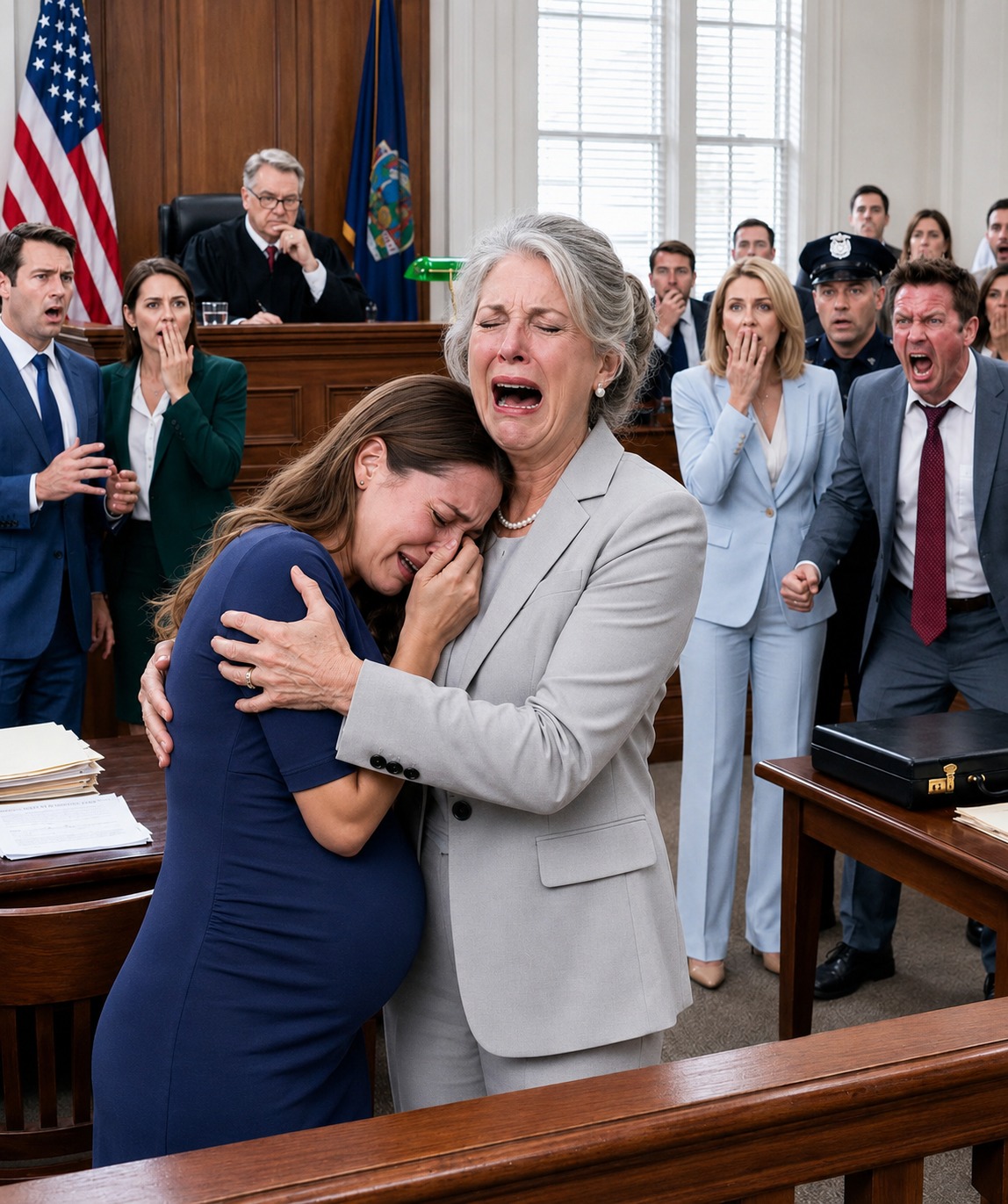
“Leave my house before five o’clock. Let’s see how you survive with that baby without me.”
Hector Luján said those words with a smile, right after the judge struck the gavel and left me with nothing.
I sat in the family courtroom in Mexico City, eight months pregnant, one hand pressed against my stomach as my son moved inside me like he was afraid too. Judge Rivas read the ruling in a flat, calm voice.
“The prenuptial agreement is valid. The Las Lomas house, joint accounts, vehicles, and investments remain under Mr. Luján’s name. Ms. Mariana Torres will receive no alimony and must leave the marital home today before 5:00 p.m.”
I felt the ground vanish beneath me. I had no parents, no siblings, and nowhere to go. I had grown up in foster homes, passed from one place to another until I learned that love usually came with an expiration date.
Then Hector appeared in my life. Handsome, wealthy, charming. He brought flowers to the bookstore where I worked and promised I would never be alone again. I believed him. I married him. I signed papers I didn’t understand because he called them a formality. I quit my job because he said he wanted to take care of me. Slowly, he separated me from everyone I knew.
When I got pregnant, the tenderness disappeared. First came silence. Then insults. Then threats. Then divorce.
Hector leaned close after court and whispered:
“You came from nothing, Mariana. You’ll go back to nothing. When that child is born, family services will take him because you won’t even afford a crib.”
I bit my lip to keep from crying.
Then the courtroom doors flew open.
Four men in black entered first, moving with the precision of trained security. Then a woman stepped inside, and the entire room seemed to stop breathing.
Doña Catalina Aranda.
The most feared investor in Mexico. Owner of half the Bajío industrial corridor. Matriarch of Grupo Aranda. Newspapers called her the Iron Queen.
She wore a white wool coat, pearl earrings, and a ring that caught the light. But what froze me were her eyes.
Green-gray.
Exactly like mine.
She walked straight to me, ignoring Hector completely. Her marble expression cracked. Tears filled her eyes as she touched my cheek.
“My little girl,” she whispered. “My beautiful girl… I finally found you.”
I could not breathe.
She placed her hand over mine on my belly. My baby kicked. A tear ran down her face.
Then she turned to Hector, and the Iron Queen returned.
“My daughter and my grandson will live far better without you, Mr. Luján.”
Hector laughed nervously.
“Your daughter? Mariana is an orphan. I saw her records. Someone is deceiving you.”
Catalina raised one hand.
Six lawyers entered carrying black briefcases.
One placed a thick file on the judge’s desk.
“Your Honor,” he said, “we present evidence of fraud, forged documents, identity theft, altered civil records, misappropriation of funds, and bribery of public officials.”
Judge Rivas began to sweat.
And Hector stopped smiling.
The lawyer opened the file.
“Twenty-eight years ago, Mrs. Catalina Aranda lost her newborn daughter during an arson attack at a family property in San Miguel de Allende. She was told the baby died.”
I gripped the table.
“The death certificate was falsified. Social workers were bribed. Records were altered. The child was placed into foster care under the name Mariana Torres.”
My knees weakened.
All my life, I thought I had been abandoned.
But I had been stolen.
Catalina looked at me with unbearable pain.
“I never stopped looking for you.”
Hector slammed his fist on the table.
“This is madness! Mariana, tell them I cared for you!”
I stared at him. He had held me while I cried about having no family. He knew my deepest fear was my child being born without protection.
And all along, he had known who I was.
The lawyer continued. Three years earlier, Hector’s company had hired a private intelligence firm for acquisition research. During that search, they found a genetic match linking me to the Aranda family. Instead of reporting it, Hector found me at the bookstore, faked romance, isolated me, married me, and gained access to a trust created for the Aranda heiress.
That trust, activated when I married, had grown to more than 900 million pesos.
Every flower. Every dinner. Every promise.
A strategy.
Hector had not married me for love.
He married my money.
Then the lawyer turned to the judge and revealed a five-million-peso payment to a shell company tied to his brother-in-law, made three days before the hearing.
Federal agents entered moments later.
“Attorney General’s Office! Nobody move!”
They surrounded Hector. He tried to reach me, but an officer threw him to the floor before he could touch me.
“Mariana!” he cried. “Tell them to stop! I’ll give everything back! Don’t take my son!”
I looked down at him.
“You’re not a father, Hector. You’re a thief who used my loneliness to open a safe.”
As they dragged him away, a sharp pain split through me. Warm liquid ran down my legs.
My water had broken.
My baby was coming in the same place where they had tried to destroy me.
Doña Catalina caught me before I fell.
“I won’t let go,” she said.
I was taken to a private hospital in Polanco. In the ambulance, Catalina told me everything. My real name was Mariana Aranda Salcedo. My father died when I was three months old. Enemies of Catalina’s business empire had burned a family property, bribed a nurse, and made her believe her baby had died from smoke.
But I had been taken alive.
Renamed.
Buried inside the system.
The delivery lasted seven hours. Catalina stayed with me, wiping my forehead, whispering:
“Almost there, my child. You’re almost home.”
When my son cried, something inside me broke and rebuilt itself at once. They placed him on my chest, and he quieted against my skin.
“Mateo,” I said without thinking.
Catalina covered her mouth.
“Your grandfather’s name was Mateo.”
We cried together then—not as heiress and queen, but as mother and daughter.
Two months later, Hector was in pretrial detention, accused of fraud, organized crime, identity theft, money laundering, and property crimes. Judge Rivas fell too. News programs talked about the scandal for weeks, but I stopped reading comments from strangers who thought they understood my pain.
I gave my statement to prosecutors with Mateo asleep in my arms and my mother beside me. I told them how Hector isolated me, controlled me, checked my phone, and convinced me no one would believe an orphan.
But I was not alone anymore.
The trust returned to my name. Accounts were frozen. Hidden properties were investigated. The Luján family claimed they knew nothing.
Catalina placed the tablet down after reading their statement.
“They knew enough,” she said.
“What will you do?” I asked.
She looked at me steadily.
“That depends on you. I am no longer the one who decides for you.”
That sentence healed something in me.
A year later, I became director of a foundation called Casa Raíz, created to help young people leaving foster care with scholarships, housing, legal support, therapy, and dignified work. I did not want another girl like me to mistake a cage for a home just because someone wrapped it in luxury.
Then a letter arrived from prison.
Hector wrote that he had made mistakes, that there had been love, that Mateo was his son, that I should not let my mother turn me cruel.
For a moment, the abandoned child in me wanted to feel guilty.
Then I looked at Mateo laughing on the rug with wooden blocks.
I folded the letter and fed it into the shredder.
After that, I signed the papers authorizing Grupo Aranda to buy Luján Logística’s debt. The company Hector had tried to save by stealing from me would now belong to the family he tried to destroy.
I signed my full name:
Mariana Aranda Salcedo.
Not for revenge.
For justice.
That afternoon, I stood with Mateo in the rooftop garden while Mexico City stretched below us. Catalina placed a blanket over my shoulders.
“Are you okay?” she asked.
I looked at my son, then at my mother.
“I’m learning.”
Hector thought he had married a helpless orphan.
In truth, he had married the long-lost heir to an empire.
And empires do not beg to survive.
They rise.