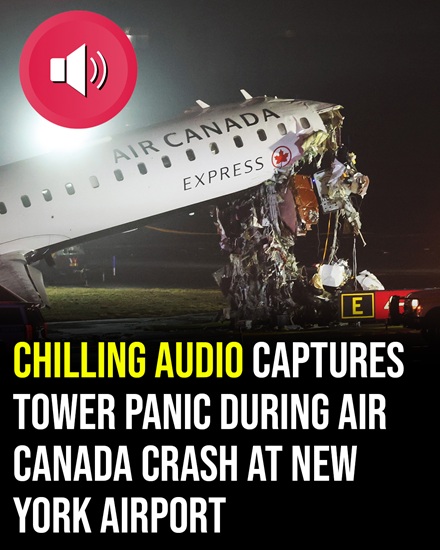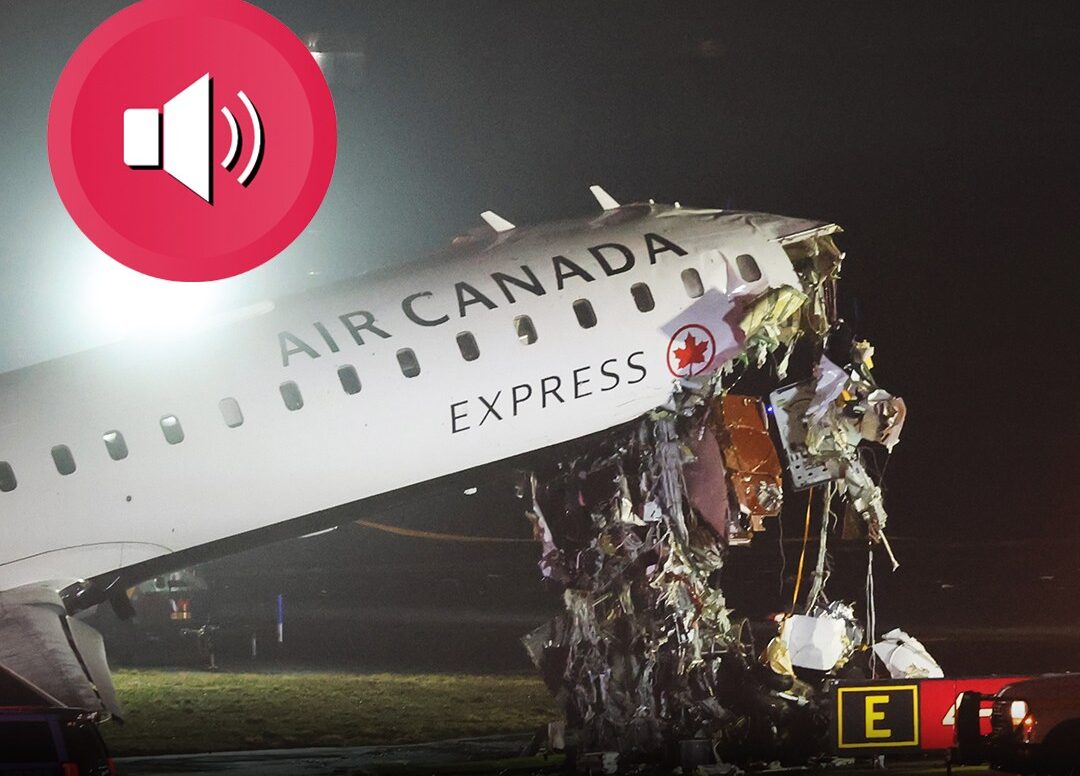
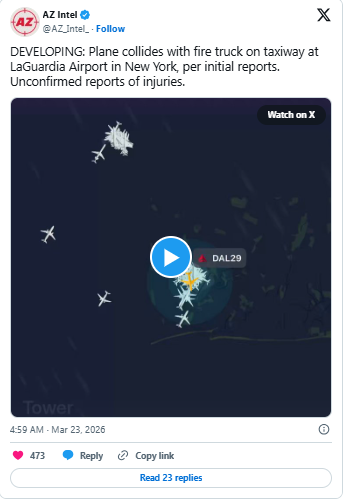
Late Sunday night on March 22, a serious aviation accident occurred at LaGuardia Airport in Queens, New York, when a passenger jet collided with an airport fire‑rescue vehicle on an active runway.
The aircraft involved was Air Canada Express Flight 8646, a Bombardier CRJ‑900 operated by Jazz Aviation on behalf of Air Canada, arriving from Montréal‑Trudeau International Airport.
Flight 8646 carried 72 passengers and four crew members when it touched down late Sunday evening, moments before the dramatic collision with an emergency vehicle.
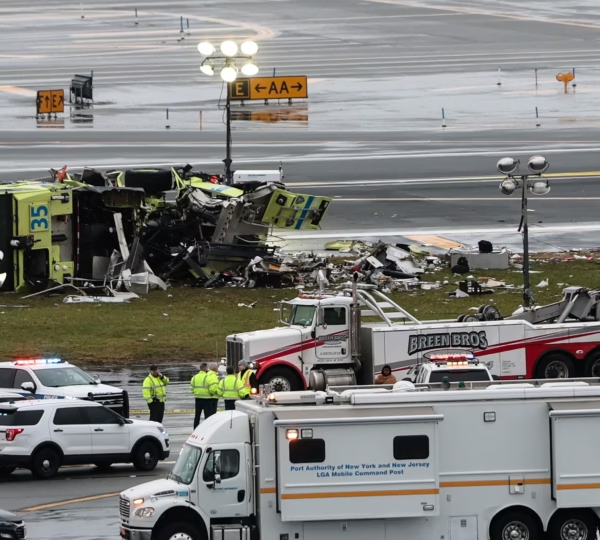
As the regional jet slowed after landing, it collided with a Port Authority fire truck that had been crossing Runway 4, an active landing strip at LaGuardia.
Authorities say the fire truck was responding to an unrelated emergency involving a United Airlines flight that had experienced a possible odor issue.
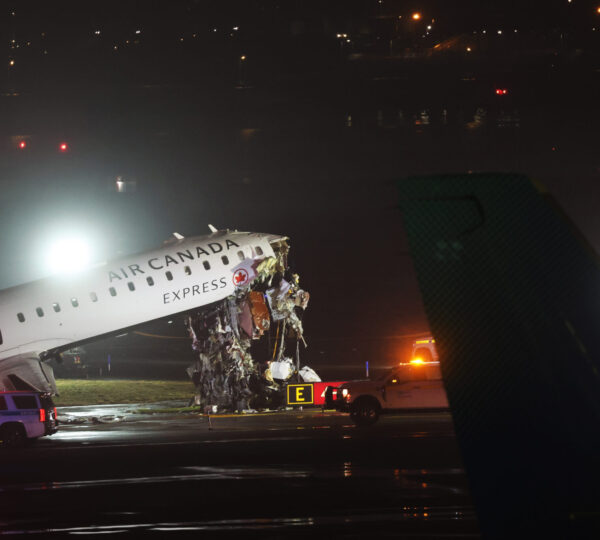
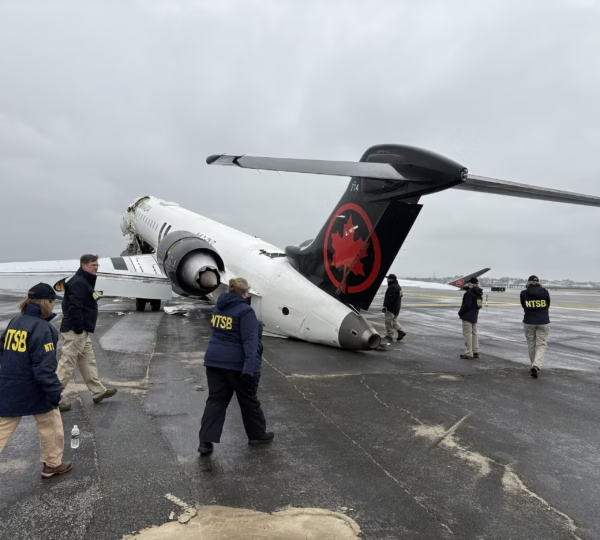
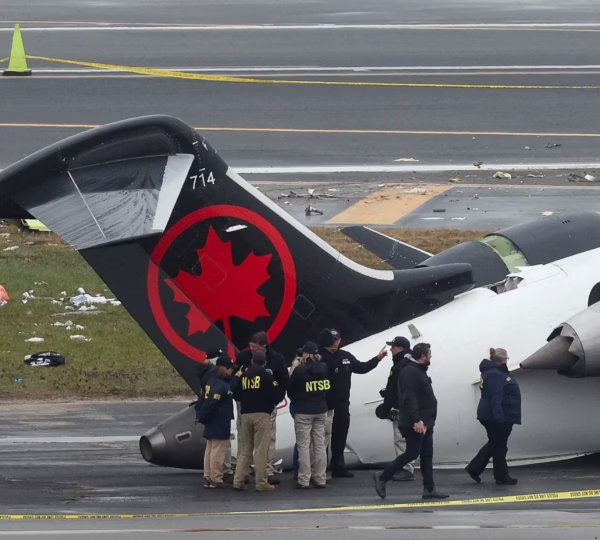
The crash destroyed the cockpit and forward section of the aircraft, and investigators have confirmed that both pilots were killed in the collision.
At least 39 passengers and crew members were injured in the impact and were taken to hospitals, with several reported to have serious injuries.
Both occupants of the fire truck were also hospitalized following the collision, though officials have not released specific details on their conditions.
In the immediate aftermath, airport officials issued a ground stop, halting all flights in and out of LaGuardia as emergency crews secured the scene and cared for those affected.
The National Transportation Safety Board (NTSB) and the FAA dispatched investigative teams to LaGuardia to determine exactly how the collision occurred and why safeguards failed.
Investigators are focusing on air traffic control communications and protocols, particularly how simultaneous clearances were given for both the aircraft and the ground vehicle.
In newly released air traffic control audio, an ATC controller can be heard urgently trying to stop the fire truck from crossing just moments before the collision.
In that recording, controllers repeatedly shout “Stop, stop, stop, stop… Truck 1, stop!” as the truck attempts to cross the active runway.
Shortly after the urgent warnings, the recording captures controllers rerouting other aircraft to prevent additional accidents amid the emergency.
Witnesses and experts state that the chaotic exchange highlights serious challenges in runway safety and communication at major airports like LaGuardia.
Although the fire truck initially received permission to cross from the tower, the audio suggests a near‑immediate conflict between that clearance and the aircraft’s landing path.
Rain and reduced visibility were reported in the region at the time of the incident, which may have contributed to the complexity of the situation.
In response to the crash, LaGuardia temporarily suspended all runway operations, forcing airlines to divert and cancel numerous flights to nearby airports.
More than 600 flights were canceled or delayed as traffic control and airline operations worked to manage the disruption across the New York area.
Nearby airports including John F. Kennedy International and Newark Liberty International absorbed diverted flights from LaGuardia throughout Monday.
Travelers at LaGuardia reported long wait times and confusion as the airport operated with reduced runways while crews cleared debris and conducted inspections.
Local authorities worked overnight to restore a limited number of runways for scheduled traffic, though full operations were expected to take additional time.
Aviation safety experts say runway incursions—when a vehicle or person enters an active runway—are rare but pose significant risks if coordination fails.
The collision has renewed debate about air traffic control staffing and technology, with some analysts citing systemic pressures in busy airports like LaGuardia.
Staffing shortages and heavy workloads for controllers have been topics of concern in the U.S. aviation sector, discussed frequently by industry watchdogs.
Officials from the FAA have declined to assign immediate blame as the investigation is ongoing, but all parties involved are cooperating fully.
The NTSB is expected to hold public briefings and release preliminary findings as more information becomes available in the coming weeks.
Flight tracking data shows that Flight 8646 was approaching LaGuardia at the normal landing speed when the collision occurred, further complicating initial assumptions about taxi and runway clearance.
The accident has triggered a broad review of runway safety protocols, prompting calls from aviation groups for enhanced communication systems and procedural safeguards.
Some airline industry figures have emphasized the need for better technology to prevent simultaneous runway clearances that could conflict with aircraft movements.
Passenger accounts describe a frightening moment, followed by professional emergency medical assistance that helped evacuate the aircraft quickly after the impact.
A few passengers credited the quick reactions of the flight crew with helping to reduce what could have been an even greater tragedy.
Authorities reminded the public that runway safety remains a top priority for aviation regulators and that lessons learned from this incident will be used to improve future operations.
While full details of the collision’s cause are not yet public, investigators continue to examine data from radar, flight recorders, and ATC tapes.
The Port Authority of New York and New Jersey, which operates LaGuardia, expressed condolences for the families of the pilots who perished.
Air Canada and Jazz Aviation set up support lines for passengers and crew affected by the crash and provided updates to families during the investigation.
Community leaders in New York expressed sympathy for all involved and acknowledged the emotional impact on airport workers and locals.
International condolences poured in as aviation organizations around the world recognized the tragedy and reiterated commitment to runway safety.
The LaGuardia collision has become one of the most serious runway incidents in recent U.S. aviation history, prompting renewed focus on how to prevent similar events.
As investigations proceed, families of victims, regulators, and airline professionals await answers that may help avert future runway collisions.
This story is still evolving as officials release updates, and more facts are expected to be confirmed in the days ahead.