
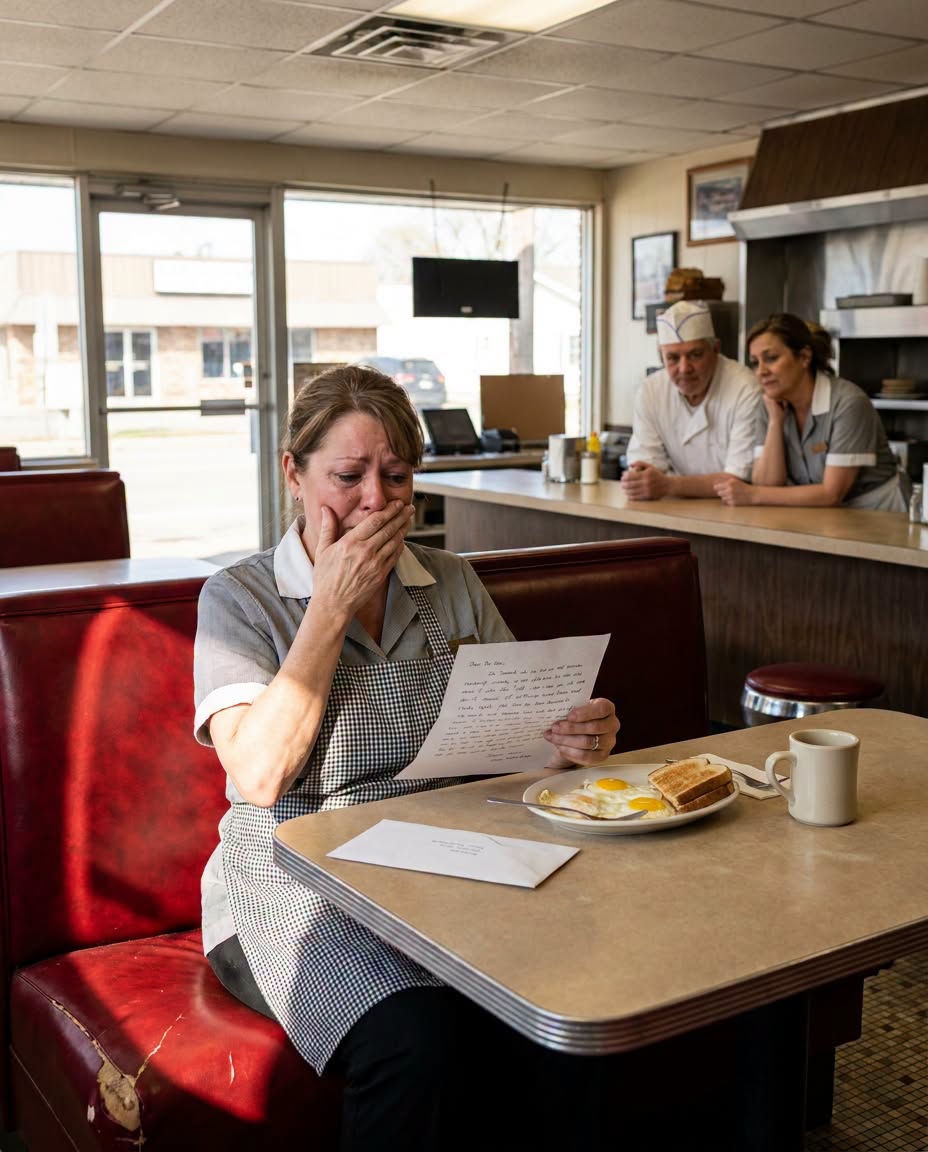
At exactly 7:15 on a Monday morning, two men in dark suits stepped into our diner and asked for me by name. They walked directly toward booth three, the same booth I had kept empty for three weeks, and placed a sealed envelope beside the untouched coffee cup. “Are you Dorothy?” the older man asked, although everyone there had called me Dot for nearly thirty years. When I nodded, he quietly explained that our longtime customer, Mr. Harmon, had passed away two weeks earlier. My knees weakened, and Big Ray shut off the grill while Marlene guided me into the booth where Mr. Harmon had eaten alone every Monday for fourteen years. Written across the envelope in his careful handwriting were five words: “For Miss Dot, at 7:15.”
Mr. Harmon had arrived every Monday since 2012 wearing a pressed gray suit and carrying a folded newspaper. His order never changed: two eggs over medium, wheat toast and black coffee, an $8.40 breakfast followed by a $20 tip. He rarely spoke beyond “please,” “thank you” and “Good morning, Miss Dot,” yet those extra bills had helped cover my son Nathan’s $3,600 braces, a $2,400 transmission repair and several lean Christmases. I knew almost nothing about him except that he valued quiet, read every page of the newspaper and occasionally cleared his own dishes when we were busy. When he failed to appear for the first time, I placed a reserved sign on booth three. By the third empty Monday, I feared I would never learn why the routine had mattered so much to him.
Inside the envelope was a four-page letter beginning with words that made me cover my mouth. Walter Harmon explained that he had spent forty years preparing wills and trusts as an estate attorney, but no professional experience had prepared him for losing his wife, June. Mondays had once been their breakfast day, and after she passed, he wandered into our diner feeling completely lost. He remembered me leading him toward the quietest booth and promising to keep his coffee full without asking questions. I had forgotten saying it, but Walter wrote that the small kindness gave him a reason to leave his house each week. Then the older lawyer opened his briefcase, removed several official documents and said, “Mr. Harmon left very specific instructions concerning this diner, your son and the home you thought you might lose.”
Walter’s estate first provided a generous donation to a hospice foundation established in June’s name, but that was only the beginning. He created an investment trust for the diner that would replace the leaking roof, purchase the espresso machine Marlene had joked about for years and permanently upgrade Big Ray’s bacon supplier. His attorney then handed me documents confirming that the remaining balance on my mortgage had been paid in full, with insurance and tax expenses addressed through the settlement. Another fund would cover Nathan’s education, whether he chose college, trade school or professional certification. Everything had been arranged legally, without a court dispute, because Walter had documented every detail long before his passing. At the bottom of the final page, he wrote that fourteen years of kindness could never truly be calculated, but by his professional estimate, my account was “paid in full through 2026.”
The new roof was installed before the autumn rains, and the espresso machine arrived a month later. Nathan enrolled in a diesel technology program and became the first person in our family to continue his education after high school. He keeps one $20 bill folded in his wallet, promising to use it someday when he meets someone who needs a steady reminder that they matter. Above booth three, we placed a small chalkboard that reads, “Everyone is somebody’s Monday.” We still prepare Walter’s usual breakfast at 7:15 each week, but now one of us always sits down to eat it. For fourteen years, I believed I was simply serving a quiet customer, never realizing that one ordinary booth had become a place where two lonely people helped carry each other through life.