
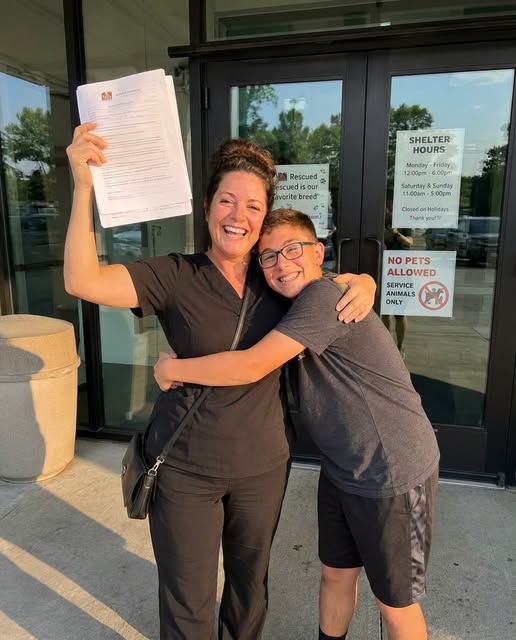
Luke’s hand was trembling beneath mine when he finally looked up from his dinner and said, “Mom, I need to tell you the truth.” The kitchen still smelled of meatloaf and warm glaze, but suddenly the ordinary comfort of the room felt fragile, suspended. He told me he had waited because he was afraid that once I knew, I would send him back like the ten families before me. I let my fork fall onto the plate and told him to keep talking. Tears gathered in his eyes as he explained that the story everyone knew—that he was too difficult, too damaged, too complicated to stay anywhere—was not the whole story. “Most of the times I got sent back,” he said, “I was trying to make someone pay attention.” Then, piece by piece, he told me what he had been carrying for four years.
I had met Luke after losing both of my children, Sophie and James, in a traffic accident three years earlier. I was a landscape architect living alone in a house that had once been full of school bags, laughter, arguments, and all the ordinary noise of family life. Fostering had never been an attempt to replace them; it began because I still had the capacity to care for a young person and nowhere for that care to go. My caseworker, Patricia, initially warned me away from Luke because he had already experienced ten placements in four years after entering foster care following his mother’s fatal overdose. Yet the boy I met was thoughtful, funny, exceptionally well-read, and so careful about taking up space that his politeness seemed less like manners than survival. Over two months of visits, I watched him return scattered crayons to a younger child, argue intelligently about books, and speak about his failed placements without asking for sympathy. When I asked what he wanted most from a permanent home, his answer was surprisingly simple: “A kitchen.” Six months later, after home studies, supervised visits, and court proceedings, I legally adopted him.
What Luke revealed that night forced me to reinterpret nearly everything in his case history. In one placement, he discovered that a foster father was harming his seven-year-old daughter; when Luke reported it and was dismissed as a troubled child making accusations, he deliberately became disruptive enough to force the agency to remove him and investigate the home. In another, he photographed illegal drugs belonging to a foster parent because younger children were living there. In another, he stole vegetables from a neighbor’s garden because the foster family was diverting the state stipend while the children went hungry, then eventually told a teacher what was happening. Some of those reports later resulted in investigations and removals. Luke admitted that not every placement had ended for noble reasons and that trauma had sometimes made him difficult, frightened, or impulsive. But the central truth was devastatingly clear: the system had repeatedly treated his behavior as the problem while overlooking what he was trying to expose. His greatest fear now was not punishment; it was that I had been quietly waiting for the defect everyone else had promised me would eventually appear.
I went around the table and held him until the years he had compressed finally came out of him. Then I told him as plainly as I could that adoption was not probation: he was my son, this was his home, and nothing he had just confessed changed either fact. In the months that followed, I worked with an attorney and social worker to document his account. Two incidents were already corroborated by prior investigations; others required follow-up, and I filed a formal complaint regarding a caseworker who had dismissed one of his reports. Luke gave a recorded statement and read the complaint before I submitted it. More important than the paperwork, however, was what happened inside our house. He stopped washing every plate as though cleanliness might determine whether he was allowed to stay. He learned he could have a bad day without losing his home. We built raised garden beds, grew tomatoes, argued about novels, and cooked in the kitchen he had once described as the one thing he wanted. He joined the debate team, excelled at school, and eventually chose to pursue social work because he wanted to become the kind of caseworker who listened when a child said something was wrong.
The house still carries Sophie and James everywhere: her bear remains on the bed, his old backpack hook is still empty, and grief did not disappear because another child came home. Luke did not fix me, and I did not fix him. What changed was simpler and more durable: we became people who had somewhere to return to. Months after that first confession, Luke told me he had stopped thinking of himself as “the kind of person bad things happen to.” He realized he had simply been paying attention to things other people preferred not to see. “I don’t want to stop paying attention,” he said. “I just want somewhere real to come back to afterward.” By then, his shoes were always near James’s old hook, his books had filled the half-empty shelf in his room, and two matching succulents were growing in the windows—one beside Sophie’s things and one beside his own photographs. Ten families had looked at Luke’s history and seen someone who could not stay. I eventually understood that staying was the one thing he had been waiting for someone else to do first.

