
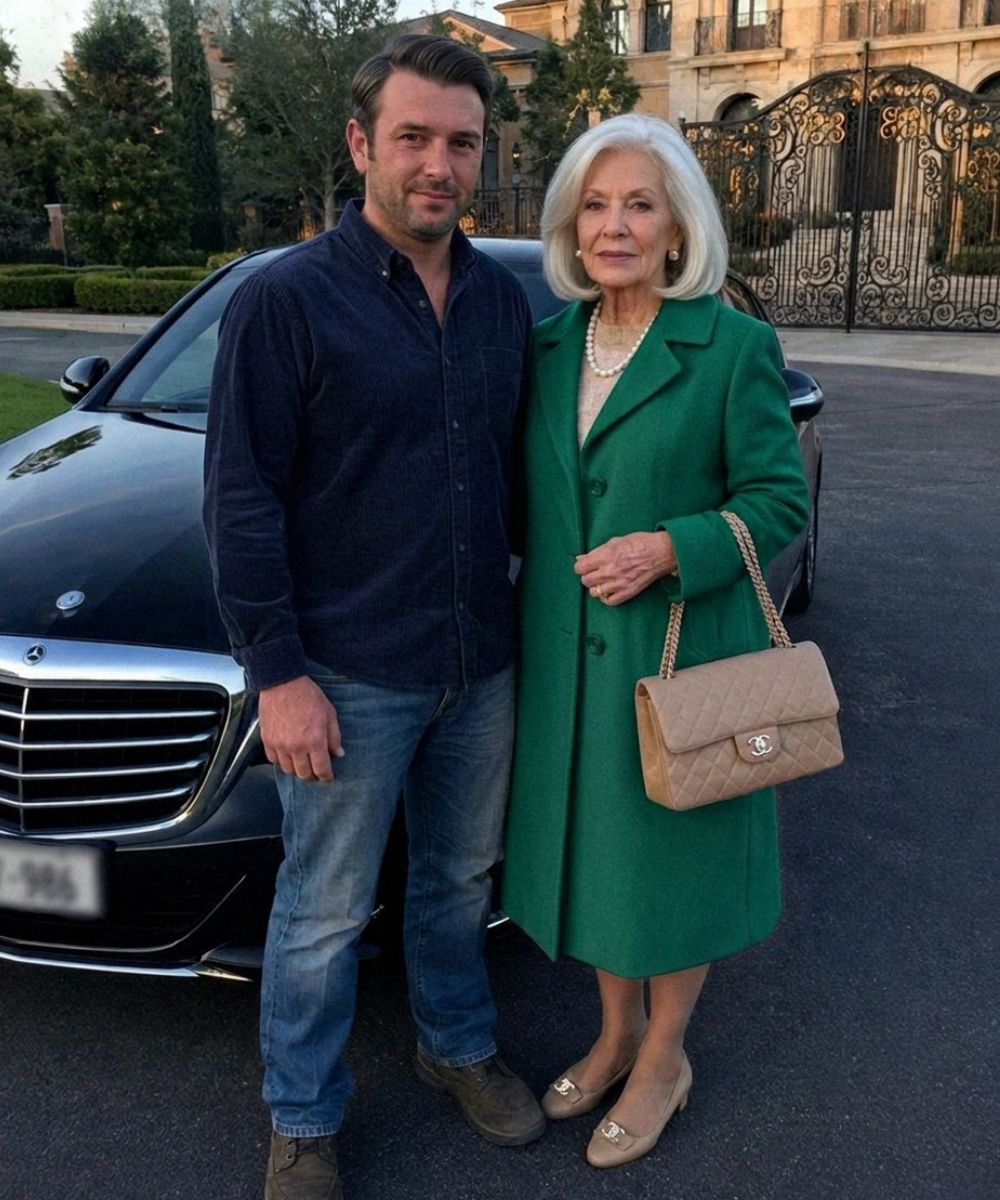
I thought working as a driver for a rich widow would simply help me support my children. But one shocking accusation pulled me into a situation far more tangled than I ever expected.
The kitchen table revealed everything before I even sat down.
Two unpaid bills, a coffee stain on the electricity notice, and a crayon picture my daughter Lily had drawn of our family in front of a home. When you are raising three children alone and rent keeps rising faster than your income, pride becomes something you cannot afford.
That was how I, Stan, thirty-five years old, became Mrs. Whitmore’s driver.
My new employer was a wealthy widow in her seventies, the kind of woman who lived behind iron gates and wore pearls even at breakfast. I expected her to be distant and cold.
But I was wrong.
On my first day, she came slowly down the marble staircase, pearls resting at her neck, and reached out her hand like I was someone important enough to welcome.
“You must be Stanley.”
“Stan, ma’am. Just Stan.”
“Then Stan it is,” she said warmly. “I hope you are patient. I am not as quick as I used to be.”
For several weeks, the work was simple. I drove her to doctor appointments, charity lunches, and every Friday to the cemetery, where she placed white roses on her husband Arthur’s grave.
She never broke down there. She only spoke softly to him, as if he were still nearby.
Then she began asking about me.
“How old are your children, Stan?”
“Seven, five, and two, ma’am.”
“Do they resemble you?”
“The older two got their mother’s looks, thankfully.”
She laughed for real, not just politely.
The questions kept coming.
“Do they understand how hard you work?”
“I think they do, ma’am. Mostly they complain that I’m never home enough.”
She sighed gently. “One day, it will all be worth it.”
Sometimes after I brought her home, she invited me in for coffee. I always sat stiffly near the edge of the chair, afraid to look too comfortable on furniture that probably cost more than my car.
“You may lean back, you know,” she once told me. “The cushions won’t hurt you.”
“Old habits, ma’am.”
“Eleanor. When it is only us, please.”
I nodded, though I knew I would never actually call her that.
She spoke often about Arthur, about the silence of the huge house, and about her four adult children, who seemed to visit only when documents needed signing.
One afternoon, while stirring her tea, she said, “Bradley called again this morning. He wants me to meet with the estate lawyer. Again.”
“That sounds serious, ma’am.”
“It sounds like vultures circling, Stan. But you did not hear that from me.”
I pretended not to hear, but I did. And I felt sorry for her. She had wealth, status, and a mansion, yet the people around her treated her more like a signature than a mother.
Maybe caring was my mistake.
One afternoon, after lunch downtown, Mrs. Whitmore forgot her wallet in the back seat. I noticed only after dropping her off and starting down the driveway. I parked, carried it inside, and handed it back untouched.
When she opened it and saw the thick stack of cash still there, she looked at me differently.
As if she had made up her mind about something.
Last Tuesday began like any ordinary day.
I arrived at the Whitmore estate exactly at nine in the morning, my hands still smelling faintly of cheap soap from my cracked bathroom sink.
But the second I stepped inside and reached for the car keys near the door, I knew something was wrong.
All four of Mrs. Whitmore’s children were there.
Bradley stood near the fireplace, arms folded. Vivian sat on the sofa with coffee, acting like the room belonged to her. Marcus and Claire stayed near the windows. Mrs. Whitmore had shown me their pictures before, so I recognized them immediately.
She stood in the center of the living room, pale and shaking.
“Ma’am?” I asked carefully. “Are you okay?”
Her eyes moved toward Bradley, then dropped to the floor.
“My diamond brooch is missing,” she said quietly.
The room went silent.
“I cannot explain where it went,” she continued. “And you were the only person outside this family who has been in the house this week.”
The words struck me hard.
“Ma’am…” I stared at her, stunned.
Then she looked directly at me.
“I believe Stan took it.”
“Of course he did,” Bradley said with a smug expression.
“Mother, we warned you,” Vivian added. “You let people like him get too comfortable.”
People like him.
That hurt even more than the accusation.
My face burned.
“Mrs. Whitmore, I would never—”
For half a second, her eyes met mine.
Something in them was wrong. Fear, maybe. Or a warning.
“That is enough, Stan,” she said sharply.
I froze. I had never heard her speak to me that way.
“Take the car to my mechanic,” she continued. “Leave it there. The documents are in the glove compartment. He will know what to do. After that, your job here is over.”
Bradley looked satisfied. Vivian seemed like she had finally won some private battle.
My hands were shaking.
I wanted to throw the keys across the marble floor and tell them exactly what kind of people they were. But then I thought of my children. I thought of Lily’s glasses, taped together for three weeks. I thought of the unpaid electric bill hidden under the sugar jar.
Pride does not pay bills.
“Yes, ma’am,” I said softly.
As I walked out, I glanced back once.
Mrs. Whitmore was staring at the floor, one trembling hand pressed to her chest. She could not look at me.
I left that mansion feeling smaller than I had in years.
The black Mercedes waited in the driveway like one final insult.
I got in, gripped the steering wheel, and let out a breath that burned in my chest.
Then I drove away.
Every red light felt like judgment.
Every stranger in every nearby car seemed to be looking at me like they knew what had happened.
Her words kept repeating in my head.
“You were the only person outside the family in the house this week.”
I felt sick.
How could I have been so foolish? The coffee, the conversations, the kindness—maybe I had only been entertainment for a lonely rich woman until she decided to discard me.
Twenty minutes later, I pulled into a garage across town.
An older man in a navy work shirt waved from the open bay.
“You must be Stan,” he called.
I stopped.
“How do you know my name?”
“I’m Harold. Mrs. Whitmore called this morning,” he said calmly. “She said you would bring me the paperwork.”
My stomach tightened.
I opened the glove compartment and took out the documents. As I did, a folded white note slipped onto the passenger seat.
My name was written on the front in Mrs. Whitmore’s handwriting.
I handed Harold the paperwork and started to step away, but he called after me.
“Don’t leave yet. We have something to talk about.”
Confused, I nodded.
“I’ll be with you shortly,” he said.
My hands trembled as I opened the letter.
“Dear Stan,
Please forgive what happened this morning.
Bradley believes anyone I trust is trying to influence me for money. He has already threatened legal action against former employees and watches nearly every decision I make. If he thought we were still in contact after today, he would pull you and your children into something painful and public.
I needed him to believe I had completely dismissed you. The brooch was never stolen. It is wrapped in a handkerchief in the glove compartment. Please keep it safe for now and return it when the time is right.
There is also a cashier’s check enclosed. Harold was an old friend of Arthur’s. He needs a dependable driver, and I told him there is no man more honest than you.
Thank you for treating a lonely old woman like a person.
Eleanor.”
I rushed back to the car before it could be moved and opened the passenger side. Inside the glove compartment, I found the folded handkerchief.
The diamond brooch glittered in the morning light.
Beneath it was a cashier’s check for three thousand dollars.
I covered my mouth and cried right there in the seat.
Not from humiliation.
From relief.
A gentle knock sounded on the window.
“You alright, son?” Harold asked. “Can we talk?”
I nodded and tried to steady myself.
Harold poured two cups of coffee from an old metal pot and placed one in front of me in the garage office.
“Mrs. Whitmore told me enough to know you had a rough morning,” he said.
“Why did she send me to you?” I asked. “She barely knows me.”
Harold leaned against the workbench.
“She knows enough. She said you returned a wallet full of cash without touching a dollar. She also said you still sit on the edge of the chair every time she offers you coffee.” He smiled faintly. “People chasing money usually act like they deserve it.”
I stared down at the check.
“I have a delivery position open,” Harold continued. “Steady work. Slightly less pay than driving Mrs. Whitmore, but weekends are yours.”
My head snapped up.
“Are you serious?”
“Completely serious.”
I laughed then, the kind of laugh that comes out when your body cannot decide whether it wants to cry.
“Yes,” I whispered. “Yes, I’m interested.”
Three days later, just after sunset, I slipped through Mrs. Whitmore’s back garden gate.
She was waiting beside the roses with a blanket over her lap.
“You came,” she said softly.
I nodded. She had called me the same day she fired me and asked me to return three days later, giving me exact instructions on how to enter without being seen.
I handed her the brooch.
“You should not have had to humiliate yourself for me.”
She gave me a sad smile.
“You did not have to return that. You could have kept it or sold it. After what I put you through, it would have been the least I could do.”
I was stunned. That brooch had to be worth thousands.
“Bradley needed a performance,” she continued. “Now he believes I finally listened to him. He will leave you alone. Making the brooch disappear was the only way to make sure he found no gap in the story.”
I sat beside her quietly.
“When I wrote that note the night before,” she said, “I was terribly nervous hiding everything in the glove compartment. At first, I thought getting the brooch back would be best. But Bradley has been searching for it for days. I believe he still doubts me. So perhaps it is better if the brooch remains missing.”
I nodded.
“You gave me peace, Stan,” she said. “More than you know.”
“No,” I replied. “You gave that to me.”
She gently squeezed my hand.
“Your part here is finished. Go home to your children.”
“But I hate leaving you here with your children circling around you like sharks.”
“Do not worry about me,” she said. “It took some time, but after this, Harold finally convinced me to fight back. He helped me find a new lawyer. I have told him everything, and we are making sure my estate is protected. Soon, my children will understand exactly where they stand.”
I smiled.
Mrs. Whitmore was going to be alright.
That night, I drove home with groceries in the back seat, Lily’s repaired glasses beside me, and enough money left to pay the electricity bill and finally breathe again.
When I walked through the door and my children ran to me while my neighbor smiled and gathered her things after babysitting, I realized something.
I used to think pride meant never needing anyone’s help.
But pride is really knowing who you are, even when life tries to bend you out of shape.
And sometimes, the people who save you do not make a grand announcement.
Sometimes they simply leave a small act of kindness where no one else would think to look.

