
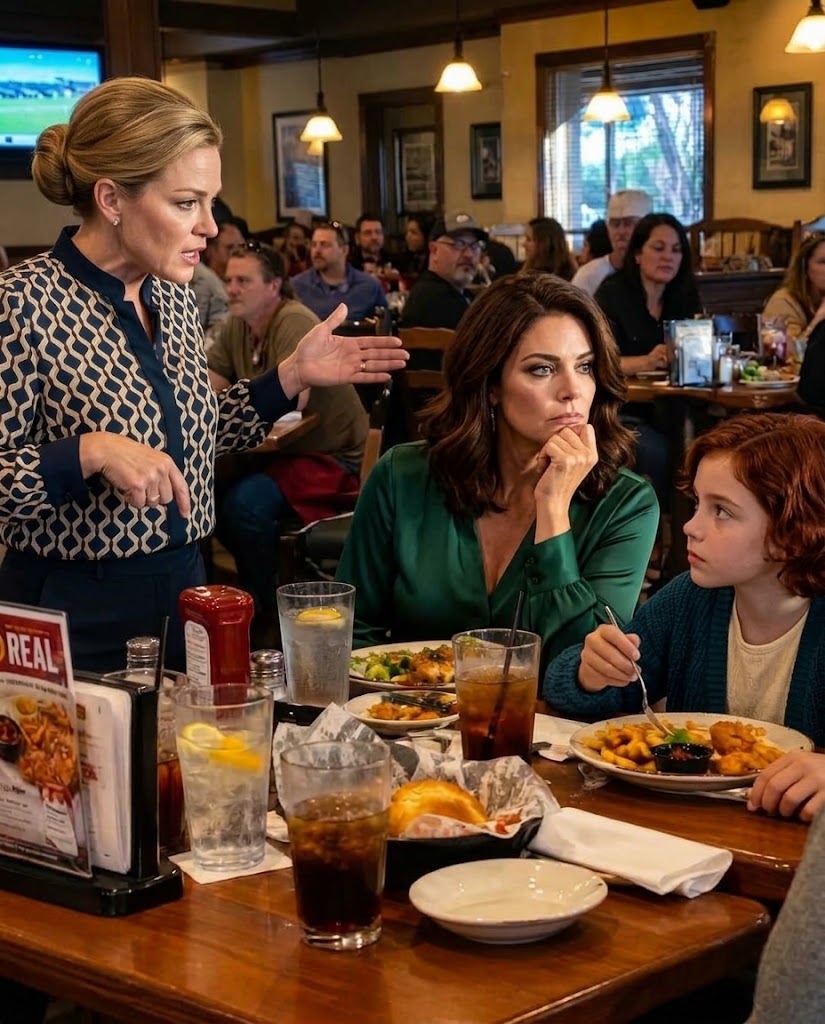
“If you’re handing out free meals, cover mine too.” The diner went so quiet I could hear the hum from the pie case. I was standing beside booth six, where a young mother named Tara sat with one hand over her mouth while her little boy Eli reached for the grilled cheese I had just served him. Three tables away, a woman in a cream blazer and pearl earrings stared straight at me, waiting for an answer. I had paid for Tara’s soup and turkey sandwich myself after noticing her count the money in her wallet and then insist she was not hungry—the same lie my own mother used throughout my childhood when there was only enough food for one of us. I explained that it was not a restaurant promotion; I had simply bought a stranger lunch. The woman raised an eyebrow. “Then pay for mine yourself.” Before I could answer, Gene Dombrowski, a seventy-two-year-old regular who came every Tuesday for apple pie and black coffee, folded his newspaper and slowly got off his stool.
Gene walked to the woman’s table, read her $17.40 check, laid down a twenty, and told her she now had the free lunch she wanted. Then he nodded toward Tara. “Look at her. That’s why she said she wasn’t hungry. Because she’d rather go without than feel like this in front of her boy.” His voice never rose. “You didn’t want a free lunch. You just didn’t want her to have one.” The woman—Patrice Holloway, though I did not know her name yet—threw the money at him, screamed that he had humiliated her, and marched to the register insisting she would pay for herself. Her card declined twice. I watched something crack in her expression before she emptied her purse and counted exactly $17.40 in bills and quarters onto the counter. After she left, Gene disappeared too, leaving another twenty wrapped around a napkin in my hand: For her soup. Don’t you pay for it. You need your tips more than I need my pension. — G. By the next morning, however, Patrice had posted online that I had been “giving away food,” that Gene had grabbed her belongings and thrown money at her, and that the diner had allowed an unstable man to abuse a loyal customer. Because Patrice was a longtime friend of the owner’s wife, I was taken off the schedule pending a meeting, and Gene was to be asked to leave if he returned.
The truth surfaced two days later in the back booth at Dot’s. Patrice arrived with the owners; I came in wearing my uniform; Gene showed up despite not being invited; and Tara came with Eli because she had already posted her own account of what happened. Then my nervous manager Dale remembered the security camera above the register had audio. The recording showed everything clearly: Patrice demanding the free meal, Gene never touching her, Patrice throwing the twenty at him, and the two declined-card messages as she stood at the register counting quarters. When the video stopped, Marianne—Patrice’s oldest friend—quietly asked why she had hidden what was happening. Patrice finally broke. Her husband had left, the house was gone, she was living in her sister’s spare room, her adult son barely spoke to her, and the salad at Dot’s twice a week had become one of the last rituals that made her feel like the woman she used to be. She admitted that seeing me give Tara food without being asked had enraged her precisely because she was barely able to afford her own lunch and could not bear the idea of needing the same kindness. Tara answered softly, “I didn’t ask. She just saw me.” In that moment, I understood that the cruelty was real, but so was the hunger underneath it.
Nick reinstated me immediately, paid the shifts I had missed, and apologized for reacting before checking the evidence. Gene refused free pie because, as always, he intended to pay twenty percent and round up. Patrice was asked to stay away for a while. I followed her into the parking lot anyway. She was sitting inside an aging Lexus with a cracked windshield, staring through the glass with the engine off in exactly the posture I remembered from my own mother when she used to sit outside grocery stores calculating what she could afford to put back. Patrice did not apologize to me that day, and I did not ask her to. She admitted she was angry, broke, embarrassed, and afraid, and that without money people no longer tolerated the difficult personality they once overlooked. I gave her the twenty Gene had left for Tara’s lunch and told her about a church on Elm Street that served hot meals without questions. “It’s not charity,” I said when she resisted. “It’s soup.” Eight months later, Dot’s has a corkboard beneath the photograph of the founder labeled LUNCH IS ON SOMEBODY. Customers buy extra meals, write them on sticky notes, and anyone who needs one can take it without explaining why. Tara now works at the dental office she had interviewed for that morning and regularly buys meals for the board. Gene still orders his apple pie every Tuesday. My mother finally came to booth six and, for perhaps the first time in years, ordered a whole turkey club and said plainly, “I’m hungry.”
Patrice stayed away nearly five months. Then one Thursday I noticed a pale-blue note pinned among the yellow ones. In careful handwriting it read: One Cobb salad. Extra bacon. Dressing on the side. Two lemons in the iced tea. Underneath, smaller: For whoever isn’t hungry. Nobody said who had left it, though Bree remembered a woman with grayish-blond hair who paid for a salad and left without eating. The note remained there for almost three weeks before somebody finally used it. I never asked who. I am twenty-six now and training to become shift manager, and the job still teaches me to notice things: the woman staring too long at prices, the old man stretching one coffee through an afternoon because his apartment is cold, the teenager pretending not to watch the pie case. They often use different words, but the message is familiar: I’m fine. I already ate. I’m not hungry. Most of the time I cannot fix whatever brought them through the door. But I can walk to the board beneath Dot’s photograph, pull down a sticky note, and tell Manny to make two plates. Sometimes the difference between hunger and dignity is simply whether somebody notices before you have to ask.

