
This is a fictional story.
My name is Ingrid Sørlie Hale. I’m 34, and for nine years I have owned a small bakery on the corner of Maple and Fifth in Madison, Wisconsin. It’s called Butter & Rye. We make Norwegian cardamom buns, wedding cakes, and the best almond kringle in the county, if I do say so myself.
I was seven months pregnant with my first baby, a boy, when my mother-in-law, Victoria Hale, decided she would host my baby shower.
“Host” is a generous word for what she did.
“You Have a Bakery, Don’t You?”
Victoria is the kind of woman who is on every charity board in town. She wears pearls to the grocery store. She once sent back a cup of coffee at my bakery because the foam was “aggressively textured.”
She called me in March.
“I’ll host the shower at my house,” she announced. “Forty guests. My friends from the club, the hospital foundation board, a few of Tom’s cousins. Now, you have a bakery, don’t you? So you’ll handle the food.”
I was seven months pregnant, running a business, and swollen to my ankles. But Tom, my husband, gave me that look. The please, just keep the peace look.
So I did it. Mini quiches. Smoked salmon on rye. Lemon tarts. Three dozen cardamom buns. A three-tier cake shaped like a stack of baby blocks. My staff and I worked two full nights on it.
At my bakery’s prices, it would have cost $2,800. I didn’t charge Victoria a dime.
The Gown
There was one thing at that shower I cared about more than all the food combined.
My grandmother, Mormor Astrid, taught me to sew when I was six. Before she passed away, she made me promise I’d make my first baby’s christening gown myself, the way the women in our family had done for four generations back in Bergen.
So I took apart my own wedding dress. The ivory silk. The lace sleeves. For three months, every night after closing the bakery, I sat at my kitchen table and stitched a tiny christening gown by hand. I embroidered a little blue anchor on the hem for my grandfather, who was a fisherman, and my son’s initials underneath: E.A.H.
It took me ninety-one nights. I counted.
I brought it to the shower in a white box tied with a blue ribbon. I wanted to show it to the family. I thought, maybe, Victoria would finally see that I wasn’t just “the baker girl” Tom married.
“Not Some Old Woman’s Leftovers”
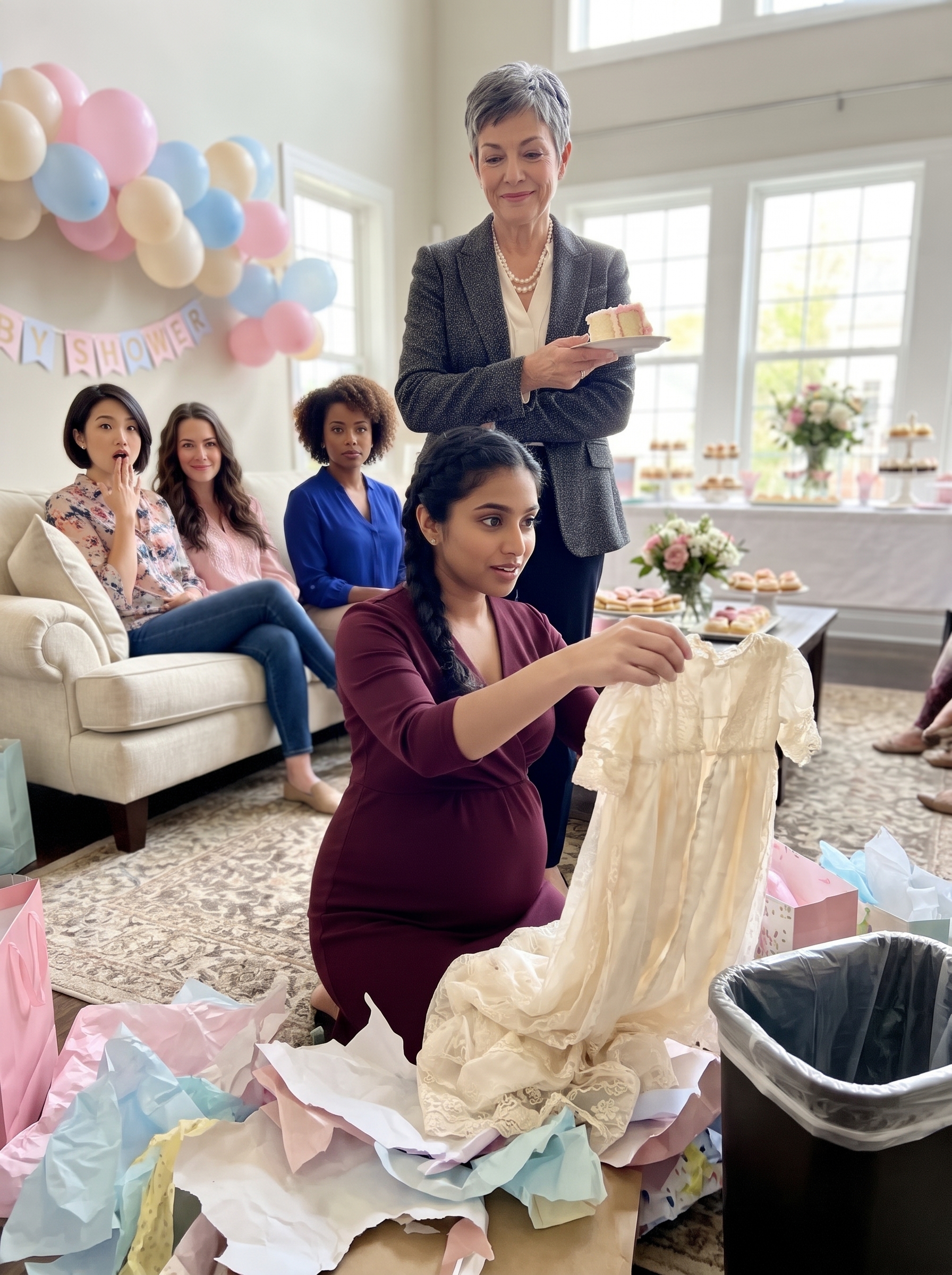
Halfway through opening gifts, I lifted the gown out of the box. The room went soft. A few of Tom’s cousins gasped. One of the older ladies from the foundation board put her hand on her heart.
“Oh, Ingrid,” she whispered. “Did you make that?”
“From my wedding dress,” I said. “It’s a family tradition.”
Victoria stood up, walked across the room, and took the gown out of my hands. She held it up by one sleeve, the way you’d hold a dishrag.
Then she laughed.
“Oh, sweetheart, no. My grandson will wear Dior, not some old woman’s leftovers.”
And she tossed it, without even looking, onto the pile of torn wrapping paper and empty gift bags by the trash can.
“I’ve already ordered a proper one from Paris,” she announced to the room. “$1,200. It arrives next month. Now, who wants more cake?”
My cake. She was offering my cake.
Forty people went completely silent. I looked at Tom. He was staring at the floor.
“Mom, come on,” he mumbled. That was all. Mom, come on.
I Didn’t Say a Word
I got up, which takes a while at seven months. I walked over to the trash pile. I knelt down slowly, and I picked my grandmother’s tradition out of the wrapping paper. There was a smear of frosting on the lace.
I folded it back into its box. I said, “Thank you all for coming.” And I left my own baby shower.
I didn’t cry in the car. I drove straight to the bakery, unlocked the back door, and turned on the lights in my office.
Because there was something Victoria had forgotten.
Five days later was the Madison Hospital Foundation’s Winter Gala. Victoria was the chair. Three hundred and fifty guests. The mayor. Donors. Local news cameras. It was the most important night of her social year.
And the gala’s entire dessert order, 400 handmade desserts, was placed with my bakery. An $8,500 contract. Signed by Victoria herself. Because, as she’d told her board, “My daughter-in-law will give us a family discount.”
I sat at my desk and opened that contract.
At 9:12 p.m., I made one decision my mother-in-law never saw coming.
By the next afternoon, Victoria had called me 22 times.
What did Ingrid find in that contract, and what happened when Victoria showed up at the bakery in person?
Clause 7
Every catering contract at Butter & Rye has the same standard clause. My lawyer wrote it for me years ago, after a bride tried to cancel a wedding cake the night before.
Clause 7: Either party may cancel this agreement with written notice no less than five days before the event date. If the bakery cancels, any deposit is refunded in full.
The gala was on Friday. It was Sunday night. That was five days exactly.
Victoria had never paid a deposit. She’d insisted that “family doesn’t need deposits.” So there was nothing to refund.
I typed a short email, polite and professional, the way I’d write to any client.
“Dear Mrs. Hale, per Clause 7 of our agreement dated September 3, Butter & Rye is cancelling the dessert order for the Madison Hospital Foundation Winter Gala. As no deposit was paid, no refund is due. I wish you a successful event. Kind regards, Ingrid Sørlie Hale, Owner.”
I copied the foundation’s events coordinator, because her name was on the contract too. I pressed send at 9:12 p.m.
Then I went home, put the christening gown in the sink with cold water and a little dish soap, and gently washed the frosting out of my grandmother’s lace.
Twenty-Two Calls
Victoria read the email at 7:00 the next morning.
The first call came at 7:04. I let it ring. The second at 7:06. The third at 7:09.
By noon, there were 22 missed calls and a string of voicemails that started furious and slowly became something else.
“Ingrid, this is completely unprofessional. Call me back immediately.”
“Ingrid, I’ve called six bakeries. Nobody can do 400 desserts in four days. Call me.”
“Ingrid… please. The mayor is coming.”
Tom called too. “Ingrid, what did you do? Mom is hysterical.”
“I cancelled a contract,” I said calmly. “Within the terms. The same way your mother cancelled my grandmother’s gown in front of forty people.”
He was quiet for a long time. “She didn’t mean—”
“She threw it in the trash, Tom. And you said, ‘Mom, come on.’ That’s all you said.”
More silence.
“I know,” he finally whispered. “I know. I’m sorry.”
Victoria at the Counter
At 2:30 that afternoon, the bell over my bakery door rang, and Victoria Hale walked in. No pearls. Her hair was pulled back in a plain ponytail. I’d never seen her without lipstick.
The bakery was full. Students with laptops. Two retired men who come every day for coffee and kringle. A mother with a stroller. Everyone looked up.
Victoria walked straight to the counter.
“Ingrid,” she said, her voice tight. “I will pay full price. No discount. $8,500. Cash, today. Just please, make the desserts.”
I wiped my hands on my apron.
“Victoria, this was never about the money.”
She swallowed hard. For the first time since I’d known her, she looked unsure of herself.
“Then what do you want?”
I reached under the counter and took out the white box with the blue ribbon. I opened it. The gown was clean now, pressed, the little blue anchor bright on the hem.
“My grandmother taught me to sew when I was six,” I said quietly. “Her mother taught her. Her mother before that. Four generations of women made these gowns by hand, out of the most precious thing they owned. I made this from my wedding dress. Your son’s wedding. Ninety-one nights of work.”
Victoria stared at the gown.
“You called it an old woman’s leftovers. In front of everyone. And then you threw it in the trash.”
The bakery was so quiet I could hear the espresso machine ticking as it cooled.
The Apology
Victoria reached out and touched the anchor with one finger. Her hand was trembling.
“My mother cleaned houses,” she said suddenly, very softly. “In Milwaukee. I wore other people’s hand-me-downs until I was sixteen. Kids at school called me ‘Leftover Vicky.’” She let out a shaky breath. “I swore my children would never wear anything secondhand. When I saw that gown, I didn’t see your grandmother. I saw… me.”
I didn’t know what to say. In nine years, she had never told me one true thing about herself.
“That doesn’t make it okay,” she added. “What I did was cruel. I’m sorry, Ingrid. I am truly sorry.”
One of the retired men at the corner table cleared his throat and very quietly started clapping. I shot him a look and he stopped, but he was grinning.
The Gala
I made the 400 desserts. Full price, $8,500, paid in advance this time. My staff and I worked four days straight.
But I added one condition, written into a new contract and signed by Victoria: at the gala, the dessert table would carry a small card that read, “Desserts by Butter & Rye, owned by Ingrid Sørlie Hale, a proud member of the Hale family.”
That night, in front of 350 guests and the mayor, Victoria gave her chair’s speech. At the end, she paused and looked at me standing by the dessert table in my maternity dress.
“I want to thank my daughter-in-law, Ingrid,” she said. “Not only for tonight’s desserts, which you’ll agree are extraordinary. But for teaching me, at sixty-one years old, that the most valuable things in a family are the ones made by hand.”
Tom squeezed my hand so hard it hurt.
The Christening
Our son, Erik Astrid Hale, was born in early spring. Eight pounds, two ounces, with a full head of blond hair.
At his christening, he wore the gown. My grandmother’s tradition, my wedding silk, the little blue anchor, and his initials stitched underneath.
The $1,200 Dior gown from Paris? Victoria returned it. She used the money to buy me a new sewing machine, and she wrote a card that said: “For the next generation. And would you teach me?”
Every Tuesday night now, after the bakery closes, my mother-in-law sits at my kitchen table in her pearls, learning to sew. She is terrible at it. She keeps stitching her sleeve to the fabric.
But she keeps coming back. And last week, she finished her first piece: a tiny, crooked bib with a blue anchor on it, for her grandson.
It’s the ugliest bib I’ve ever seen. Erik wears it every Sunday.
This story is a work of fiction. Names, characters, places, and events are products of the author’s imagination. Any resemblance to actual persons, living or dead, or actual events is purely coincidental.