
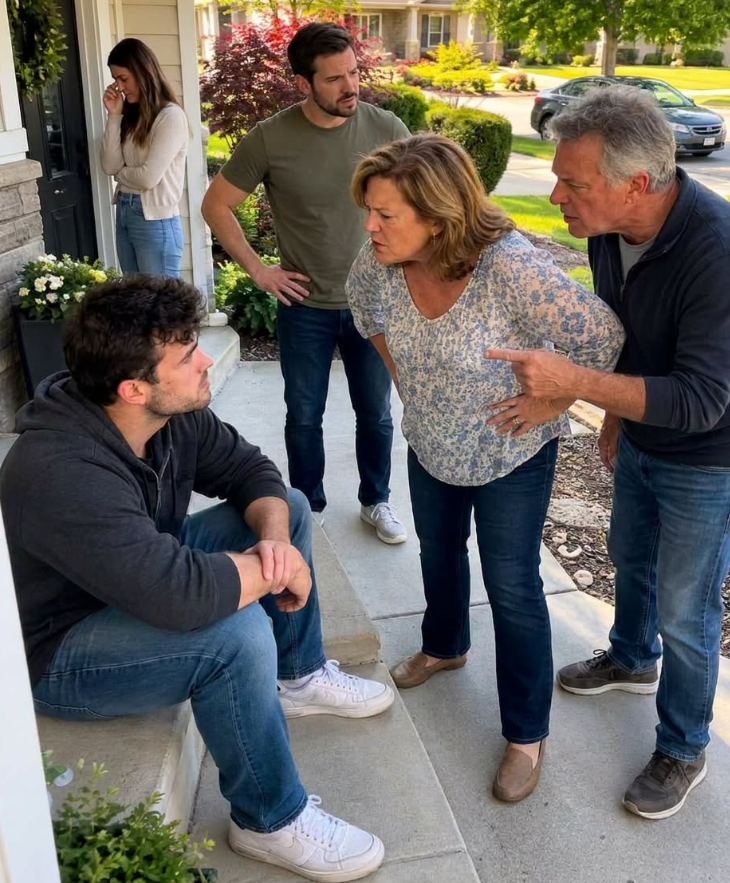
“You need to leave, Ryan. Only real family is allowed here.” My mother said it from the front porch while I stood there after a twelve-hour drive from Nashville, one hand wrapped around a gift bag containing my brother’s favorite bourbon and the other holding a housewarming card I had rewritten twice because I wanted it to sound like something a brother would say. Through the windows behind her, relatives were laughing around Caleb’s new kitchen island while champagne glasses flashed in the afternoon light. My father folded his arms and added, “Caleb doesn’t want drama today.” Then Caleb appeared in the hallway, saw me, and looked at the floor. That hurt more than either of my parents’ words because three months earlier he had been crying at my kitchen table while I arranged the $95,000 that made his home purchase possible. I set the unopened bourbon beside the porch railing, said, “Congratulations on the house,” and drove away before anyone could turn my reaction into the reason the party had been spoiled.
Caleb was thirty-two and worked with construction contracts for a living, but several difficult years had damaged his credit and left him short of the cash his lender required to close. I had helped him before—rent after college, emergency bills, problems that somehow became mine because I was the son who had built a successful logistics company and learned not to ask our parents for permission. This time I refused to hand over family money informally. My attorney prepared a private loan agreement for the $95,000, Caleb had independent advice available, and a security interest against the property was properly documented so that my advance was treated like what it actually was: a loan secured by the house, not a gift. If Caleb made the agreed monthly payments, nothing dramatic happened. He kept his home, paid me modest interest, and eventually satisfied the debt. What I did not know was that he had allowed our parents to believe he had managed the purchase largely on his own, while my mother and father continued telling everyone that I had “distanced myself” after I stopped financing family vacations, credit-card emergencies, and the recurring rescues they had come to treat as ordinary.
Three days after the housewarming, my mother called demanding to know why mortgage paperwork showed $95,000 connected to my name. When I explained that I had already supplied the money and held the recorded private lien, her tone changed instantly. Dad took the phone and declared, “Family doesn’t put liens on family.” I reminded him that three days earlier he had stood on Caleb’s porch and told me I was not family at all. That evening Caleb finally called. He admitted that he had wanted one perfect day of being the son our parents could praise—the successful homeowner who had done it himself—and when Mom suggested excluding me because I was supposedly the difficult one, he had chosen their approval over defending me. “I thought you’d get over it,” he said. Those six words ended any temptation I had to pretend the porch incident was merely a misunderstanding.
I did not accelerate the debt, threaten foreclosure, increase his rate, or use the lien to punish him. The original loan agreement remained exactly as signed: scheduled payments, modest interest, and the same remedies any private lender would have if the borrower actually defaulted. Caleb made his first payment on time. A few weeks later, Aunt Denise called to apologize because every person inside the house had watched me being turned away and nobody had stepped outside with me. Eventually Caleb asked to meet at a diner halfway between Nashville and Columbus. Over two untouched coffees, he admitted he had spent most of his life comparing himself to me and protecting our parents’ approval because he was terrified of losing it. I told him the principal balance would not disappear, but if he made twelve consecutive payments on time, I would waive the remaining interest and apply every future dollar directly to principal. “Helping you doesn’t require letting you disrespect me,” I said. “And having boundaries doesn’t require destroying you.” For once, he did not defend himself. He simply said he understood.
A year later, Caleb had not missed a single payment, so I kept my word and recalculated the loan without further interest. Our parents remained distant because neither of us wanted another reconciliation built entirely from words while the old behavior stayed untouched. Caleb and I were different. We were not magically close again, but we became honest, which proved more useful than pretending everything was repaired. On the anniversary of his first payment, he drove to Nashville carrying the same unopened bourbon I had left on his porch twelve months earlier. We poured two glasses on my balcony while the city lights came on below us, and Caleb turned the bottle slowly in his hands. “I should’ve opened that door myself,” he said. I raised my glass and told him, “Next time, make sure you know who belongs inside before you decide who belongs outside.” We sat there quietly afterward—two brothers who had finally stopped asking our parents to define what family meant, sharing a bottle neither of us had wanted to drink alone.

