
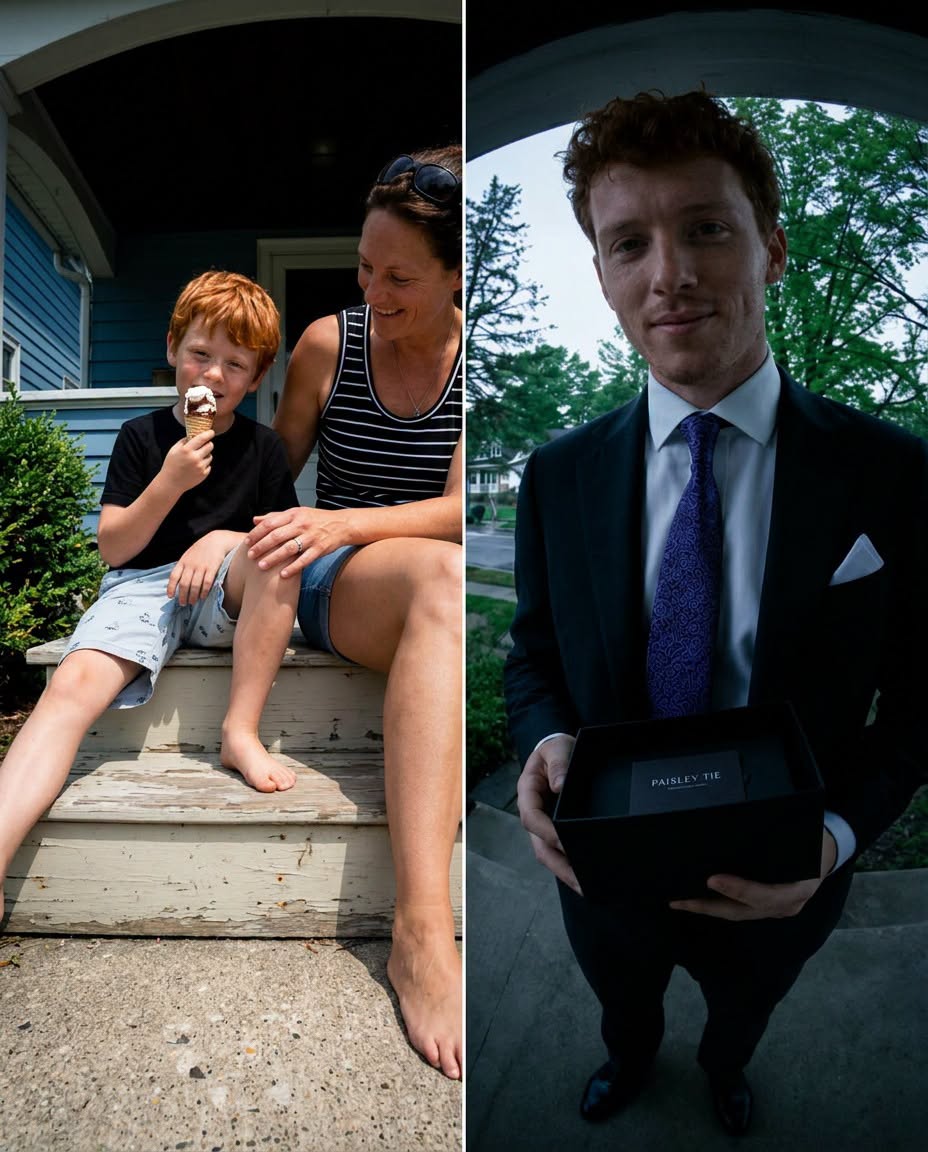
The man on my porch looked nothing like the skinny eight-year-old boy who once asked whether I had any cookies, but the nervous way he pushed his hair back gave him away immediately. Rain streaked the windows behind him as he held a heavy black box against his chest and said, “Mrs. Holland, I came to give this back.” Twenty years had passed since Dylan disappeared from my life the same morning my jewelry and emergency cash vanished from our bedroom. My husband Richard had blamed him instantly, the police had written Dylan’s name into their notes, and eventually even I had begun wondering whether the boy I had fed, comforted, and loved like a son had betrayed me. Now he stood in my doorway with tears in his eyes. When I opened the box, there was no jewelry on top—only yellowed folders, sealed letters, financial ledgers, and the old metal lockbox Richard had once hidden in our garage. Then Dylan said the sentence that dismantled two decades of belief: “I never stole from you. I stole from him.”
Dylan had entered my life because I could not ignore a lonely child sitting outside in an undersized coat while his strict parents treated pleasure like a character flaw. Over the years, my kitchen became the place where he ate grilled cheese, pizza, brownies, and chocolate-chip cookies, but food was only part of what brought him back. He helped carry groceries, shoveled snow, raked leaves, and talked to me about the things he could not say at home. Richard tolerated him but never trusted him, especially after Dylan noticed a small metal lockbox hidden behind paint cans in our garage. The night before Dylan left for college on scholarship, he returned upstairs after everyone was asleep and saw Richard moving that same box. Curious and already suspicious of my husband’s strange reaction, Dylan opened it and found cash, ledgers, account numbers, and company documents. Richard came toward the room, Dylan panicked and grabbed the box, and several pieces of my jewelry caught around its handle as he pulled it free. Richard saw him holding everything and immediately understood he had found the one person he could turn into a convenient thief.
The documents inside the box revealed that Richard had been stealing from his employer for years through fabricated vendors, false invoices, and hidden accounts containing hundreds of thousands of dollars. Dylan took the material to an attorney, who copied the evidence and advised him to preserve the originals, but Richard moved faster. Three days after Dylan left for college, he came back intending to explain everything to me, only to find Richard waiting. My husband threatened to use the burglary report, the missing jewelry, and the cash from the lockbox to frame Dylan for theft and blackmail if he ever contacted me again. Dylan wrote anyway—birthdays, Christmases, even Mother’s Day—but every letter came back unopened because Richard intercepted them. At one point Richard even sent a returned envelope with a note claiming I had sold the house and wanted nothing more to do with him. Dylan believed the lie, and I believed Richard’s version of his silence. Only after Richard died did his former employer reopen the case, authenticate the records Dylan had preserved, recover much of the stolen money from hidden accounts, and formally establish that Dylan had never been the thief.
At the bottom of the black box, Dylan finally removed several velvet pouches. Inside were my grandmother’s pearl earrings, my mother’s wedding ring, the gold bracelet, and every piece of jewelry I had mourned for twenty years. He had never sold any of it because, as he told me, “They were yours.” The financial records had become evidence in the company’s recovery action, and the old lockbox had remained preserved for chain-of-custody purposes while investigators reconstructed Richard’s fraud. Dylan had spent two decades carrying property that could have destroyed his life if he returned it before the truth was documented, yet he had also kept something far less valuable in monetary terms: a faded copy of my chocolate-chip-cookie recipe, folded so many times the edges had nearly turned white. When I asked why, he smiled and said it had tasted like home. I apologized for believing Richard, and Dylan admitted that he had made his own mistake too—he had believed he had lost me forever. Neither of us had understood how thoroughly one man’s lies had separated two people who still loved each other.
That evening, pizza baked in my oven while chocolate-chip cookies cooled on the counter exactly as they had when Dylan was a boy. He picked one up, smelled it, and grinned with the same expression I remembered from forty years of memory compressed into a single face. My jewelry was back, Richard’s secret life had finally been exposed, and Dylan’s name had been cleared, but none of those things felt like the most important return. What mattered was discovering that the relationship I thought had ended in betrayal had actually been stolen from both of us by fear, manipulation, and silence. Twenty years could not be restored, and there was no pretending they had not been lost. But when Dylan carried two plates to my kitchen table and asked whether I would still make him pizza, the house no longer felt empty. The black box had returned my mother’s ring and my grandmother’s pearls; what it really gave me back was the son I had never stopped missing.