
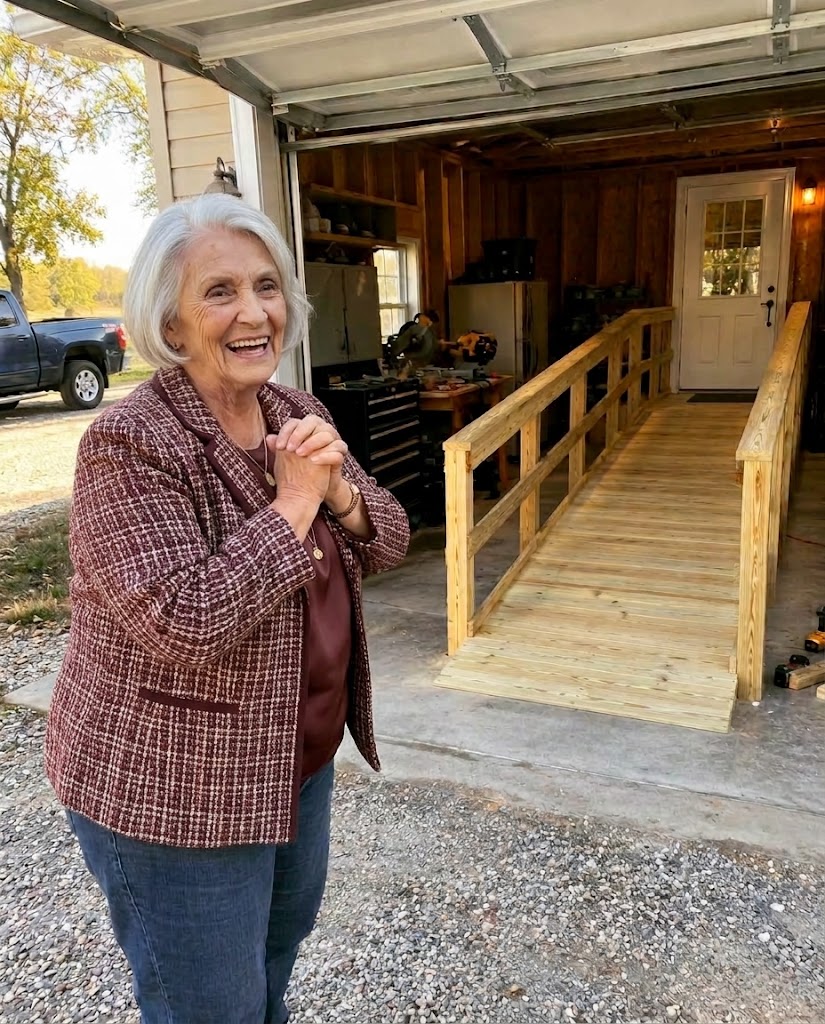
The garage door stood wide open, and the smell of freshly cut pine drifted toward me as George Strait played softly on an old radio. I had driven forty minutes through the Texas countryside to discover what my new boyfriend, Wendell, had been hiding from me for four months. My son had warned me that the man might have another woman, another family, or an interest in the $220,000 life insurance policy my late husband had left behind. Standing in my good blouse with its little blue buttons, I was suddenly afraid that the man who’d brought happiness back into my life had been lying to me. Then I noticed a broad wooden ramp stretching from the garage floor toward the house, its handrails sanded smooth and positioned unusually low. I rested my palm against one of them and realized that, although Wendell stood six feet two inches tall, the rail fit my five-foot-three frame perfectly. Beyond the open doorway, I could see freshly painted walls the color of pale butter, white cabinets with glass knobs, and a kitchen designed for someone whose knees might someday fail her. And in that moment, before Wendell appeared or offered an explanation, I understood that the secret he’d been keeping was nothing like the one my son had imagined.
My name is Winona Pruitt, though most people call me Winnie, and I was sixty-four when Wendell came into my life. I’d spent thirty-four years working as an emergency room nurse at Baylor in Dallas, learning to recognize changes in a person’s health from the smallest details: a grayness around the mouth, unusual sweating, the way someone held a hand against the chest while insisting nothing was wrong. My husband, Dwight, used to tease me that I couldn’t attend a church picnic without checking the congregation for signs of illness. We were married for thirty-nine years, and despite the long hospital shifts and ordinary disagreements that come with sharing a life, he was the person I expected to grow old beside. Two years earlier, he came inside after mowing our lawn on an unusually warm November afternoon and mentioned that his arm felt strange. He settled into his favorite brown corduroy recliner and asked for a glass of iced tea. By the time I returned from the kitchen, he was unconscious. I performed CPR until the ambulance arrived, but Dwight never recovered. After decades of recognizing medical emergencies in strangers, I found myself consumed by the thought that I’d failed to recognize the danger in my own husband. His recliner remained beside the living room window, its arms worn smooth where his hands had rested. I dusted around it every week and couldn’t bear to let anyone sit there. My daughter Megan gently suggested that I might feel better if I moved it, but I told her I’d decide when I was ready. After Dwight died, my life narrowed to grocery shopping, Sunday church services, and occasional visits to his grave beside Highway 175. My knees had been deteriorating for years, an occupational consequence of long shifts on unforgiving hospital floors. Some mornings I descended the porch steps sideways, holding the railing because bending my knees hurt too much. I worried that I might eventually need a wheelchair, as my mother had during the final eight years of her life. My neighbor Carla, a seventy-one-year-old widow who wore bright pink lipstick even to collect her mail, finally insisted I accompany her to a grief support group at the senior center. I resisted, but she arrived one Tuesday morning already carrying her purse and announced that I was coming whether I liked it or not. The room held a dozen folding chairs, several boxes of tissues, and coffee so bad that even Carla couldn’t defend it. A young facilitator named Brooke welcomed us, and I noticed a large, quiet man sitting across the circle, carefully holding a Styrofoam cup between enormous hands. His name was Wendell Haskins. He was sixty-six, had retired after thirty-eight years as a lineman for an electric cooperative, and had lost his wife, Ruth, to amyotrophic lateral sclerosis, commonly called ALS. When it was his turn to speak, he managed only a few sentences before falling silent. Something about his expression reminded me of the relatives I’d comforted in hospital waiting rooms, people who had endured so much that even ordinary conversation seemed exhausting. The following week, when I arrived late because my knees were especially painful, Wendell quietly brought me coffee with two creams. I’d taken it that way only once in front of him, yet he remembered. A week later, he offered to repair the porch light I’d mentioned during a group discussion. It hadn’t worked since before Dwight died, and although I’d tried changing the bulb, the problem appeared to be electrical. Wendell arrived that Saturday with his tools, repaired the faulty switch and wiring, and restored the light I’d spent two years navigating without. I stood in the yard that evening staring at the warm yellow glow above my front door. Then I invited him to stay for chicken-fried steak, mashed potatoes, and green beans with bacon. He ate two helpings, washed the dishes afterward, and asked where each plate belonged. The next Sunday he returned for supper, and soon it became a weekly tradition. By August, I was preparing meals for two again and looking forward to the sound of his truck in my driveway. I hadn’t expected another relationship, and I certainly wasn’t looking for a replacement for Dwight. But Wendell made me laugh, listened when I spoke, and noticed things most people overlooked. He drove me to Dwight’s grave on his birthday and waited in the truck without complaining. When my knees hurt, he adjusted his pace to mine without making a performance of helping. One Sunday, I mentioned that my mother had spent her final years in a wheelchair and described the old farmhouse where she’d lived in Kaufman. I remembered her kitchen vividly: buttercup-yellow walls, white cabinets, small glass knobs, and pink geraniums growing on the windowsill. Wendell asked several questions about the color, then returned to the subject weeks later, wanting to know whether the cabinets were white and whether the yellow was pale or bright. I assumed he simply enjoyed hearing about my childhood. But another part of our relationship increasingly troubled me. Wendell always came to my home and never invited me to his. Whenever I suggested visiting his place near Ferris, he said it wasn’t ready for company and asked me to give him until Christmas. I began noticing sawdust in the cuffs of his jeans, splinters in his palms, pale yellow paint beneath his fingernails, and exhaustion deep enough that he once fell asleep in Dwight’s recliner within seconds of sitting down. I let him sleep for forty-five minutes, surprised by how comforting it felt to see someone resting in that chair again. When I asked what he’d been doing, he called it puttering and changed the subject. My son Zach was less willing to overlook the mystery. At thirty-eight, he operated Pruitt Collision, an auto body shop in Balch Springs that Dwight and I had helped him establish eleven years earlier. Zach was hardworking and protective, but since his father’s death, he’d become unusually involved in my finances. Shortly after the funeral, he’d offered to manage my online banking temporarily so I wouldn’t have to deal with paperwork while grieving. He kept the password, checked balances for me, and reassured me that he was protecting his father’s life insurance proceeds from scammers. I accepted because I was exhausted and trusted him. When Zach met Wendell, he immediately began asking questions about his pension, retirement, home, and finances. He started bringing his wife Jordyn and their children, Kaylee and Brody, to Sunday supper every week, although he’d rarely visited so regularly before. He watched Wendell closely and made little effort to hide his suspicion. Jordyn, who worked as a dental hygienist, seemed uncomfortable with the interrogations. My daughter Megan, a thirty-five-year-old school counselor living in Longview, also became concerned after speaking with Zach. One evening, Zach accused Wendell of being interested in Dwight’s insurance money and threatened to stop bringing the grandchildren if I continued seeing him. He even opened my banking app at the table and began checking transactions while lecturing me about financial exploitation. I ordered him to put the phone away, humiliated that my grown son was treating me like a confused child in front of my family. He stopped scrolling abruptly, stared at something on the screen, then said everything looked fine for now. Later, Megan telephoned and warned that loneliness could make anyone vulnerable to manipulation. Her words hurt because they echoed my own doubts. I knew financial exploitation of older adults was real, and I had seen patients suffer because they trusted the wrong people. Yet Wendell’s tired hands, the splinters, the paint, and his strange interest in my mother’s kitchen suggested a different explanation. Finally, I remembered that he’d written his address on a napkin months earlier in case of an emergency. I found it in my kitchen drawer: 1412 County Road 664, Ferris, Texas. On Thursday morning, I put on my good shoes and drove out to discover what he was hiding.
The little white farmhouse stood behind a chain-link fence beneath an enormous pecan tree, its faded tire swing moving slightly in the breeze. Wendell’s truck was parked near a metal shed, and the garage stood open, revealing workbenches, tools, lumber, and paint cans arranged in careful rows. I nearly turned around before getting out of my car. I imagined an unfamiliar woman stepping onto the porch, asking why I had come. But the house remained quiet, and when I approached the garage, I saw the newly constructed ramp leading toward the kitchen. It was wide enough for a wheelchair, gently sloped, and fitted with handrails that were comfortable for someone my height. Beside the workbench stood several gallons of paint labeled Buttercup, the exact shade I’d described from my childhood. I walked up the ramp, discovering that the gradual incline placed far less strain on my knees than ordinary steps. Inside, the kitchen had pale yellow walls, white cabinets with glass knobs, and lowered countertops. Wendell had removed part of the cabinetry beneath the sink to provide knee clearance for someone using a wheelchair. Doorways had been widened, grab bars installed, and a pink geranium placed on the windowsill. I was still looking around when Wendell entered through the back door carrying a paint roller and a bucket. He stopped so suddenly that the roller fell from his hand. Yellow paint marked his hair, his cheek, and the old overalls he wore. He stared at me, then admitted I’d arrived before he finished. He’d planned to bring me there on Christmas Eve and surprise me with a home where I could visit comfortably regardless of how much my knees deteriorated. I sat at the kitchen table while he explained the reason. When Ruth developed ALS, the disease gradually weakened her hands, legs, and ability to move independently. Their house had narrow doorways, small bathrooms, and steps at every entrance. Wendell repeatedly promised to build a ramp, but after years of exhausting work and the strain of caring for his wife, he continued postponing it. The lumber waited in the shed for months. Ruth loved sitting beneath the pecan tree, but as her mobility declined, the steps prevented her from reaching her favorite place. She eventually died in a hospital bed positioned near the living room window, looking toward the tree she could no longer visit. Wendell had lived with the regret of not building the ramp while she was alive. When he met me and saw how painfully I moved after sitting through a grief group, he began to think about the future differently. He remembered my joke about someday needing a wheelchair, my mother’s struggle with arthritis, and the happy memories I associated with that yellow kitchen. He didn’t want to make another promise he might fail to keep. He wanted the work completed before inviting me, so I’d know I would always be welcome in his home, whether I could walk easily or needed mobility assistance. The house wasn’t simply being redecorated. He’d been making it accessible, with a walk-in shower, a lower bed, wider interior doors, grab bars, and a second ramp leading toward the pecan tree. Beneath the tree, he’d built a bench wide enough for two people. I cried as he showed me the work, touched by how carefully he’d remembered details I hadn’t realized were important. Then I noticed his exhaustion, the trembling in his hands, and the pain medication sitting beside his coffee pot. He admitted he’d been working eight to ten hours most days, sometimes longer, and sleeping only four or five hours a night. I told him that making the house safe for me wasn’t worth damaging his own health. He promised to rest, and we sat beneath the pecan tree holding hands while the late afternoon light filtered through its branches. Driving home, I thought about the difference between the man Zach had described and the man I’d found carefully sanding handrails to fit my height. But I also remembered something troubling: the way Zach had stopped scrolling through my bank account during Sunday dinner, the tension in Jordyn’s hands while she cut pie, and Megan’s hesitation before repeating her brother’s suspicions. Wendell had given me a reason for every puzzling detail I’d noticed about him. My son’s behavior, however, still didn’t make sense. The following morning, I visited the branch of First Texas where Dwight and I had opened our first account in 1985. I asked the manager, Tamika, to print the statements for every account in my name, review authorized access, and help me change my online banking credentials so that I alone controlled them. Back at my kitchen table, I examined two years of transactions. Dwight’s life insurance benefit had been $220,000, and after paying funeral expenses and purchasing his headstone, I believed approximately $190,000 remained in a money market account. The statement showed only $146,000. I checked every transaction and discovered a series of transfers beginning in February, including withdrawals of $5,000, $3,000, $8,000, and larger sums later in the year. One September transfer alone was $11,000. Altogether, $44,000 had left my account, and every transfer had been directed to the same recipient: Pruitt Collision LLC, my son’s business. I sat staring at the statements, realizing that while Zach accused Wendell of pursuing my husband’s insurance money, Zach himself had been quietly moving that money into his company. The timing of the largest transfers matched his sudden habit of attending every Sunday dinner and questioning Wendell about his finances. My son had insisted that I was vulnerable to deception, yet he was the person who’d been using the banking access I’d entrusted to him after Dwight died. I called Megan and explained everything, beginning with the ramp and yellow kitchen before telling her about the missing money. She was shocked and said she knew nothing about the transfers. She admitted Zach had repeatedly warned her about Wendell, and she’d accepted his fears without considering what might be motivating them. I told her I intended to speak with Zach at our next family supper and wanted her there. I invited Wendell too, because after months of accusations at my table, he deserved to hear the truth directly. On Sunday, I made pot roast, carrots, potatoes, yeast rolls, sweet tea, and banana pudding. I set the table for eight, including Zach, Jordyn, Megan, and Wendell, while my grandchildren played in the living room. When the meal ended, I asked Jordyn to take the children to watch a movie. Then I placed the folder of bank statements in front of my son, opened it to the transfers totaling $44,000, and asked him to explain why money from my account had gone into Pruitt Collision without my permission. His face changed immediately. He looked toward the door, then at Jordyn, then down at the statements. At first he said he’d intended to repay every dollar. I told him that wasn’t an explanation for taking it. Finally, he began talking about the trouble at his business. Repairs had become less profitable as insurers reduced reimbursement rates, experienced employees had left, and a new paint booth had cost far more than expected. Then an electrical fire damaged equipment and three customers’ vehicles, creating losses of approximately $60,000. The company’s insurer was disputing the claim because of alleged electrical-code violations, and Zach feared the dispute could continue for months. He had employees depending on their wages, a loan secured against the building, and a business Dwight had helped him create. Rather than ask me for help, Zach used the password he controlled to transfer money from my account, convincing himself he would repay it when the insurance claim was settled. When Wendell entered my life, Zach became frightened that another man might encourage me to examine my accounts or ask questions about financial decisions. He began attending every Sunday dinner and accusing Wendell of having dishonest intentions. He even threatened to keep the grandchildren away to pressure me into ending the relationship. As I repeated the sequence back to him, Zach broke down in tears. Jordyn admitted she’d discovered the transfers in June and had begged him to tell me. She apologized for remaining silent, and I remembered the way her hands shook during those uncomfortable dinners. Wendell, who’d said almost nothing throughout the confrontation, finally spoke. He told Zach about the ramp he’d failed to build for Ruth and how shame had made him postpone the work until it was too late. He explained that admitting a mistake becomes harder the longer a person avoids it, and that hiding the mistake often causes more harm than the original failure. He didn’t excuse Zach’s conduct, but he recognized the fear and humiliation that had driven him to keep digging himself deeper. Zach apologized to Wendell for calling him a con man, and Wendell accepted the words without pretending the insults had been harmless. Later that night, after everyone left, I sat for the first time in two years in Dwight’s brown corduroy recliner. I thought about my son crying at the kitchen table, the man who’d built a ramp for me, and the strange ways grief had changed the people I loved. I decided I wouldn’t abandon Zach, but neither would I allow love to become an excuse for financial dishonesty.
The following week, I accompanied Zach to an attorney’s office and insisted that the $44,000 be documented as a legitimate debt rather than left as a vague family promise. Unauthorized transfers from a parent’s account aren’t made acceptable merely because the money supports a family business or because repayment is intended. I wanted a written agreement establishing the amount owed, the interest rate, a repayment schedule, and the consequences of missing payments. We arranged for the loan to carry two-percent interest over a six-year term, with monthly payments and a provision requiring the remaining balance to be paid if his company received the disputed insurance proceeds. The attorney helped us put the arrangement in writing, and Zach signed it. I also retained sole control of my banking password, reviewed the access permissions on my accounts, and made clear that nobody would move money without my explicit authorization again. Zach was relieved I wasn’t immediately pursuing criminal charges, but I reminded him that the seriousness of his conduct didn’t disappear because we were handling the repayment privately. He’d violated my trust and attempted to redirect suspicion toward an innocent man. If he wanted our relationship to recover, he would need to demonstrate accountability through consistent behavior rather than apologies alone. He began making the required payments and stopped treating my financial affairs as something he was entitled to supervise. The next Saturday, he drove to Wendell’s house with a professional paint sprayer and two employees from his shop. He’d heard that Wendell had been working long hours and wanted to help finish the renovations without further exhausting him. The men painted trim, stained the ramps, completed remaining work in the bathroom, and checked that the exterior surfaces were ready for use. Zach handled much of the finishing himself, working carefully with a level and trowel while Wendell supervised. At the end of the day, my son stood at the bottom of the ramp and apologized again for the accusations he’d made. Wendell told him he understood how shame could make people behave badly, but that it was what Zach did next that would matter. That small act of repair did more for their relationship than I expected. They weren’t suddenly close friends, and I didn’t ask them to pretend otherwise. But Zach began greeting Wendell respectfully at family gatherings, and I could see him gradually recognizing that my relationship with a new companion didn’t erase the love I’d shared with his father. Christmas Eve arrived with cold weather and a clear sky. Wendell collected me in his truck, wearing a red flannel shirt and looking unusually nervous. He joked that his surprise was ruined because I’d already seen the house, but I reminded him that he’d promised me a speech and had yet to deliver it. When we turned onto County Road 664, I saw Christmas lights wrapped around the pecan tree and a wreath on the freshly painted front door. Several vehicles were parked in the driveway, including Zach’s truck, Megan’s minivan, and Carla’s silver Buick. Inside, the buttercup-yellow kitchen was filled with our family. Zach, Jordyn, Kaylee, Brody, Megan, her husband, their daughters, and Carla had gathered around a long dining table made from two smaller tables pushed together. Zach had borrowed chairs with supportive arms from the church because he knew they would make it easier for me to stand without straining my knees. He was wearing a Christmas apron and preparing gravy, having obtained what he believed was Dwight’s recipe from Megan. It was far too peppery, but I told him it was perfect because the effort mattered more than the seasoning. After supper, Wendell asked me to come outside. He helped me down the new rear ramp, following the concrete path toward the pecan tree, where little lanterns illuminated the way. We sat together on the wooden bench he’d built, the Christmas lights casting a soft glow over the bare branches. He admitted he’d prepared an elaborate speech about love, grief, and the years he regretted losing with Ruth. But he decided the important thing was simpler. He wanted me to know I could come to his house whenever I wished, whether my knees were painful or strong, whether I needed a wheelchair someday or remained able to walk. He wasn’t asking me to marry him, sell my home, or abandon any part of my life with Dwight. He wanted to offer me a place where I would always be welcome and where practical care had already been built into the walls, entrances, and rooms. I thought about my own house in Seagoville, Dwight’s chair by the window, and the years of memories I’d spent so long protecting. Then I asked Wendell whether he’d continue coming to my home for Sunday supper. He said of course. I asked whether I could visit him on Wednesdays, sit beneath the pecan tree, and have coffee prepared with two creams. He smiled and said he’d always remember. I told him that was enough for now and suggested he ask me again about the future at Easter. He laughed, his deep voice carrying through the cold evening, and promised he’d keep asking for as long as I would listen. Over the following months, our arrangement settled into a comfortable rhythm. Wendell visited me on Sundays, and I spent Wednesdays at his house, enjoying the kitchen he’d designed around memories of my mother. My family gradually became more at ease with our relationship. Megan, who called regularly from Longview, began asking after Wendell rather than questioning his intentions. Zach continued repaying the money he’d taken, and when his company’s fire insurance claim was eventually settled, he used the proceeds to clear the outstanding balance. He brought me confirmation that the debt had been paid and apologized again for having treated my account as though it were his own. I appreciated the repayment, but I told him the money mattered less than the trust he needed to rebuild. I’d learned to manage my online banking myself, and I intended to keep doing so. Dwight’s insurance had been left to provide security for my future, not to become an account other people could draw upon without asking. I also finally moved his recliner from my living room. Zach took it home, and one Sunday he sent me a photograph of Brody asleep in the chair, his head tilted in almost the same way Dwight used to fall asleep after a long afternoon in the yard. Seeing my grandson there didn’t feel like losing another piece of my husband. It felt as though something familiar had found a new place in the family.
Ten months after that first unexpected visit to Wendell’s house, I still live in Seagoville, and the little white farmhouse near Ferris has become an important part of my week. I haven’t sold my home, and I haven’t made a decision about marriage. Wendell asked me again at Easter while we sat beneath the pecan tree, its branches beginning to fill with new leaves, and I told him to ask again in the fall. He accepted the answer with a smile. We both spent decades married to people we loved, and neither of us feels the need to rush into arrangements simply because we’re older. I value having someone to share meals with, talk to in the evenings, and sit beside when words aren’t necessary. I also value the home Dwight and I built, the familiar streets where I raised our children, and the independence I’ve maintained since retiring from nursing. Loving Wendell doesn’t require me to stop loving Dwight or to treat the life I had before as something that must be put away. That understanding has come gradually. For the first two years after Dwight’s death, I avoided sitting in his recliner because I feared doing so would make his absence impossible to ignore. I kept the chair arranged exactly as he’d left it, dusting the table and lamp around it as though preserving the scene might keep some part of him close. Then I sat in it the night I learned Zach had taken $44,000 from my account. I expected to feel overwhelmed, but instead I found myself remembering Dwight’s practical nature and the way he would have approached a family problem. He would have wanted our son to take responsibility, repay what he’d taken, and understand that fear doesn’t justify dishonesty. Moving the chair into Zach’s house later felt less like surrendering a memory than allowing that memory to remain part of our family. I see photographs of the grandchildren curled up in it, and I imagine Dwight smiling at how completely the chair has been claimed by another generation. Zach and I are still rebuilding our trust. I love him, and I understand that the trouble at his business frightened him. He faced employee wages, equipment losses, disputed insurance coverage, and the possibility of losing a company his father helped him establish. But he had other choices. He could have come to me, explained the financial problem, and allowed me to decide whether I wanted to help. He could have explored business financing, negotiated with creditors, or discussed repayment options with his insurer. Instead, he quietly transferred money from my account and then tried to make Wendell appear untrustworthy. I haven’t forgotten the way he spoke to me at my own kitchen table, telling me that loneliness made me incapable of judging a man’s intentions. At the time, his words stirred doubts I hadn’t felt in years. I’d spent thirty-four years assessing emergencies, comforting families, and making difficult decisions under pressure. Yet my son seemed to believe I couldn’t manage my own relationships or finances because I was a widow in my sixties. I had allowed him access to my banking because I trusted him and appreciated his help while I was grieving, not because I’d lost the ability to understand money. Discovering the transfers forced me to recognize that even within a loving family, financial arrangements need clear boundaries. I now review my accounts regularly, keep my passwords private, and make my own decisions about how Dwight’s insurance proceeds will support my future. I haven’t excluded my children from my life or stopped discussing plans with them. I simply understand the difference between accepting advice and surrendering authority. Megan has apologized for allowing Zach’s fears to shape her view of Wendell without learning more about him. She and her daughters visited the farmhouse for a picnic beneath the pecan tree, and one of the little girls fell asleep against Wendell while he sat on the bench. He looked so startled and pleased by the trust she’d placed in him that I nearly laughed. Carla continues to insist she knew from the beginning that Wendell was special. She claims she noticed the way he watched me enter the grief group on that second Tuesday, moving slowly and holding the wall because of my painful knees. According to Carla, he looked at me as though the sun were coming up. I tell her she has an overactive imagination, but she only smiles and reminds me that I’m not the only retired woman capable of noticing things. My knees have grown worse, and my doctor believes I may need joint replacement surgery in the coming year. Some mornings, I can barely make it down the steps of my own porch without turning sideways. The discomfort frustrates me because I’ve always been physically active, even after leaving the hospital. But every Wednesday, when I drive to County Road 664, Wendell is usually waiting in the garage with a cup of coffee. He hands it to me with two creams, exactly as he did the second week we met. Then I place my hand on the smooth wooden rail he built at precisely the right height and walk up the gentle ramp into his buttercup-yellow kitchen. The doorway is wide, the floor is level, and the chair by the table has sturdy arms that help me sit and stand comfortably. Those details might seem ordinary to someone who has never struggled with stairs or mobility, but they make an extraordinary difference when pain turns simple movements into obstacles. Wendell thought about those things before I ever asked him to. He remembered my mother’s kitchen, the pale yellow walls, the white cabinets, the glass knobs, and the pink geraniums because he listened carefully when I spoke. He also remembered Ruth, the ramp he hadn’t built, and the years he spent regretting that she couldn’t reach her beloved pecan tree. I know he began the work partly because he wanted to do something differently the second time he loved someone. I don’t believe completing the house could erase his regrets about Ruth, and I wouldn’t want him to imagine that it had. She was an important part of his life, just as Dwight was of mine. But Wendell found a way to turn what he’d learned through loss into practical kindness. When I first drove out to his house, I thought I might discover another woman or a secret he was ashamed to reveal. Instead, I found a home being carefully altered so that I could enter it without fear of what my knees might do next. Later, the visit led me to examine my own accounts and discover a betrayal I would never have expected from my son. Both revelations changed my life, though in very different ways. One required me to establish boundaries and rebuild trust with a person I’d loved since the day he was born. The other allowed me to trust that affection could return after years of grief without diminishing what came before. I still think about the handrail whenever I visit Wendell. It’s made from ordinary lumber, sanded smooth and fixed securely in place. There’s nothing elaborate about it, nothing that would impress someone looking for grand romantic gestures. But the height is exactly right, and when I rest my hand against it, I remember that someone noticed how difficult stairs had become for me and chose to make the journey easier. By the time I reach the kitchen, Wendell has usually pulled out my chair and set the coffee on the table. Sometimes we talk about the children, sometimes about Ruth or Dwight, and sometimes about nothing more consequential than what we’ll have for supper. The pecan tree is visible through the window, its branches moving gently in the wind. I sit down beside the man who built the ramp, take a sip of coffee, and enjoy the quiet comfort of knowing that he wanted me there long before I ever discovered why he was keeping me away.

