
The wooden spoon slipped from my hand and struck the kitchen floor when I lifted the lid of the small box Lily had placed before me. Inside lay a worn stuffed rabbit, its faded fur pressed flat and one ear hanging at an awkward angle where I had repaired it years earlier. I recognized him before I saw the crooked green initials on his tag, written by a little girl whose hands had barely been big enough to hold a marker. Mr. Bunny. My daughter Josie’s favorite toy, the one that had disappeared on the day a car accident took both her life and my husband’s. I pressed the rabbit against my face, trying desperately to catch some familiar trace of my child, but he smelled only of dust and cedar. Across the table, seven-year-old Lily began to cry, frightened by my reaction, and whispered, “Dad told me to give you this today.” Her father had been dead for exactly one year, and somehow he had left behind the one thing I had spent years believing was lost forever.
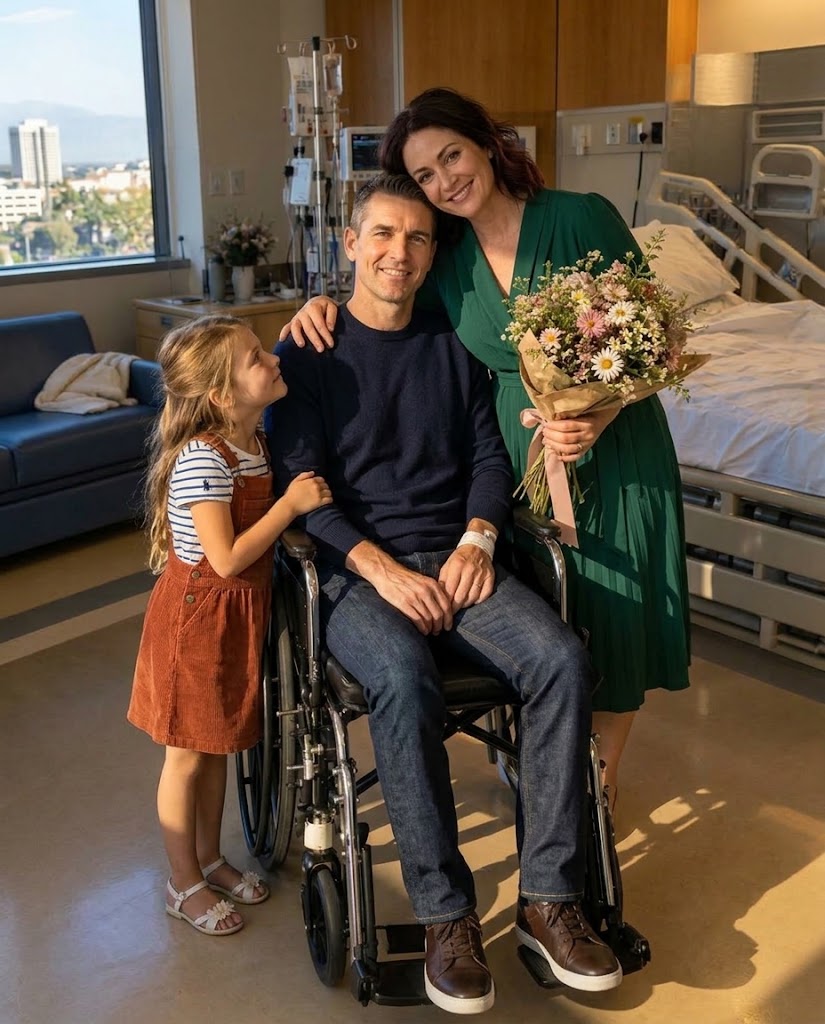
Several years earlier, I had buried my husband and our little girl, Josie, after an accident that divided my life into a before and an after. Friends encouraged me to rebuild, but grief was not something I could simply put away because the calendar kept moving. I eventually found work as a hospital housekeeper, grateful for the predictable rhythm of changing linens, wiping surfaces, and moving quietly between rooms where nobody expected me to explain my sadness. I never remarried, never had another child, and learned to live with the empty spaces in my house. One absence troubled me more than I could explain: Josie’s stuffed rabbit had never been returned among her personal belongings after the accident. I remembered his threadbare belly, the crooked stitches I had sewn into his damaged ear, and the way Josie insisted on taking him everywhere. Then, one ordinary morning, I entered Room 412 and met Daniel, a widowed father receiving treatment for terminal cancer. His wife had died giving birth to their daughter, Lily, who was six and spent her afternoons at the hospital with a backpack almost as large as she was. Daniel was already becoming too weak to manage the small tasks that make up a child’s day. One morning, I found Lily standing beside his bed holding a hairbrush while he struggled to untangle her hair with trembling hands. Without thinking, I offered to help and braided it the way I once braided Josie’s. Lily touched the finished plait, smiled, and told me it was just right. After that, I began helping her with spelling words, sharing snacks, and keeping her company while Daniel rested after treatment. What started as a moment of kindness gradually became an attachment none of us had planned. Daniel and I talked during quiet hospital hours, sometimes over cups of tea, and eventually I told him about the family I had lost, although I could never bring myself to describe the accident in detail. He listened with an expression I mistook for the sorrow of another parent who understood how precious time could be. As his illness advanced, he told me he loved me and asked whether I would marry him, admitting that his greatest fear was leaving Lily without someone who would care for her. I was startled by the proposal, but by then I had come to love both of them. We married in his hospital room, with me wearing a simple white sundress and Lily dressed in yellow, holding my hand throughout the ceremony. Before his death, Daniel had completed arrangements naming me as Lily’s guardian, and two weeks after our wedding, he was gone. Lily and I moved into his house and began the difficult work of grieving together, finding comfort in ordinary rituals: Friday pancakes, made-up songs during car rides, and evenings curled together on the couch. Over time, the house began to feel like ours. Then, on the first anniversary of Daniel’s funeral, Lily carried a hidden box into the kitchen and told me her father had instructed her to wait an entire year before giving it to me.
Beneath Mr. Bunny lay a folded letter addressed to me in Daniel’s familiar handwriting. My hands shook as I opened it, and the first lines left me almost unable to breathe. Daniel confessed that he had been near the accident that killed my husband and daughter. He had stopped when he saw the wreckage, called emergency services, and rushed to help, but my husband was already beyond saving. Josie, however, was still conscious. Daniel had stayed beside her, reassuring her that help was coming while she clutched her beloved rabbit. Before she died, she placed Mr. Bunny in his hands and asked him to take the toy home to her mother. He promised he would. According to the letter, Daniel attended the funeral intending to return the rabbit, but when he saw me standing beside the caskets, overwhelmed by grief, he lost his courage. He convinced himself that there would be a kinder moment later, once the shock had begun to fade, yet the longer he waited, the more impossible the conversation seemed. Years passed. Then I walked into his hospital room, unaware that the man lying in the bed was carrying a promise made to my dying child. Daniel wrote that he had not recognized me immediately, but when he learned my name and heard about my husband and daughter, he understood who I was. Even then, he could not bring himself to tell me. He kept the rabbit hidden, married me without revealing the connection, and eventually asked Lily to deliver the box one year after his death, believing that by then we would have become a family strong enough to withstand the truth. In the letter, he apologized for failing to honor Josie’s final request, but his words did little to soften the shock. I had trusted him, cared for him through his illness, and promised to raise his daughter, never knowing that he possessed something precious belonging to mine. I thought of the conversations in Room 412, the times he had watched me with an expression I couldn’t understand, and the extraordinary decision to conceal the truth even as his life was ending. For the first time, I questioned whether Daniel had married me because he genuinely loved me or because he wanted to ease his guilt by placing Lily in the care of the mother whose child he had once failed. Then I looked at the frightened little girl beside me and realized that his final secret had left her carrying a burden she was far too young to understand. When Lily whispered, “Are you mad at Dad?” I answered honestly that I was, but assured her she had done nothing wrong. Her next question struck me harder than anything in his letter: “Are you going to leave me?” I pulled her onto my lap and promised I wasn’t going anywhere, although I was still struggling with the possibility that the family I had grown to cherish had begun with a terrible secret. That was when Lily quietly corrected the thought I had barely spoken aloud: “Dad didn’t choose you. I did.”
She told me that long before Daniel proposed, she had watched me braid her hair, remember her favorite snacks, help with homework, and stay beside her when her father was too exhausted to talk. One evening, she had asked him whether that was what having a mommy felt like. When Daniel asked what she meant, Lily explained that I listened to her, remembered what she said, and always came back. She told him that she wanted me to keep staying, and he admitted that he wanted the same thing. Listening to her, I began to understand that Daniel’s secrecy, however painful, had existed alongside a relationship that Lily and I had formed independently. He had known something about my past that I didn’t know about his, but he had not invented the affection growing between us. Lily had welcomed me because I showed up for her, and I had come to love her because of the child she was, not because I was searching for someone to replace Josie. None of that erased Daniel’s deception. He had broken a promise to my daughter, withheld the truth throughout our marriage, and left a child to deliver a revelation that should have come from him. I wished he were still alive so I could ask why he had waited, why he had decided I could not bear the truth, and whether he understood how much pain his silence would cause. Yet there was no lawyer, document, or explanation that could answer the questions I most wanted to ask about Josie’s final moments. The guardianship arrangements Daniel had completed before his death had given Lily stability, but those papers were only part of what bound us together; our daily life had been built through trust, care, and countless ordinary acts of love. I sat with Lily on the kitchen floor until the soup cooled in its pot, holding the rabbit in one hand and my new daughter’s fingers in the other. Eventually, she reached toward Mr. Bunny’s crooked ear and asked who he belonged to. I told her his name and explained that he had been Josie’s favorite companion, carried everywhere and loved until his fur grew thin. Lily already knew I had once had a daughter, but she had never heard her name. When I told her it was Josie, she repeated it softly, as though introducing herself to someone important. Then she leaned against my shoulder and asked whether I was still her mommy. “Yes,” I answered before she had finished speaking. She wrapped her arms around me, and after a while, she asked whether I would tell her more about Josie. So I began with the funny things: the way Josie sang the wrong words to songs in the car, how she refused to eat green vegetables unless Mr. Bunny pretended to taste them first, and the afternoon she insisted that her rabbit needed a birthday cake. For the first time in years, I spoke about my daughter without forcing myself to stop when the memories became too painful. Lily listened closely, gently stroking the rabbit’s worn fur as though she understood that he was carrying more than an old childhood story.
Since that afternoon, I have kept Mr. Bunny in a safe place where Lily and I can take him out whenever we want to remember Josie. Sometimes she asks about the daughter I lost, and sometimes she simply wants to sit beside me while I hold the little rabbit whose journey home took far longer than anyone could have imagined. I still have complicated feelings about Daniel. There are days when I remember his kindness during our brief marriage and feel grateful that he brought Lily into my life, and other days when I am angry that he denied me the chance to hear about Josie’s final moments while he was still alive to answer my questions. I have stopped trying to force those feelings into a single judgment. Daniel did something compassionate when he stopped at the accident and stayed beside a frightened child, and he did something deeply hurtful when he failed to keep his promise to her mother. Both things can be true. More importantly, his choices do not determine what Lily and I are to each other. Our family was not created by a hidden letter or an old stuffed animal; it grew slowly through mornings when she needed her hair braided, evenings when grief interrupted our plans, and the simple comfort of knowing neither of us would have to face another loss alone. I had once believed that becoming Lily’s mother meant finding a way to move forward without looking back at Josie, as though loving one child too openly might somehow take something away from the other. Now I know there is room in our home for both girls: one whose life ended far too soon, and one whose life is unfolding before me. Sometimes Lily curls up beside me and asks for a story about her sister, a word she chose herself after hearing enough about Josie to feel connected to her. I tell her about the patched ear, the stubborn rabbit, and the little girl who wanted him returned to her mommy. Then I look at Lily, with her hair neatly braided and her hand resting trustingly in mine, and feel the strange fullness of a life I once thought would remain empty forever. Mr. Bunny finally came home, just as Josie had asked. And although nothing can restore the years I lost or undo the pain of discovering Daniel’s secret, the rabbit has become a quiet reminder that remembering one child and loving another are not competing promises. They are simply two ways my heart continues to be a mother’s.

