
This is a fictional story.
I worked thirty-four years as a school cafeteria cook in Dayton, Ohio. I fed other people’s children every weekday and saved every dollar I could.
Three years ago, I gave $85,000 of those dollars to my son.
The Down Payment
My name is Joanne. I’m seventy-one. My son, Derek, and his wife, Ashley, found a four-bedroom house in a good school district. The bank wouldn’t approve them on their own. Ashley’s credit was a mess.
So I put down the $85,000 from my retirement account, and I co-signed the $410,000 mortgage. My name went on the loan and on the deed, right next to theirs.
“You’re a lifesaver, Mom,” Derek said, and hugged me in the title office.
Ashley hugged me too. That was the last time.
Thanksgiving
This year, Ashley insisted on hosting Thanksgiving. Her parents were coming, her sister, a few friends. Fourteen people.
I brought two pies and my sweet potato casserole, the one Derek used to eat straight out of the dish as a boy.
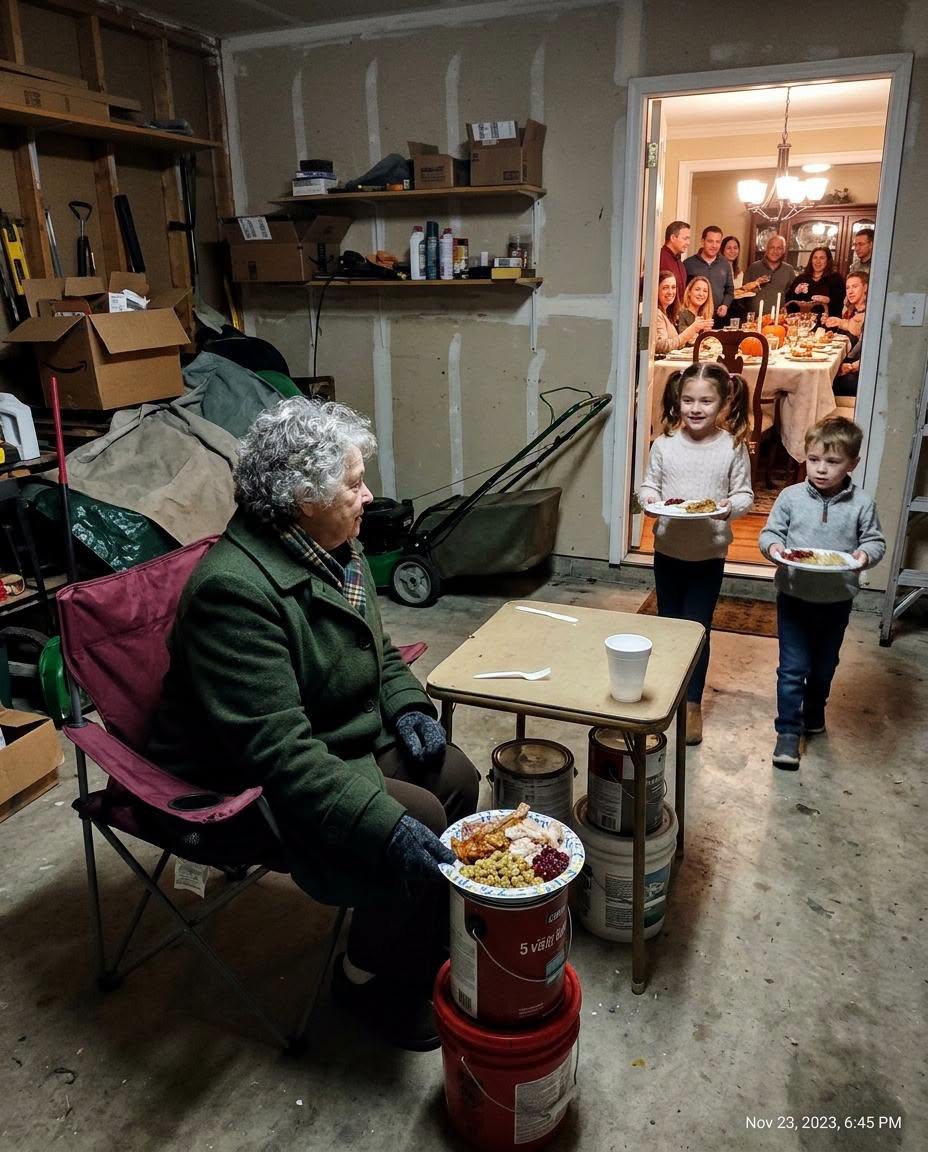
When it was time to eat, Ashley took me by the elbow and steered me past the dining room. Past the beautiful table with the gold chargers and the place cards. Through the kitchen. Into the garage.
There was a wobbly card table. One folding chair. A paper plate. Next to the lawnmower and a stack of paint cans.
“It’s the dog hair on your coat, Joanne,” she said, smiling. “My mom’s allergic. You understand.”
I have a fourteen-year-old beagle named Pickles. I’d lint-rolled my coat twice in the car.
The Paint Can
I looked back at my son. He was carving the turkey. He looked up, saw me standing in the garage doorway, and looked back down at the turkey.
So I sat down. The folding chair was too low, so I set my plate on a paint can to reach it better. I ate my Thanksgiving dinner in a cold garage that I had helped pay for, listening to fourteen people laugh through the door.
Halfway through, the door creaked open. My grandkids, Ella, nine, and Mason, six, carrying their plates.
“We want to eat with Grandma,” Ella said. They sat on upside-down buckets on either side of me. Mason gave me his roll.
I didn’t cry until I was in my car.
Monday
On Monday morning, my phone rang. It wasn’t Derek.
It was the bank.
“Mrs. Hollis? You’re listed as a co-borrower on a mortgage on Sycamore Lane. Are you aware that the account is four months past due, and that a notice of default was mailed to the property in October?”
I sat down on my kitchen floor.
“Ma’am, because you’re on the loan, this will affect your credit too. And if it isn’t resolved, the bank can begin foreclosure in thirty days.”
Where had the mortgage money gone, did Derek know, and what did Joanne do with the house she co-owned?
The Bank Office
I drove to the bank that afternoon. A kind loan officer named Mr. Okafor printed everything out for me.
The mortgage payments had always come from a joint account Derek and Ashley shared. In July, the payments stopped. Not because there was no money. Because the money was going somewhere else. Mr. Okafor couldn’t show me their bank statements, but he could show me the address on the account. It had been changed in June. To a P.O. box.
Derek never saw a single late notice.
Derek
I called my son and asked him to meet me at a diner. Alone.
He came in apologizing about Thanksgiving before he even sat down. “Mom, I’m so sorry about the garage. Ashley said—”
I slid the default notice across the table.
I watched my son’s face go from confusion to disbelief to something I’d never seen on him before. He pulled up their bank app right there in the booth. Ashley had moved the mortgage money every month into a separate account in her name only. From there: a boutique she was trying to start, $6,000 on a trip to Scottsdale with her sister, and three new credit cards he’d never heard of.
“She told me she was handling the bills,” he whispered. “She said I worked too much to worry about it.”
The Deed
That night, Ashley called me screaming. How dare I go behind her back to the bank. How dare I “turn Derek against her.”
I let her finish. Then I said, very calmly, “Ashley, I own one third of that house. I’m on the loan. The bank called me because you hid their letters. I didn’t go behind your back. You put me in the garage, and then you put my name in default.”
She hung up.
What I Did
I had a little left in savings. Not much. Enough to cover the four missing payments and stop the foreclosure. I paid the bank directly, myself, the next morning.
Then I met with a lawyer. With Derek’s agreement, we refinanced the house into Derek’s name and mine only. Ashley’s name came off the loan and the deed as part of their separation. Every payment now goes straight from Derek’s paycheck to the bank, and I get a copy of every statement.
Ashley moved into her sister’s place in January. The boutique never opened. The credit cards are hers to deal with.
The Garage
In the spring, Derek asked me something that made me cry for the second time that year.
“Mom, would you move in with us? The kids want you here. I want you here.”
He and a contractor buddy spent three months turning the garage into a little in-law suite. Heated floors. A window over the backyard. A real bed. A dog door for Pickles.
This Thanksgiving, I hosted.
We ate in my suite. In the garage. At a real table with a tablecloth I bought on sale. Ella made the place cards. Mason made sure I got two rolls.
And on the windowsill, where it used to sit on the floor, there’s one old paint can. Ella painted it gold and planted a little geranium in it.
She says it’s to remember where Grandma’s seat used to be. And where it is now.
This story is a work of fiction. Names, characters, and events are products of the author’s imagination. Any resemblance to real people or events is purely coincidental.