
The envelope was waiting in my mailbox on Hope’s eighteenth birthday, thick and unmarked except for one sentence written across the back: Your daughter has been lying to you. I was still standing on the front step when a woman across the street called my name. She had dark curls threaded with gray, the same jawline as my daughter, and an expression caught somewhere between terror and hope. Then Hope appeared behind me in the doorway, saw the woman, and went completely still. I asked the question before I was ready for the answer: “Do you know her?” Hope began to cry. “Yes,” she whispered. “I’ve known her for two years.”
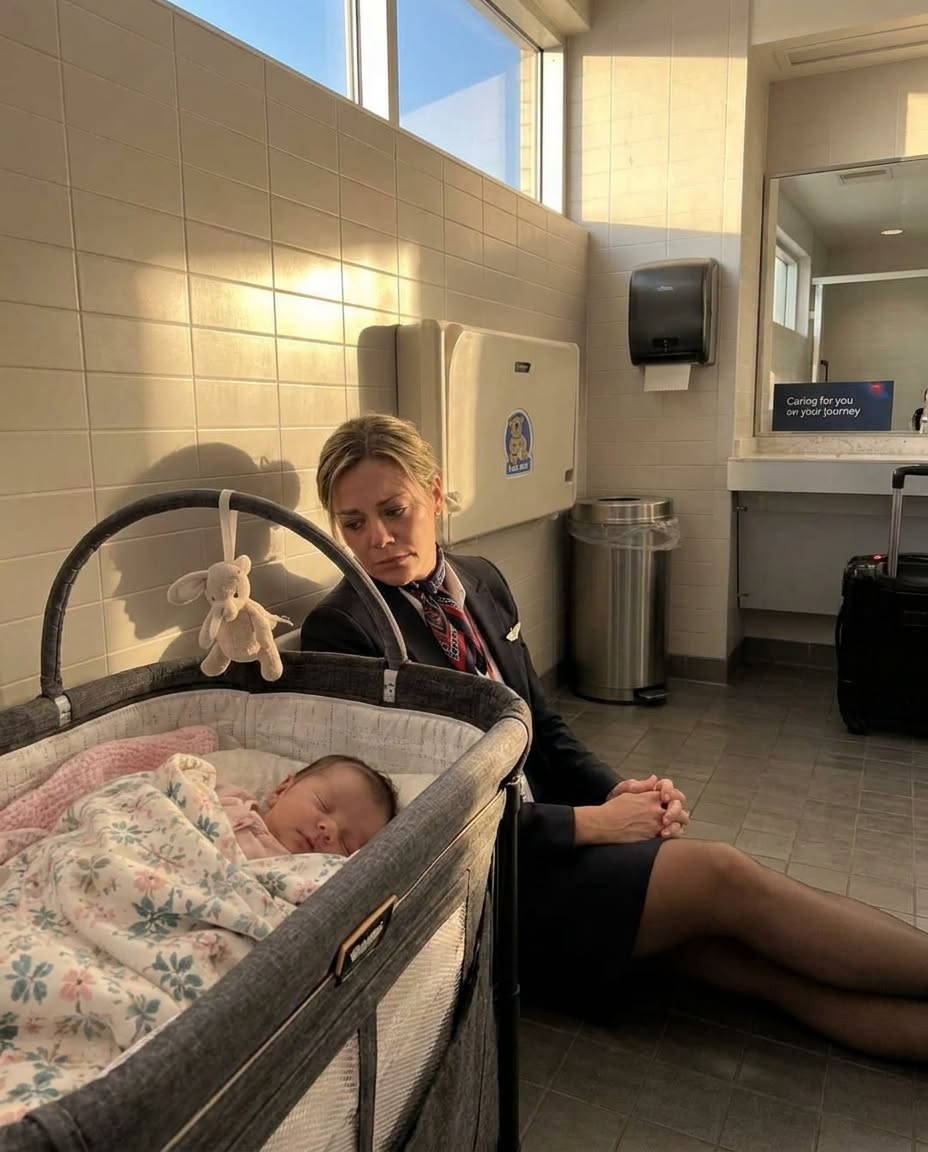
Eighteen years earlier, I had been a thirty-seven-year-old flight attendant walking through a nearly empty airport after a red-eye when I heard a weak cry from the women’s restroom near Gate 17. On the changing table lay a newborn girl wrapped in a yellow blanket with a note pinned to it: Please take care of her. Her name is Hope. Airport security and child-welfare authorities took over, but I could not stop thinking about her. Two months before that morning, I had lost my three-year-old daughter Emma after a sudden illness, and my marriage had collapsed under the grief. I began visiting Hope through the authorized process, later applied to foster her, rearranged my work schedule, completed the required home studies and approvals, and eventually adopted her. She grew up knowing the truth of her beginning. Every birthday she asked me to tell the airport story, and every year I ended it the same way: “I didn’t find you, baby. You were sent where I could hear you.”
The woman across the street was Lily Chen, Hope’s biological mother. She told me she had been twenty-two when Hope was born and had believed, for years, that her own mother had arranged a legitimate adoption with a waiting family. Only after her mother died did Lily discover documents suggesting something very different: Hope had been taken from her while she was recovering and abandoned at the airport instead. Lily spent years trying to understand what had happened and later used lawful search channels, intermediary records, and eventually DNA-based matching to locate Hope. Hope had responded when she was sixteen. For two years they had exchanged messages and learned about one another without telling me. Hope said she had hidden it because she feared that searching for her biological mother would sound like rejecting the mother who raised her. She was not trying to replace me. She was trying to understand where she came from without destroying where she belonged.
We sat at the kitchen table with Hope’s lemon birthday cake untouched on the counter while the three of us tried to make room for facts that did not cancel one another out. Lily did not claim parental rights or try to rewrite Hope’s childhood; Hope was legally an adult now, and the adoption that made me her mother had long been final. Lily wanted Hope to know that she had been wanted before the airport, and that whatever her own mother had done had not been Lily’s decision. I told Hope I wished she had trusted me enough to tell me sooner, but I understood why a sixteen-year-old might believe she had to protect everyone at once. We agreed there would be no instant version of “family” created that morning. There would be time, boundaries, questions, perhaps counseling, and whatever relationship Hope chose to build with Lily as an adult. Nothing about finding her biological mother erased the eighteen years we had lived together.
Eventually I lit all eighteen blue candles. Lily hesitated when I began singing, then joined in softly from across the counter. Hope blew them out in one breath, as she always had, and for the first time there were three pieces of lemon cake on the plates instead of two. I had spent years believing Hope’s beginning was the airport bathroom where I heard her cry. That morning I understood her story had started earlier, with a young mother who believed her baby had been placed somewhere safe. Learning that did not make our story smaller. It made Hope’s life larger. Lily was part of where she came from. I was the person who raised her. And Hope, sitting between us with wild curls and eighteen years of memories, no longer had to choose which truth she was allowed to keep.

