
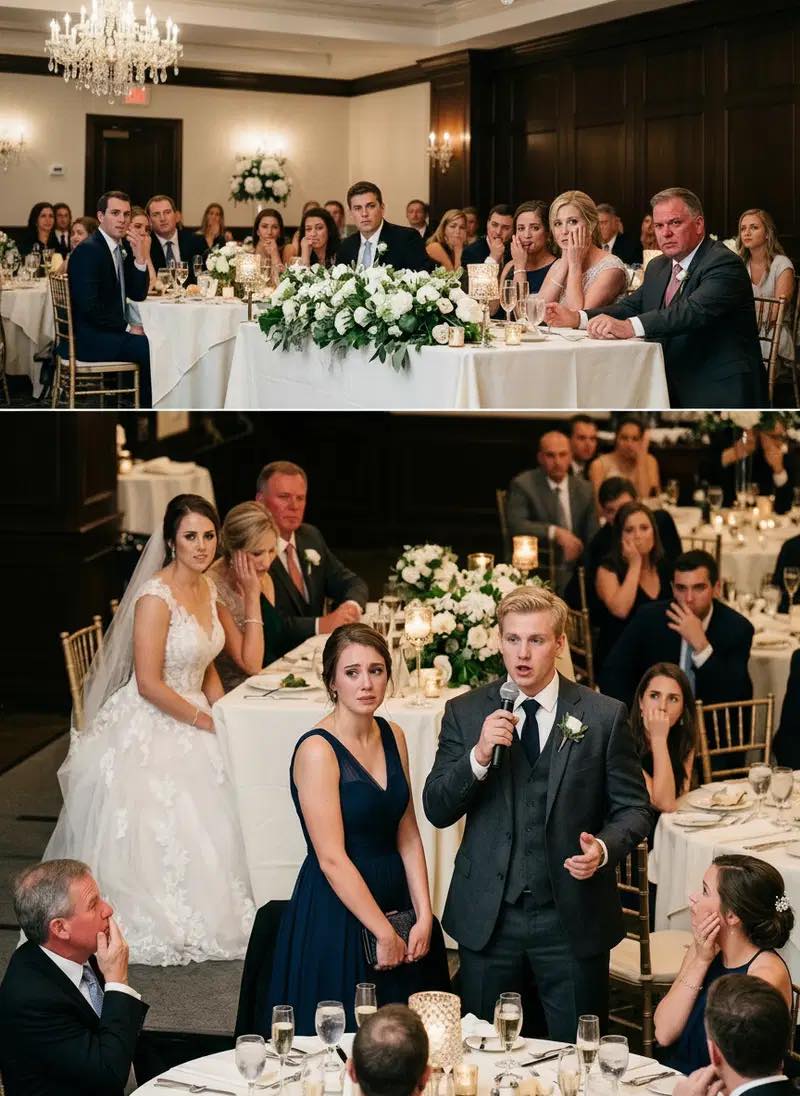
I watched my parents pay for every flower arrangement, every champagne glass, and every flawless detail of my sister’s wedding—then hand me $30 like I was some distant relative they barely knew. I smiled anyway… until my husband stood up, grabbed the microphone, and said, “Before this night goes any further, there’s something everyone here deserves to hear.”
The entire room fell silent. My mother turned pale. My sister froze in place. And in that moment, everything I thought I had buried was suddenly about to explode into the open.
My name is Emily Carter, and if you had seen me during my sister’s wedding reception, you probably would have assumed I was happy.
I smiled in every photograph, adjusted my navy dress, complimented the centerpieces, and helped the catering staff find table twelve when they got confused. From the outside, I looked exactly like the supportive younger sister doing everything possible to make the day perfect for Madison—the golden child of our family.
And honestly?
It was perfect.
My parents paid for the country club venue outside Columbus, the photographer, the florist, the string quartet, the six-tier wedding cake, and the open bar my mother kept calling “classy” as though it were her personal accomplishment. My father gave a speech about love, family, and how proud he was to “give his daughter the wedding she deserved.”
He meant Madison.
Everyone knew it.
What nobody sitting at those tables knew was that three years earlier, when I married my husband Daniel, my parents told me they “couldn’t really help financially.” At first, I believed them. Daniel and I got married in a tiny public garden with thirty guests, folding chairs, and cupcakes from a local bakery. It was beautiful because it belonged to us, but I would be lying if I said it didn’t hurt.
The week before Madison’s wedding, my mother pulled me aside in her kitchen and pressed an envelope into my hand.
“This is just a little something,” she said.
Inside was thirty dollars.
Not three hundred.
Not even enough to fill my gas tank twice.
Thirty dollars, like I was a babysitter who stayed later than expected.
I stood there staring down at it while she adjusted flowers in a vase and casually added, “You understand, sweetheart. Weddings are expensive.”
Oh, I understood far more than she realized.
So during the reception, I smiled.
I carried plates.
I helped my aunt search for her purse.
I stayed quiet while my mother bragged to guests about “how important family is.”
Then the DJ tapped his microphone and announced open toasts.
Before I could even react, Daniel pushed back his chair, stood up, and reached for the mic.
And the moment he said, “I think it’s time everyone heard the full story,” my stomach dropped.
Part 2
The atmosphere in the room shifted the instant Daniel stood.
At first, guests smiled politely, expecting a sweet marriage story or some funny childhood memory about Madison. Daniel was never the kind of man who enjoyed attention. He was calm, thoughtful, and usually the last person to create drama. That was exactly why every instinct in my body told me something serious was about to happen.
My mother’s smile stiffened instantly.
My father froze halfway through a sip of whiskey.
Madison, glowing in white satin, turned toward us with the same irritated expression she’d worn since high school—the look that said any moment not focused on her was an inconvenience.
Daniel looked at me first.
Not asking permission exactly.
More like reminding me I wasn’t alone.
Then he faced the room.
“First,” he began, “Madison, congratulations. I sincerely hope you and Brian have a wonderful marriage.”
He paused, and the tension eased for half a second.
“But,” he continued, “I can’t sit here listening to speeches about fairness, generosity, and family without saying something.”
The silence fell heavily across the room.
My father stood immediately. “Daniel, this is not the time.”
But Daniel kept speaking.
“Three years ago, Emily and I paid for our own wedding. We were told there simply wasn’t money to help. We accepted that. We built a day we could afford, and we were grateful for it.”
I felt every eye in the room turn toward me.
My mother hissed, “Sit down.”
Daniel slipped a white envelope from inside his jacket.
“Last week,” he said while holding it up, “Emily’s mother handed her this and called it ‘a little something.’”
Then he opened it and held up the cash.
“Thirty dollars.”
Someone near the back of the room actually gasped.
Madison looked embarrassed for one brief second before her expression hardened. “Oh my God, are you seriously doing this at my wedding?”
Daniel turned toward her calmly. “No, Madison. Your parents did this. I’m just saying it out loud.”
My father started walking toward him, voice low and furious. “Give me the microphone.”
Daniel stepped backward. “Not yet.”
Then he said the part I never knew he planned to reveal.
“Emily never told anyone this because she spent years trying to protect her parents. But when we got engaged, her mother told her, ‘We already helped one daughter build a future. We’re not wasting money twice.’”
A loud ringing filled my ears.
That sentence had been spoken privately in a kitchen—with only my mother, me, and Daniel there afterward when I broke down crying. Hearing those words blasted through speakers in front of two hundred guests felt like someone tore the roof off the entire building.
My mother’s face drained white. “That’s not what I meant.”
Then my sister grabbed the front of her wedding dress, stepped forward, and shouted, “Can everyone please stop ruining my wedding for once?!”
Part 3
That was the moment everything finally snapped.
“Ruining your wedding?” I repeated before I could stop myself. My voice sounded sharper than expected, but after years of swallowing every insult, I was done trying to sound agreeable. “Madison, this isn’t ‘for once.’ This is just the first time somebody said it where other people could hear.”
Nobody moved.
Even the bartenders stopped pouring drinks.
My father pointed toward the exit. “Emily, Daniel, if you can’t behave yourselves, leave.”
I laughed, shaky and bitter. “Behave? You mean smile politely and pretend I don’t notice what you’ve done my entire life?”
My mother looked around the room, humiliated. “This is not the place for this.”
“It never is,” I replied. “That’s exactly how people like you get away with it.”
Daniel handed me the microphone, and for one second I nearly gave it back. I hate public scenes. I hate being stared at. But then I looked around the room—at cousins, family friends, Madison’s new in-laws—and realized they spent years hearing my parents tell a version of our family story where they were generous, loving, and fair. Maybe they even believed I was distant by choice.
So I told the truth.
I told them about our tiny wedding and how my parents arrived late, left early, and never once offered help. I told them how I drove my father to appointments after surgery while Madison lived two states away. I told them how I helped my mother pack boxes during their move, handled paperwork when they were overwhelmed, and answered every emergency call they made. I told them none of it ever seemed to matter because Madison had always been the daughter worth investing in.
Then I handed the microphone back to Daniel.
He reached into his pocket one final time and pulled out the envelope again. Calmly, he walked to the head table, placed the thirty dollars in front of my mother, and said, “You clearly need this more than we do.”
Some guests looked horrified.
Others looked strangely satisfied.
Madison’s new mother-in-law stared at my parents like she was seeing them clearly for the first time.
Then Daniel took my hand, and we left.
The next morning, my phone exploded with messages. Some relatives claimed I should have stayed quiet. But many more admitted they noticed the favoritism for years and were relieved someone finally confronted it. One aunt told me, “Honey, the wrong people are embarrassed.”
That sentence stayed with me.
I haven’t spoken to my parents in four months.
It’s been quiet.
Painful.
And honestly healthier than I expected.
Daniel says peace feels uncomfortable at first when chaos is what you were raised inside. He’s right.
Madison sent one text message:
You could’ve chosen literally any other day.
Maybe.
But they chose every other day of my life.
So tell me—have you ever felt like the “lesser” child inside your own family? And what would you have done in my place? Because I know I can’t be the only person who’s had to choose between keeping the peace… and finally telling the truth.