
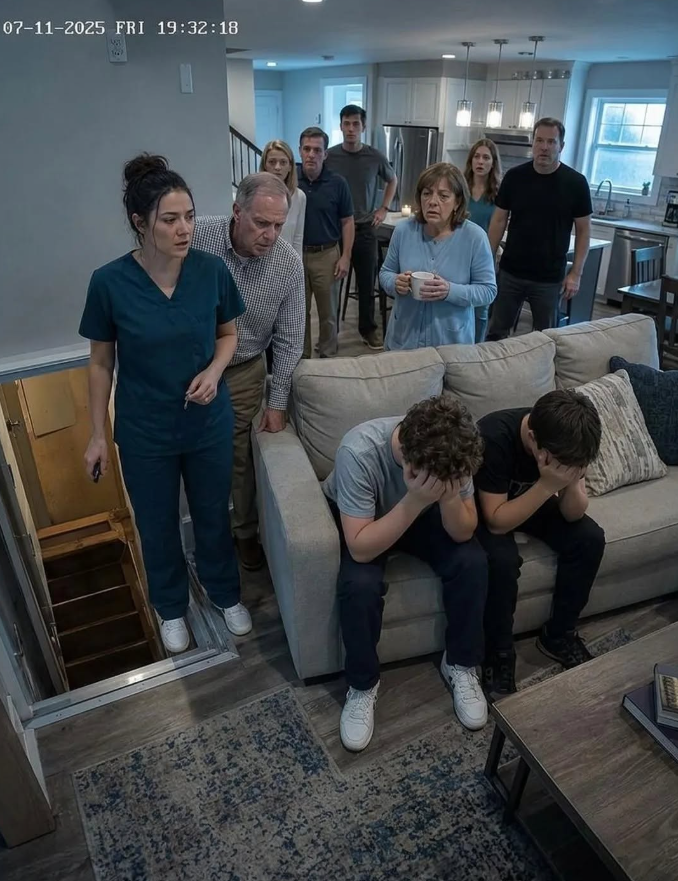
Sarah Bennett was still wearing her navy hospital scrubs when she opened her parents’ front door and smelled damp concrete drifting up from the basement. Her ten-year-old twins, Leo and Chloe, sat silently on the couch with their backpacks at their feet, looking smaller than they had that morning. Chloe held her clarinet case tightly against her chest, while Leo kept his asthma inhaler within reach. Through the open basement door, Sarah could see a bare mattress, a badly folded comforter, and several storage boxes beneath a dim hanging light. Her mother, Eleanor, sat calmly in the kitchen drinking tea as though nothing unusual had happened. When Sarah asked why her children’s beds had been moved downstairs without her permission, Eleanor replied that the “older children could adjust” because baby Owen deserved the best rooms. Sarah reached into her scrub pocket, felt the cold brass key hidden there, and realized she no longer needed to argue.
Two years earlier, Sarah had moved into her parents’ home after her divorce, bringing the twins, three suitcases, and a promise that the arrangement would be temporary. She paid toward groceries, covered the internet and utilities, cleaned after long shifts, and quietly saved every dollar she could. The twins occupied the two upstairs bedrooms until Sarah’s brother Mark arrived with his wife, Brooke, and their young son, claiming their home renovation would take only six weeks. Months passed, and the entire household began revolving around Owen. Brooke purchased a $400 high chair while Eleanor questioned the monthly cost of Leo’s asthma medication. Chloe was told to stop practicing her clarinet because the baby might nap, and Leo’s district art award received less attention than nursery curtains. Instead of continuing to plead for fairness, Sarah took extra hospital shifts and secretly signed a lease on a modest two-bedroom apartment near the children’s school.
Standing in that kitchen, Sarah asked her father, George, and Mark whether they had personally carried the twins’ beds into the basement. Neither denied it. George said the children should be grateful they had somewhere to stay, while Mark insisted his baby needed the better arrangement. Sarah turned away from them, walked upstairs, and told Leo and Chloe to pack school clothes, toothbrushes, medication, music books, and the belongings that mattered most. Both children asked whether they were in trouble, and Sarah knelt beside them to promise they had done nothing wrong. When Chloe quietly asked where they were going, Sarah finally pulled the new apartment key from her pocket and said, “I found us a home.” Downstairs, Eleanor laughed and claimed Sarah had nowhere else to go—until Sarah opened her tote bag and placed a signed lease on the kitchen table.
Sarah also produced bank transfers, utility confirmations, and grocery receipts proving she had contributed thousands of dollars while living there. She had already consulted an attorney about tenant rights, updated the children’s insurance information, and arranged to remove her parents from the school’s emergency pickup list. The new apartment had no mortgage or valuable estate attached to it, and it was not an impressive investment property, but its windows opened, the bedrooms were dry, and the lease carried Sarah’s name alone. She warned her family not to contact the school, collect the children, or pressure them with guilt. When Eleanor accused her of humiliating everyone, Sarah replied that the humiliation had begun when two children were treated like stored furniture. No court argument or dramatic confrontation followed; the paperwork was valid, the keys were hers, and within an hour Sarah and the twins were driving toward a home nobody else controlled.
Their first night was spent eating cereal from paper bowls beside two air mattresses and a single borrowed lamp. Leo walked through the bedrooms twice before announcing with relief that there was no damp smell, while Chloe immediately chose a spot beside the window for her music stand. Over the following months, Sarah added a used couch, a thrift-store table, and two proper beds purchased with overtime pay. Eleanor eventually arrived with cookies, colored pencils, and clarinet reeds, but Sarah explained that seeing the twins again would require patience and changed behavior. The children were no longer responsible for protecting adults from uncomfortable consequences. One evening, Sarah returned from work and found a drawing taped to the refrigerator showing the three of them outside their apartment beneath the words, “WE FIT HERE.” The apartment was smaller than her parents’ house, but every time Sarah turned the brass key in the lock, her children knew they had entered a place where they were allowed to breathe, play music, and take up space.

