
# THE KEY I LEFT BEHIND
The spare key to my parents’ house struck my mother’s kitchen counter with a sound far too small for the damage it caused.
It was an ordinary brass key, faded after twelve years spent at the bottom of my purse, inside coat pockets, in the dish beside my apartment door, or clenched in my hand on winter evenings when my parents called because the furnace sounded strange or Mom could not remember whether she had locked the back entrance.
I had carried it for so long that it no longer felt like an object.
It felt like an unspoken agreement.
I belonged there.
I could enter whenever I wanted.
They needed me.
That evening, I placed it beside the pile of grocery coupons my mother clipped every week but never remembered to use.
She did not notice immediately.
She stood at the sink with her back turned, rinsing a coffee mug she had already washed twice because angry hands always need a task. Steam rose from the kettle on the stove. The evening news washed blue light across my father’s face in the family room, although his rigid posture told me he was not listening.
Outside, November rain streaked the windows and stretched the driveway lights into long, blurred lines.
“If you’re so unhappy here,” my mother snapped without turning around, “then get out and never come back.”
The words were not loud.
That was what made them so dangerous.
They drifted into the kitchen with the steam, settled over the island, and waited for someone to withdraw them. My father shifted in his recliner. The television anchor continued talking about traffic on I-94. The refrigerator hummed. Above the pantry, the wall clock ticked with cruel patience.
No one said, “She didn’t mean that.”
No one said, “Don’t go.”
No one said my name.
I looked at the key on the counter. I had positioned it where she would eventually see it, between a coupon for canned soup and a grocery list written in her round, slanted handwriting.
Then I lifted the overnight bag I had packed that morning without knowing whether I would actually carry it out.
My mother finally turned when she heard the bag brush against my coat.
Her expression shifted, but only for a second.
“Where are you going?”
I looked at her, then toward my father.
He continued staring at the television.
Most of my life had taught me the difference between silence and peace. That was the gift my father gave me without intending to. He was not cruel or loud. He simply vanished emotionally whenever tension entered a room, and because he disappeared, the rest of us arranged ourselves around the empty space where his opinion should have been.
“You told me to leave,” I said.
My mother pressed her lips together. “Don’t be dramatic.”
“I’m not.”
“Claire.”
My name sounded unfamiliar in her voice.
Not affectionate.
Not concerned.
A warning.
I waited.
Then she noticed the key. Her gaze dropped to it before returning to my face.
“That’s unnecessary.”
I almost smiled, but no humor remained. “I think it’s very necessary.”
I walked through the front hall, where family pictures covered the wall in mismatched frames: my parents on their wedding day, my brother wearing his graduation cap, me at twenty-three holding my first employee badge, and all of us seated around a Thanksgiving table that looked warmer in photographs than it had ever felt in real life.
My shoes squeaked softly against the floorboards.
Behind me, the kettle began screaming.
No one followed me to the door.
I closed it gently because even then, after everything, some part of me still did not want anyone accusing me of slamming it.
The surprising thing was not that I walked away.
It was that no one believed I truly would.
For almost three weeks, I stayed in a furnished apartment across town, above a bakery that began working before sunrise. Each morning, the smell of cinnamon and rising dough drifted through the old floorboards before my alarm sounded.
The radiator clanged whenever it decided the room deserved warmth. The windows rattled whenever the wind strengthened. The bookshelf leaned slightly because the floor dipped near the wall, and the kitchen contained only two cabinets, one of which refused to open unless I pulled from the bottom.
It was not beautiful.
But it belonged to me.
On my first evening there, I purchased a single mug from a thrift shop on Halsted Street. It was blue ceramic with a tiny chip near the handle. I drank tea from it while sitting on the edge of the bed, listening to the rain tapping the window and wondering when the guilt would arrive.
It came in waves rather than all at once.
At eight, I wondered whether Dad had taken his nighttime medication.
At nine-thirty, I wondered whether Mom had remembered to turn off the oven after heating leftovers.
At midnight, I reached toward my phone to check whether their porch camera had lost its connection.
Then I stopped.
The system was no longer mine to monitor.
On the second morning, I woke and automatically reached into my coat pocket for the spare key.
My fingers found empty fabric.
Its absence hurt more than I expected.
I had carried that key for twelve years, ever since the spring when Mom collapsed in the cereal aisle and every role in our family quietly shifted.
She recovered for the most part. The doctors called it a warning. Dad called it bad luck.
I called it the day I began paying closer attention.
Money was the first thing I noticed.
Unopened envelopes hidden beneath the fruit bowl.
A late notice tucked inside a cookbook.
Dad standing in the garage with his phone in one hand and his glasses in the other, pretending the utility website confused him when he was actually frightened by the balance on the screen.
Mom buying cheaper coffee but keeping the expensive brand’s container on the counter so visitors would not notice.
Nobody asked me to intervene.
That detail became important to them later.
One night, however, I discovered the mortgage website still open on Dad’s computer. When I saw the overdue amount, I paid it before I could reconsider.
I told myself I would explain the next morning.
I never did.
Mom looked exhausted at breakfast, one hand pressed against her temple while she stirred oatmeal. Dad already appeared ashamed of calculations he had not shared.
So I allowed the payment to remain unmentioned.
The following month, it happened again.
And again.
By the fourth month, I had redirected the automatic payment to my own account. I told myself it was temporary, the same way people describe the first lie that eventually becomes a way of life.
My salary had increased. I worked as a project manager at a logistics company and earned enough to absorb the payment as long as I avoided vacations and continued driving my aging car.
My parents were still recovering from medical bills, reduced work hours, and Dad’s habit of ignoring uncomfortable numbers until they became emergencies.
I stepped in because somebody needed to.
That was the explanation I gave myself.
Families survived through the things no one discussed.
At first, I felt quietly proud.
Not in any way I would have confessed, but there was private satisfaction in knowing the house remained stable because I had kept it that way. The porch light stayed on. Mom kept her garden. Dad remained in his recliner beneath the framed photograph of his grandfather, pretending he had not been rescued by his daughter’s spreadsheet.
Then months became years.
Invisible generosity turned into invisible obligation.
During the second year of payments, I moved back into my parents’ house “for a while” after my lease expired.
It seemed practical. I already spent most evenings there helping with appointments, groceries, paperwork, repairs, and every new letter containing fine print that made Dad leave it on the counter until I arrived.
My childhood room still had a bed.
Mom said having me around would be nice.
She did not mention that having the mortgage managed from inside the house would also be convenient.
But that was what happened.
I paid the bills.
I cooked whenever Mom was tired.
I drove Dad to dental appointments.
I replaced filters, spoke to insurance companies, repaired the router, shoveled the front walk, and took over the property-tax installments because they had become “too confusing now that everything was online.”
I never announced what I did during dinner.
I never asked my brother, David, to help.
He lived three states away, called during holidays, and sent photographs of his children wearing matching pajamas. Everyone praised him for remembering birthdays.
I remembered payment deadlines.
Mom still managed to make me feel as though I occupied too much room.
“You don’t need to keep all your work things on the dining table.”
“Your father likes the thermostat lower.”
“You’re lucky you don’t have children. Your schedule is flexible.”
“David has real responsibilities.”
That last sentence always hurt.
As though quietly paying bills did not count as responsibility.
As though a woman without children had an empty life where everyone else was free to store their needs.
The argument that finally drove me away began with groceries.
That was the ridiculous part.
A sack of onions, two cartons of eggs, and Dad’s preferred coffee.
I returned after a ten-hour workday and found Mom rearranging the refrigerator with sharp, irritated movements.
“You bought the wrong yogurt,” she said.
“I bought the one on the list.”
“No, I wrote plain Greek.”
“It says vanilla.”
She grabbed the paper and stared at it. “I meant plain.”
“I can exchange it tomorrow.”
“You always say that like everything is so easy.”
I was exhausted.
That was my mistake.
Exhausted people sometimes speak honestly.
“Mom, I worked all day, went to the pharmacy, picked up Dad’s prescription, bought groceries, paid the water bill, and sat on hold with the mortgage company for forty minutes. I’m allowed to buy the wrong yogurt.”
Her expression closed.
“You don’t have to throw what you do in my face.”
“I’m not.”
“You act like we’re helpless.”
“No. I act like I’m responsible for things no one else wants to name.”
Dad was in the next room. His recliner creaked.
He never entered the kitchen.
Mom’s eyes shone, not with tears, but with wounded pride hardened into anger.
“If living here is such a burden, then go. Get out and never come back.”
There it was.
One sentence constructed from years of smaller ones.
I could have stayed and argued.
I could have apologized.
I could have allowed the evening to join the long family history of words spoken and later denied.
Instead, I looked at her and realized with sudden, painful clarity that I had been waiting for permission to leave.
She had just issued an order.
So I packed.
During those first weeks in the apartment, I felt like I was learning how to exist as a person instead of a household appliance.
I discovered which café opened before sunrise and which barista remembered customers’ names. I bought groceries for one person and felt strange placing them in a refrigerator without Dad’s low-sodium turkey, Mom’s almond milk, or three jars of pickles nobody admitted buying.
I stopped setting reminders for their trash collection.
I stopped checking whether the garage door had closed.
I stopped planning my evenings around the possibility that Mom might want company but refuse to ask.
Some evenings felt peaceful.
Others were unbearable.
I would sit at the tiny kitchen table with my blue mug and picture the house I had left—the one with the maple tree in the yard and the crooked mailbox a delivery truck had struck years earlier.
I wondered whether Mom had discovered the key.
I wondered whether Dad had noticed the approaching mortgage date.
I wondered whether anyone missed me or only missed what I provided.
The answer came twenty-six days after I left.
My phone rang at 9:14 in the morning while sunlight stretched across the apartment floor beside a moving box I still had not opened. Inside were family photographs I had not yet found the courage to display.
The bakery downstairs had just removed something sweet from the oven, and for a moment my apartment smelled like a childhood I could not fully remember.
Dad.
I nearly ignored the call.
Then I answered.
“Hi.”
“Claire.”
His voice sounded more confused than angry.
That hurt in a different way.
“Everything okay?”
He paused.
“The mortgage payment didn’t go through.”
I closed my eyes.
“I know.”
Another pause followed.
“We called the bank.”
“I figured.”
“They said the automatic transfer was canceled.”
“Yes.”
The silence lasted long enough for me to hear someone laughing in the courtyard below. Life continued with astonishing indifference to private heartbreak.
Finally, he asked what he truly wanted to know.
“Why did you stop paying the mortgage?”
I looked around the apartment.
The leaning bookshelf.
The chipped blue mug.
The stack of mail addressed only to me.
For the first time in years, every bill on the table belonged to the life I was actually living.
“Dad,” I said, “I thought I was supposed to get out and never come back.”
He released a slow breath.
“That was an argument.”
“I understood it as a decision.”
“You know your mother.”
“Yes. I do.”
“She didn’t mean it.”
“You didn’t say that.”
He became quiet.
I imagined him sitting at the kitchen table with one hand covering his forehead and bills spread in front of him. Mom was probably nearby, standing instead of sitting because sitting would make the situation seem too serious.
The mortgage statement would be open.
Perhaps the bank had finally explained, in plain language, what I had quietly done for years.
Perhaps Dad had finally seen my name in the place he had trained himself not to notice.
“I knew you handled some bills,” he said.
“All of them.”
His breathing shifted.
Barely.
But enough.
“I never asked you to.”
“No. You just let me.”
“That’s not fair.”
“Isn’t it?”
He said nothing.
I opened my wallet and removed an old grocery list I had carried for years without admitting why.
Mom had written it when she taught me to make her chicken soup after college. The paper had softened from repeated folding. Her handwriting wandered across the page with notes beside the ingredients: fresh onions, not frozen; don’t forget cinnamon; Dad likes extra carrots.
I had kept it because it belonged to a gentler version of our family, one where love felt like guidance rather than obligation.
“I was paying the mortgage because I thought I was protecting the family,” I said. “But if I no longer belong in the house, I can’t keep pretending I’m responsible for holding it together.”
The words came out more softly than I expected.
Not rehearsed.
Only true.
Dad whispered, “She’s been crying.”
“So have I.”
It was the first time I admitted it aloud.
He made a sound that was neither a word nor a sigh.
“Claire, I don’t know what to do.”
I watched the sunlight crossing the floor.
“That’s the first honest thing anyone has said.”
One week later, they asked me to visit.
Not to discuss money, Dad insisted.
To talk.
I parked on the street rather than in the driveway.
That felt important.
The house appeared exactly the same and completely altered. The porch light still flickered. The mailbox still leaned. Mom’s chrysanthemums had turned brown in the planters because no one remembered to trim them.
The living-room curtains were open, and the television flashed blue inside.
Some places change so gradually that people mistake them for permanent.
Mom opened the door before I could knock.
She looked smaller.
Not exactly weaker.
Quieter.
She wore a gray cardigan without earrings, which told me she had not been trying to make the day appear casual.
“Hi,” she said.
“Hi.”
Neither of us moved for a moment.
Then she stepped aside.
The house smelled of lemon cleaner, coffee, and the faint dusty heat of the furnace starting for the season. My shoes made the same sound on the hallway floor. The family photographs remained on the wall. My old bedroom door was closed.
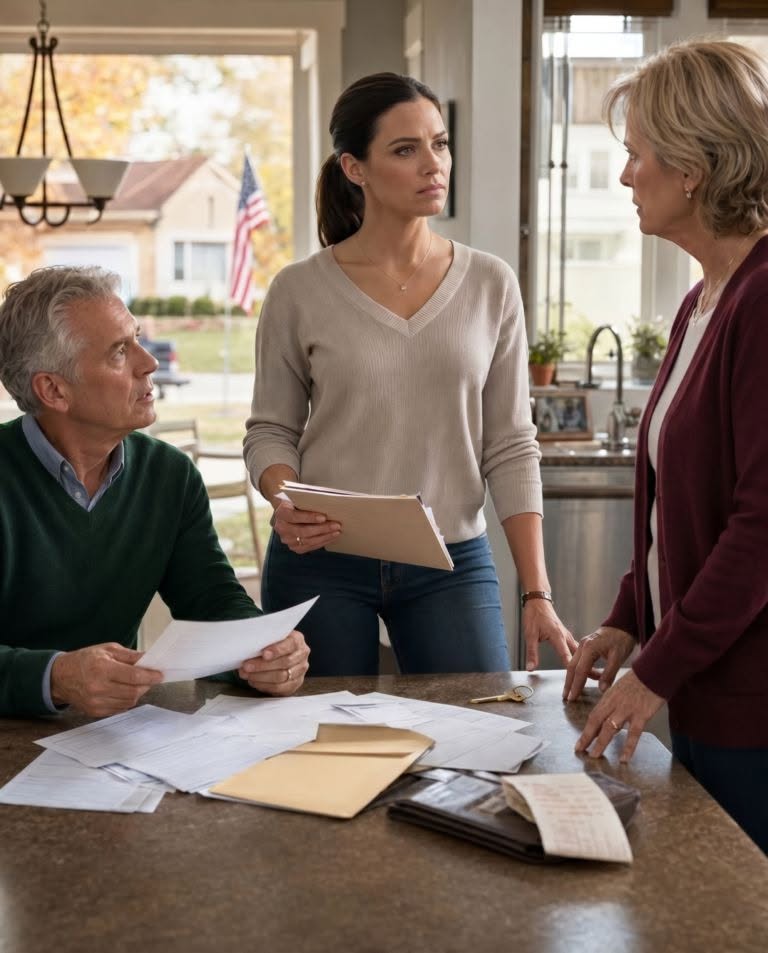
Dad had spread folders across the dining-room table.
Mortgage statements.
Utility bills.
Insurance documents.
Property-tax notices.
Medical payment plans.
Letters from the bank.
Everything that had lived in drawers, beneath fruit bowls, and inside silent assumptions was now visible beneath the chandelier.
There were no more invisible responsibilities.
Dad stood when I entered.
“You want coffee?” he asked.
“No, thank you.”
He nodded as though he had anticipated the answer and knew he had earned it.
Mom rested one hand on the back of a chair but remained standing.
“I kept expecting you to come home,” she said.
“You told me not to.”
“I know.”
Her answer surprised me.
Not because it repaired anything.
Because she did not deny what she had done.
She looked at my hands, then toward my wallet as I set my keys on the table. The old grocery list was visible inside.
“You still have that?” she asked.
I looked down.
“Yes.”
“Why?”
I ran my thumb over the softened fold. “It reminds me there were good days too.”
Her face crumpled briefly before she covered her mouth.
Dad pulled out a chair. “We need to say some things.”
I stayed on my feet.
He accepted it.
“I didn’t know the full amount,” he said.
“You could have.”
“Yes.”
“I wasn’t hiding it very hard.”
“No.” He looked down at the paperwork. “I think I didn’t want to know.”
That admission mattered more than an apology would have if it had come first.
Mom finally sat.
“When you started helping after my hospital stay, I told myself it was temporary,” she said. “Then things felt easier, and I let easy become normal.”
“And when normal became impossible for me?”
She met my eyes. Hers were red but steady.
“I told myself you were fine.”
There it was.
The oldest wound in a single sentence.
I had performed strength too convincingly.
“I wasn’t,” I said.
“I know that now.”
“No,” I said gently. “You know it because the mortgage stopped. That’s not the same as knowing it before.”
She flinched but did not disagree.
Dad opened one of the folders. “We’re refinancing.”
I had not expected that.
“I’ve picked up consulting work,” he continued. “Not much yet, but enough to start. Your mother is going back to part-time teaching at the community center. We met with a housing counselor. We made a budget.”
Mom pushed a sheet of paper toward me.
It was handwritten in her familiar script.
Income.
Expenses.
Due dates.
The numbers were imperfect and uncomfortable.
But they belonged to them.
“We will manage,” she said.
I wanted to feel relief.
Instead, grief filled me.
Because they could have done this earlier.
Maybe not all of it.
Maybe not perfectly.
But they could have sat together at a table. They could have asked. They could have thanked me. They could have named the weight before I had to leave to prove it existed.
Dad seemed to see some of that in my expression.
“I’m sorry,” he said. “For letting you become the plan.”
My throat tightened.
Mom reached toward the grocery list. She did not take it. Her fingers only touched one corner.
“I never thanked you,” she said.
“For what?”
I was not trying to punish her.
I needed to hear the words.
“For the house,” she whispered. “For the bills. For the appointments. For the groceries. For staying longer than you wanted because we made needing you feel like loving you.”
The room became completely still.
I looked toward the kitchen where I had left the spare key three weeks earlier.
It was no longer on the counter.
“Where is it?” I asked.
Dad understood instantly.
He left the dining room and returned with the key lying across his palm.
“I kept it in the drawer,” he said. “I thought you might want it back.”
The key appeared smaller than it had on the evening I left.
For twelve years, it had represented belonging.
Then it represented obligation.
Now it was only brass.
I took it and turned it over once.
Mom watched with cautious hope that almost hurt to see.
“This will always be your home,” Dad said.
I believed that he meant it.
That was the difficult part.
I folded his fingers around the key again.
“No,” I said.
His expression tightened.
“Claire—”
“I hope it becomes a place I’m invited into,” I said. “Not a place I’m responsible for keeping alive.”
Mom began crying quietly.
I did not rush to comfort her.
That was new.
“I love you both,” I said. “But I am not moving back. I am not restarting the automatic payments. I am not managing the house from my apartment. I can come for dinner. I can help you understand paperwork sometimes if you ask respectfully and plan ahead. But I can’t be the foundation anymore.”
Dad nodded slowly.
Mom wiped her cheeks.
“I don’t know how to do this differently,” she said.
“Then learn.”
It was not a gentle response.
But it was honest.
For the first time, no one accused me of being dramatic.
I left before dinner.
The autumn wind pushed the smell of wet leaves across the driveway. My old bedroom window was dark. Behind me, the porch light flickered once before becoming steady.
My parents stood together in the doorway, close enough to resemble a married couple again rather than two people waiting for their daughter to solve the next crisis.
When I reached my car, I looked back.
Mom lifted one hand.
I raised mine.
Then I drove to the apartment above the bakery, where the radiator clanged, the floor tilted, and a single blue mug waited inside the cabinet.
The following months were not cinematic.
That is what people rarely explain about boundaries.
The moment itself can feel sharp and powerful, but the life afterward is created through small, ordinary decisions.
Not answering a midnight phone call because the issue can wait until morning.
Saying, “I can’t this week,” without writing several paragraphs defending yourself.
Allowing people to feel disappointed without immediately trying to soften their discomfort.
Paying only your own rent and feeling both relieved and strangely guilty.
Buying two plates instead of a full family set because no one needs to be fed in your kitchen unless you invite them.
I developed my own routines.
Laundry on Saturdays at the laundromat beside the pharmacy.
Thai takeout every Wednesday from the restaurant downstairs.
Walks along the river on Sundays whenever the weather cooperated.
I unpacked the family photographs gradually and displayed only a few on the bookshelf.
Mom teaching me to make soup.
Dad teaching me to ride a bicycle.
David and me in matching Christmas pajamas before life separated us into different family roles.
I did not throw away the others.
I placed them in a box labeled Later.
David called in January.
“I heard things got weird,” he said.
“That’s one way to put it.”
“Mom says you stopped helping.”
“I stopped paying their mortgage.”
He went silent.
“You were paying the mortgage?”
“Yes.”
“For how long?”
I stared through the window at snow gathering on the bakery awning.
“Years.”
He exhaled. “Claire.”
The way he said my name told me he genuinely had not known.
I believed him.
That hurt too, though differently.
Afterward, he began sending our parents money each month.
Not because I asked.
Not as much as I had contributed, but enough to make a difference.
He called Dad every Sunday and reviewed bills with him over speakerphone. He flew home one weekend to repair the garage shelves and replace the porch light.
Mom told me he had “really stepped up,” and for one bitter, familiar second, I nearly laughed.
Then I released it.
David’s contribution did not erase what I had done.
It only proved I had never been the only possible solution.
I had simply been the easiest one.
In March, my parents invited me to dinner.
Not because a payment was late.
Not because they needed a form signed.
Only dinner.
At first, I almost declined out of habit.
Then I almost accepted out of guilt.
Finally, I stopped and asked myself what I actually wanted.
I wanted to go.
So I went.
The porch light no longer flickered because David had repaired it. The mailbox stood upright. Mom had planted fresh pansies in the planters.
I carried bread from the bakery downstairs and a bottle of wine.
Dad opened the door and said, “Come in,” rather than “You’re home.”
That small correction told me he had been thinking.
Dinner consisted of roast chicken, green beans, and Mom’s soup.
She had written a new grocery list and left it beside the stove.
Fresh onions.
Extra carrots.
Don’t forget cinnamon.
I saw it and smiled before I could stop myself.
She noticed.
After dinner, she handed me a folded sheet of paper.
“I wrote it down,” she said.
“What?”
“The soup recipe. Properly this time. So you don’t have to carry that old list forever if you don’t want to.”
I unfolded it.
Her handwriting was more careful than usual.
At the bottom, she had added: Thank you for carrying us when we did not know how to carry ourselves. I am sorry we let you disappear inside the help.
I read the words twice.
Dad stood at the sink, washing dishes badly but sincerely.
For once, I allowed the room to remain quiet without fearing what that silence meant.
I continued carrying the old grocery list in my wallet.
Not because I still needed proof that good days had existed.
Because I had learned that love could be genuine and still require distance.
Parents could fail their children without becoming monsters.
Leaving a house did not mean abandoning the people who lived there.
It meant refusing to confuse access with responsibility.
One year after moving out, I bought a small condo of my own.
It was nothing extravagant.
One bedroom.
Large windows.
A balcony barely wide enough for a chair and two pots of basil.
On the first night, I stood in the empty living room holding the new keys and listened to the silence.
No television playing in another room.
No hidden bills beneath a fruit bowl.
No kettle screaming through an argument.
Only distant city noise and the sound of my breathing inside a home I had chosen.
My parents visited the following Sunday with a plant and a toolbox.
Dad insisted on installing the curtain rods. Mom arranged the basil plants on the balcony as though their position mattered deeply.
David called and joked that I had become the family landlord, and for once the joke did not feel like someone assigning me another responsibility.
Before leaving, Dad looked toward the new key dish near the door.
It was small, ceramic, and blue like the thrift-store mug.
“Do we get one?” he asked.
I smiled.
“No.”
He nodded, understanding before I needed to explain.
“Fair,” he said.
Mom hugged me cautiously. She had learned to ask with her arms rather than assume permission. “Dinner next Sunday?”
“I’ll check my calendar.”
She laughed softly. “Good.”
After they left, I placed my keys inside the dish.
Mine.
It had taken me years to earn that word.
Some people believe the hardest part of leaving is closing the door.
It is not.
The hardest part is enduring the silence that follows without running back to prove you are still useful.
I loved my parents while I lived inside their house.
I loved them while I paid the bills.
I loved them when I left the key on the counter.
I still love them now.
But love cannot be measured by the mortgage payment you quietly cover, the appointments you organize, the arguments you absorb, or the number of times you return after someone tells you to leave.
Love, if it is meant to survive, must make room for honesty.
The truth was simple.
I was their daughter.
Not their emergency savings.
Not their property manager.
Not the invisible foundation beneath a house everyone else was allowed to call home.
I had spent years protecting a roof that never protected me in return.
So I built one of my own.

